
 I’m guessing that most people who read this site are roughly familiar with the history of the Bolsheviks and the subsequent degeneration of the Russian Communist Party. The historical irony is that it’s the caricature of the monolithic, disagreement-free party which has emerged as the dominant form or party organisation on the English speaking far left.
Yet in many ways the emergence of the German Communist Party has many richer lessons for socialists in advanced capitalist countries, particularly those with big social democratic parties. Pierre Broué’s book the The German revolution 1917-23 should become one of the indispensable texts for socialists in the twenty first century. We all owe a big debt to John Archer the translator and the editors Ian Birchall and Brian Pearce for making available an account of a period which deserves to be more closely studied by those of us who are committed to the establishment of mass class struggle parties.
I’ll try to summarise some of the conclusions I’ve drawn from it. I’ve omitted all the background detail about events in Germany and internationally at the time. I end rather abruptly at the point when the USPD splits and decides to merge with the marginal, ultra-left KPD . That’s because I want to focus on the process which led up to the emergence of the German communist Party. It was very messy and convoluted and I barely hint at just how tortuous it was. I also refrain from making any comparisons with contemporary politics.
The key points as I see them are:
- You have to engage with the forces that actually exist around you which identify themselves as class struggle, socialist or anti-capitalist.
- You can’t pretend either that they don’t exist or that only their own blinkered stupidity prevents them from seeing just how right you are.
- It is not possible to create new mass organisations from scratch by recruiting ones and twos.
- Every organisation will change under the influence of events in the national and international class struggle.
- New organisations need to be born from a process of real mass political struggle and a real process of clarifying ideas.
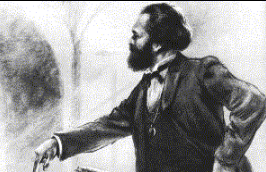
Karl Radek (pictured above) was the Bolsheviks’ representative in Germany for much of the revolutionary period. Here is how he described the emergence of the Communist International in its heroic period. “It is the regroupment of all the revolutionary tendencies of the old International, those that declared and strengthened themselves during the war. It is not only the Bolsheviks who sowed the seeds of it… but likewise… Debs, de Leon… Rosa Luxemburg, the work which we German radicals accomplished during ten years.”
A Stalinist called Kaganovich took a contrasting view in 1931. Radek had described this process in Russia and compared it to the best currents and streams in the Russian working class movement emptying into the Bolshevik party. Kaganovich argued “the theory of rivulets lays the basis for the freedom of groups and factions…Our party is not a reservoir of muddy streams, it is a river… fully capable of making all the obstacles in our path disappear.” Setting the hyperbole aside I think it’s obvious which organisations have a rather more high Stalinist theory of parties.
The chronology of the creation of the KPD is fascinating. Rosa Luxemburg and Karl Liebkneckt spent a political lifetime in the SPD. In August 1914 a small group of internationalists around Luxemburg met to begin organising opposition to the war. It took a little time for Liebkneckt to make the break from SPD discipline. That month he voted to authorise war loans, something he acknowledged to be a mistake. Famously in December he was the only MP in the Reichstag to vote against the war.
It took until March 1915 before the anti-war grouping in the SPD was able to hold its first conference. The following month it produced the first issue of Die Internationale. In January 1916 this publication’s supporters organised their first conference. At this point they still viewed themselves a a loyal opposition.
January 1917 saw the expulsion of all the oppositionists from the SPD, ten days after they had held a conference. Ninety one local organisations were expelled, including the majority of party members in Berlin, Leipzig and Bremen. Two months later the Spartacists decided in favour of establishing a party with the centrists. In April the USPD is formed. Thirty three SPD MPs opposed to the war joined it and its membership reached 120 000. This included the Spartacist League, led by Luxemburg and Liebkneckt. The SPD retained 170 000 members.
The Spartacists had reservations about entering the USPD. The influential reformists Kautsky and Bernstein had joined it but it had also attracted a lot of industrial militants whom they could not have easily reached through any other means. Luxemburg’s perspective was to stay in the USPD for as long as possible with the aim of winning the majority inside the party to revolutionary Marxism. They functioned as a propaganda group inside the larger organisation and were a pole of attraction for radical groups which were emerging all over Germany with little political experience but an enthusiasm for the Russian Revolution. They saw themselves not as a vanguard but as a militant minority which could lead by the power of example.
The USPD split over its attitude to the SPD government in the November revolution. When it did it could reasonably expect to bring with them the leading indstrial militants and much of the vanguard of Berlin’s working class. But the timing of the split was controversial as well as arguably premature. The KPD was a fusion of the Spartacist League and the IKD (a small group called the International Communists of Germany).
By 1919 following the murders of Luxemburg and Liebkneckt and the suppression of the January uprising the KPD was more a collection of fragments than a party. Only in the town of Chemnitz, where under the leadership of Henrich Brandler it had grown to 10 000 members, did it resemble a mass party. Here’s what Broué say about Brandler: “he adhered to the Spartacist traditon of seeking the unity of the class by way of struggle, in agreement with the Bolshevik theory of the Soviets.”
Brandler’s success was the exception rather than the rule for the KPD. In the rest of the country it was the USPD which was growing. By March 1919 it had 300 000 members recruited against a backdrop of a revolutionary situation and represented the majority of Germany’s militant workers. At the same time a differentiation was taking place inside the party. A left current was emerging which was drawn to the Communist International but not by the practice of the German communists.
Lenin was keen to encourage this process and pull the left moving sections of the USPD into the Communist International and contrasted the ultra-leftists who favoured “small, hard, nuclei” with “that German revolutionary social democracy …which comes closest to being the party the proletariat needs”. In October 1920 the USPD split when the majority decided to join the Communist International and fuse with the KPD.

 Liam redux
Leave a comment