
The traditional narrative of the Irish War of Independence dwells on the flying columns and Michael Collins. Yet not even Ireland was immune to the effects of the revolutionary wave in Europe and for a brief period workers’ control was established in Limerick.
Socialist Resistance is holding a forum in the episode and below is the text of the leaflet advertising the meeting on the subject next week in Birmingham.
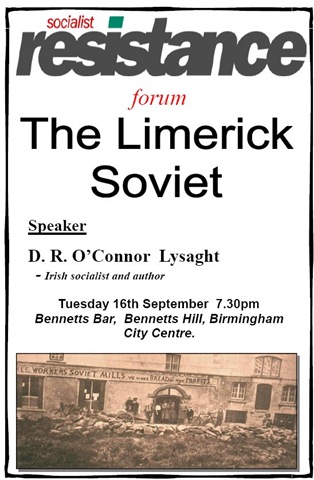
Speaker: D. R. O’Connor Lysaght – Irish socialist and author
Tuesday 16th September 7.30pm
Bennetts Bar, Bennetts Hill, Birmingham
The Limerick soviet was part of the international social upsurge following the First World War. This has been described as the “Red Mirage” because of the revolutions and general strikes inspired by the October Revolution, but dashed by the guile and treachery of the old Social democratic leaders and the revolutionary leaders’ own inexperience.
Such struggles have been overshadowed in Ireland by the Anglo-Irish War and its aftermath. Nonetheless, in1919, the Irish capitalists were more worried by the social threat than by that of armed contest.
It was, however, the combination of both of these that sparked the general strike that created the Limerick Soviet: the running of the city of Limerick by its Trades Council for a fortnight. Significantly, it was sparked by the death of Robert (Bertie) Byrne, a trade union militant and Irish Volunteer. A prisoner recovering in hospital, he was killed in an attempted rescue on 6th April.
The British colonial regime was more concerned with the simultaneous deaths of the two constables who had been guarding Byrne. It placed most of the city and its surroundings under martial law. The newly-unionised workers in the Condensed Milk Company factory responded, on April 12th, by voting for strike action. The next day, the city Trades Council voted to extend the strike to all city workers.
From Monday 14th April, all business was closed save government departments (the post office was open for stamp sales only), hotels and the railway. The Army remained obstinate, so the council established sub-committees to organise permits to leave the city (as the Army allowed entry only by its own permits) to bring in and distribute food supplies, for pickets to police the area, transport, propaganda and, at the end of the week, finance. The last named was supervised by the Irish TUC treasurer, Thomas Johnson.
However, he was playing a double game. Since 1916, he had inspired his movement’s strategy of staying out of too active an involvement in the Irish national movement. Now he opposed demands to spread the strike through the country, and, on 15 April, acted to persuade the Soviet leaders to limit its application and, on the 28th, to end it altogether. A week later, martial law was lifted.
Understandably, Limerick would never play such a leading role in the social sphere during the troubles. Other areas, in Co. Tipperary and Co. Cork would take over the lead. They too would find themselves circumscribed by the reformist strategy of Labour’s national leadership and the bourgeois nature of the Republican leaders.
Nonetheless, the attempt had been made to light the way to the workers’ republic.



 Liam redux
Leave a comment