
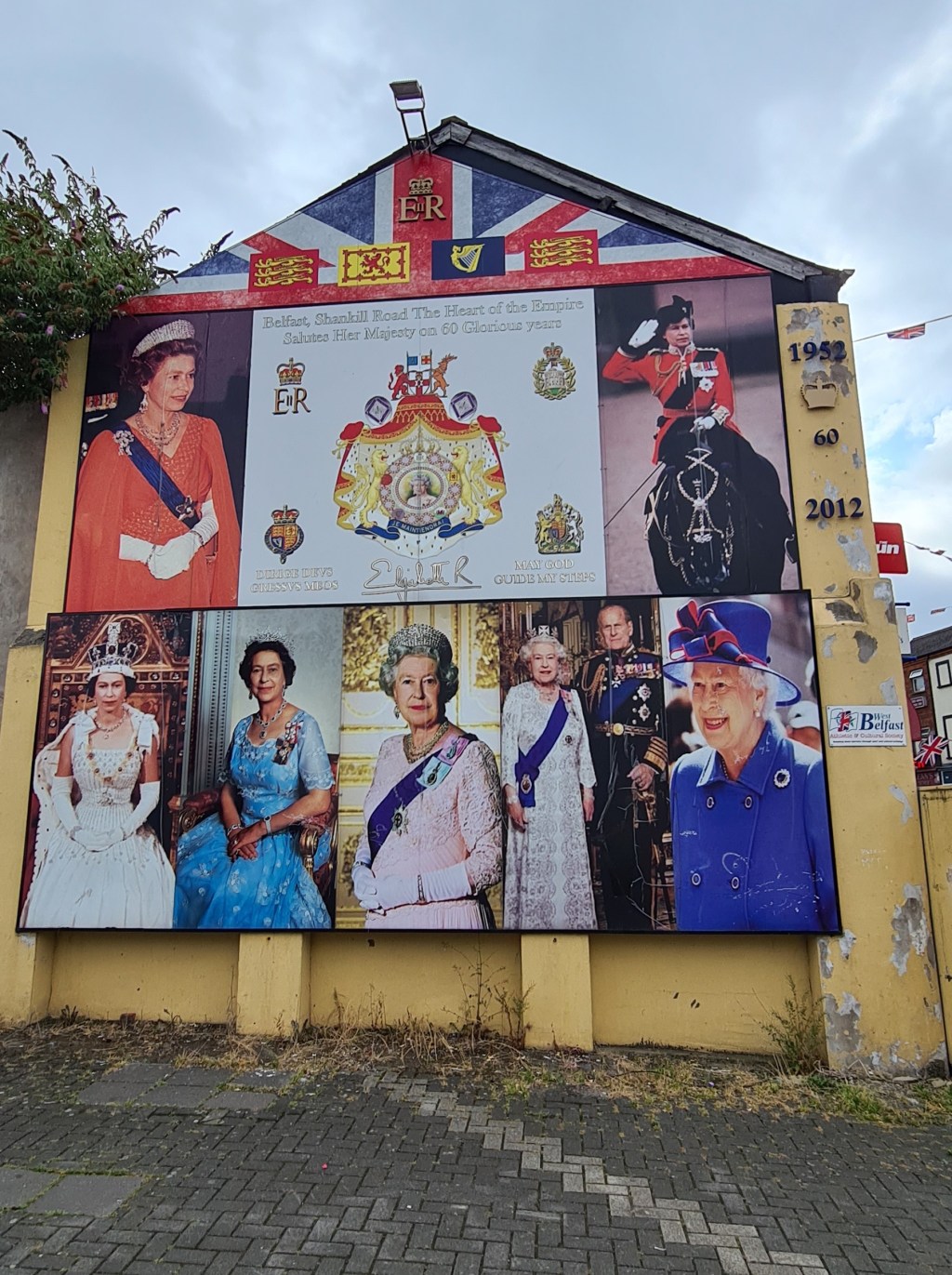
To mark one of Europe’s best loved community festivals here is a review of mine that first appeared in the 2022 edition of Feminist Dissent. In order to get the photos I walked down the Shankhill Road at about 8.30 on a Sunday morning.

The ‘Northern’ in the book’s title refers to Northern Ireland, the version of the state’s name preferred by unionists and liberals. As I’m neither of these I’ll refer to the place as ‘the six counties’ or the ‘north’. It was created in 1921 following the defeat of the Irish revolution and the mobilisation of the Protestant working class by the northern ruling class in support of a project of creating a small state that would be part of the United Kingdom. Protestants in Ireland were largely loyal to British imperialism for historical reasons, due to the way the country was colonised by Scottish and English settlers in the 17th century.
By the standards of the party she led until April 2021, Arlene Foster was on the modernising, inclusive wing of the Democratic Unionist Party (DUP). She was willing to go into Catholic churches for funerals and attended a Gaelic football match – even standing for the Irish national anthem. Unlike many of her colleagues, including several MPs, she probably doesn’t believe that the world is 6000 years old either. David Ervine provides an indication of just how untypical of her party this was; he is a man who joined the Ulster Volunteer Force – a murder gang that existed for no other purpose than to murder and torture Catholics – as a teenager. Ervine said that ‘the DUP couldn’t make Northern Ireland work because the party just hated Taigs (a derogatory word for Catholics)’. So a man who spent 11 years in prison for transporting a bomb intended to kill Catholics found the attitudes of the DUP too bigoted. In fairness to Ervine, he was one of a small number of loyalist terrorists who subsequently re-evaluated his ideology. This is not true of the vast majority of DUP MPs and councillors.

Susan McKay, a founding member of Belfast’s Rape Crisis Centre and now a fairly regular contributor to The Guardian and The Irish Times, takes her readers on a geographical and political trip among the Protestants and loyalists of the six counties. The two terms have never been synonymous and there has always been a thin strand of Protestant anti-imperialism and socialism. One of the things that McKay demonstrates in a series of interviews, reflections and pen portraits is that they are becoming fractionally less synonymous as the southern Irish state has radically secularised and many Protestants see Brexit for the reactionary English nationalist mess that it is.
Ski masks
It was a project that required a certain amount of physical courage. While the days when bearing the name ‘Liam’ in many of the areas she visited would have been enough to get you bundled into a car for a one-way trip have been consigned to fairly recent memory, they do not tend to be welcoming places. Those men you see parading on the streets in ski masks against the Brexit protocol aren’t planning to practise their slaloms after they’ve finished marching. They’re telling you that they are willing to use random sectarian violence against anyone who disagrees with them. It’s fair to say that the offer of a million pounds would not persuade most northerners from a Catholic background to undertake what McKay did. Some of her interviewees would regard McKay as more morally reprehensible than a Catholic who just had the misfortune to be born that way. They would see her as traitor who turned her back on her own Protestant people by holding a mirror up to them. This led one politician to describe McKay, who was born in 1957, as both a ‘wee girl’ and ‘Goebbels’ in an interview. ‘Wee’ is a dialect word meaning little. Roughly speaking her interviewees fall into four broad categories.

Dawn Purvis succeeded David Ervine as leader of the Progressive Unionist Party, which had attracted her by its support for a woman’s right to choose and ending academic selection for children – policies that distinguished it from the two larger unionist parties. She claims to have been surprised to learn that some of the men associated with the party’s armed wing were still capable of committing murder; she quit when they reverted to type. She then became director of Belfast’s Marie Stopes clinic, putting her in direct conflict with the major unionist parties and the churches. In British terms she’s someone who’d be on the leftish Dawn Butler wing of the Labour Party but is now politically homeless, one of those left-leaning people who think the north can be a ‘normal’ state with ‘normal’ class politics. If this hasn’t happened one hundred years after the state was created, it probably isn’t going to happen at any other time.
Carla Lockhart, the DUP for Upper Bann, has a large portrait of her party’s founder and fundamentalist evangelical cleric Ian Paisley on her office wall. She is much more representative of the unionist political mainstream than Purvis, describing the Westminster government’s 2020 legislation requiring the north’s health service to provide abortion as ‘one of the darkest days’ in the state’s history. That said, her knowledge of history does seem to be fairly shaky as she argues that preventing loyalist parades marching through nationalist areas is identical to how Black people were treated in South Africa. This comparison must be upsetting for Emma Little-Pengelly, a former DUP MP whose father was so friendly with the apartheid government that they sold weapons to him for the loyalist murder gangs.
A bit of manners
Pastor Barrie Halliday makes Lockhart, the career politician hand-picked by the party leadership, seem reasonable. He articulates a 17th century rural Calvinism in the modern world. You see small churches like his scattered over the north’s Protestant areas where men like him thunder against sodomy, abortion, alcohol and Catholicism. Addressing Black Lives Matter supporters on Facebook he told them: ‘Youse have shown yourselves to be lesser breeds… You’d need to have a bit of manners, a bit of respect. We are a white civilisation, a Christian culture.’ None of that ‘we’re all God’s children’ stuff for him. But while his depth of religious obscurantism might make him a bit of an outlier, his racism his very typical of both the DUP and many loyalist working class communities in the cities where attacks on migrants are frequent.

McKay’s personal courage is more than matched by that of Toni Ogle. Her father, a former member of a loyalist murder gang, was kicked and stabbed to death by his former associates. These gangs now run drugs, prostitution and protection rackets in working class Protestant areas and get government grants at the same time. It takes some nerve to stand up to them if you live among them and Toni Ogle is one of the rare people willing to do it. She is motivated by a desire for justice for her father and an abhorrence of the rampant gangsterism in her area. And to do that she has had to put the sectarianism of loyalism behind her.
Northern Protestants on Shifting Ground is a valuable contribution to an understanding of a group of a million or so people who are largely inaccessible both physically and intellectually to anyone outside their own community. Their major cultural event, the Twelfth of July, is a drunken sectarian marking of territory with bonfires and marches where even journalists are not welcome. Their ideological points of reference are The Somme, another battle that happened in 1690, some evangelical Protestantism and whatever the current flavour on the far right is – Trump, Farage, Brexit. As McKay notes in her epilogue: ‘Feminists have long realised that they are seen in mainstream unionism as outsiders whose demands must be resisted and that they…still have no country to call home.’ What she doesn’t quite do is draw the political conclusion of that insight about unionism and the six counties to its logical conclusion on the nature of those two things.
As for the ‘modernising, inclusive’ Arlene Foster, she’s got herself a new job on a far right TV station where the most famous presenter advocates letting migrants drown in the English Channel.

 Liam redux
Leave a comment