
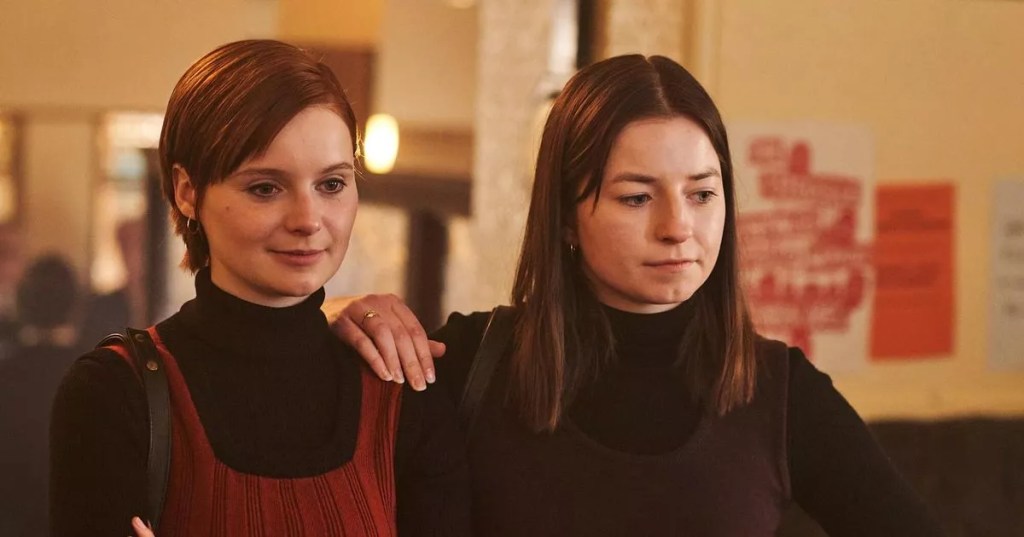
This is a compelling series now showing on Disney Plus (that makes no sense to me either) with superb performances which gives a convincing recreation of the period and Belfast at that time. I watched it over two days, but you must bring a critical eye to the politics.
Frank Kitson features in a few of the early episodes of Say Nothing, a dramatisation of how Dolours and Marian Price joined the IRA and were involved in the abduction and killing of Jean McConville, a widowed mother of ten children. We are told little of Kitson’s career before he arrived to take charge of the British Army in the north of Ireland. He would have been a very capable Einsatzgruppen commander of the sort who ended up dangling from a Red Army rope in Russia in the 1940s. Instead, he ended up as Commander-in-Chief UK Land Forces from July 1982 and Aide-de-Camp to the English queen from 1983-1985. He was a white supremacist mass murderer who was involved in suppressing the Mau Mau in Kenya. Ann Caddwallader writes:
“An estimated 90,000 Kenyans were slaughtered in the Kikuyu uprising while just over a thousand were hanged on a portable gibbet. Some 160,000 were detained in internment camps where torture was routine.”
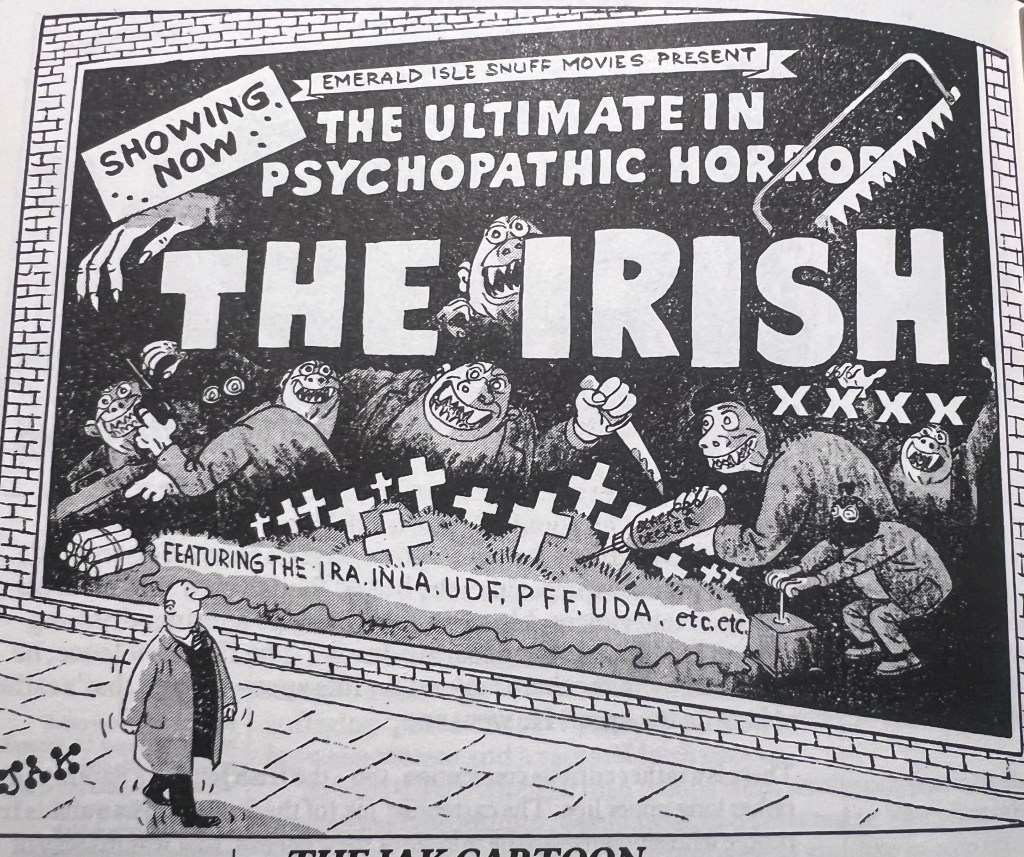
As in Kenya, torture, arbitrary murder and the cultivation of local gangs to kill the insurgents and terrorise their communities were techniques he applied in the six counties. Kitson isn’t the villain in this TV version of history, it is the Irish who are the savages. While it is indisputable that the IRA killed Jean McConville the British Army judged her to be a disposable asset and allowed it to happen. Kitson was at least as responsible for her death as the IRA.
The sisters
The Price sisters were born into a Belfast Republican family. Their father had been active in the 1939 bombing campaign, and they lived with an aunt who’d lost both eyes and both hands making a bomb. A prophetic early scene has Dolours arguing correctly with her father that his military campaign had been doomed to fail, a conclusion she eventually arrives at decades later. The sisters joined the IRA after being attacked on a Civil Rights by a loyalist mob. For the next twenty plus years guns and bombs took the place of politics.
Gerry Adams, who has always denied being involved in the IRA, is depicted as a smart, charismatic military leader. Anyone favourably disposed to rebellions against imperialism will be impressed by the sympathetic treatment of how a group of young working class militants organised to fight the British Army on the streets of Belfast. Central to this group was Brendan Hughes, known as The Dark. An affectionate appreciation of his character and politics can be found here.
As part of the IRA’s plan to “bring the war to England” as an alternative to building a movement for withdrawal, the sisters led a bombing mission. Inevitably they were caught. They were sent to Brixton Prison which houses only men. When their demand to be sent to a women’s prison in the north of Ireland was refused, they went on hunger strike. That episode is harrowing viewing. They were force fed for over 200 days in a process which was effectively a form of gang rape by the British state. When that torture stopped, they resumed the hunger strike and were sent to Armagh prison when Marion was hours from death. They were eventually released on medical grounds, unbroken in their commitment to Republicanism.
An earlier phase in their IRA career had them in a special unit which the series claims answered to Adams. This often involved driving informers and suspected informers across the border for execution. A paradox of the IRA is that an organisation which had a policy of executing informers ended up riddled with them up to the highest levels.
The dramatic centre of the story is their role in the death of Jean McConville, two women actively involved in the political killing of a woman. This is where the writers seriously obfuscate the truth as told by Hughes and Dolours Price to Anthony McIntyre, a former IRA member who was gathering participants’ accounts of their involvement in armed groups. My review of the book in which Hughes’ story is told is here.
Hughes says that he confiscated a radio transmitter the British Army had given to Jean McConville, interrogated her and released her with a warning not to repeat this behaviour. He says she was treated leniently because she was a woman.
The cruellest story
Her British handlers gave her another transmitter despite knowing that she had been uncovered. She was seized by the IRA again and Hughes says that there was a discussion in which Gerry Adams argued for killing her and disappearing the body and IRA commander Ivor Bell said that she should be killed, and her body left where it could be found, the normal way of dealing with informers. Adams has always denied being involved in the killing, even falsely claiming that he was in prison when it happened. Hughes says that he agreed with Bell’s view. In the series we see that Marian Price also made that point.
The political Adams is presented as a more slippery, dishonest figure than he was as a military commander. Old comrades like Hughes and the Price sisters turned against him, arguing that what they saw as his sellout had rendered their armed struggle and personal sacrifices meaningless. Adams and his supporters in turn publicly deride them as embittered, alcoholic and mentally ill. Yet this doesn’t stop him ostentatiously carrying the Dark’s coffin in the full knowledge that Hughes loathed him.
People with an eye for detail might wonder if Gerry Adams really did receive the results of an IRA internal investigation beside the Belfast shipyard, a part of the city where he was more likely to be shot on sight, or if two bank robbers dressed as nuns would have run in the direction of a loyalist area. By and large the atmosphere of the city is well caught. Lora Petticrew playing Dolours as a young woman, to be replaced by Maxine Peake as she ages give performances which catch both the strength and fragility of a woman who ends up regretting much of what she did and coping with the trauma of what happened in Brixton Prison. Hazel Doupe as Marian brilliantly shows how she changed from the quieter of the two to become the most determined.
Jean McConville’s children were treated with immense cruelty by the IRA and the British Army. We are offered only glimpses of what they went through in the years following her death. Theirs is probably the cruellest story of a very cruel time, and as the young Dolours observed in the first episode, all the cruelty was to be for nothing.
 Liam redux
Leave a comment