
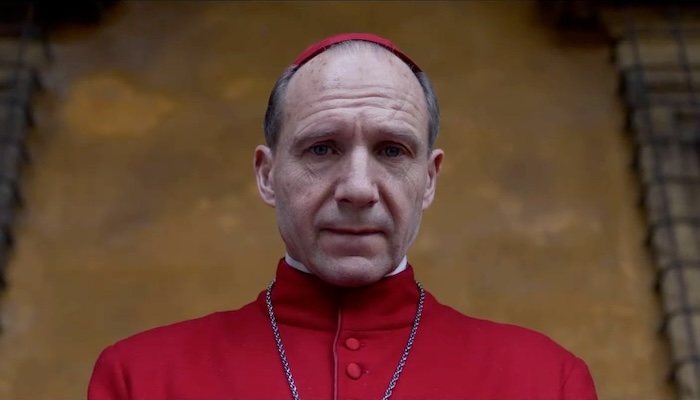
Every organisation is a blend of idealism, venality, abuse of power and factionalism. Starmer’s Labour Party is now pretty light on the idealism, but it has the other things in abundance. Members of the Socialist Workers Party chanted in support of a man accused of rape. What makes Conclave stand out as a film is that it doesn’t shy away from the many faults of the men who make up the leadership of the Catholic Church as they go through a process of selecting a new pope, it also shows that many of them are driven by deep religious faith and a willingness to make significant personal sacrifices for their beliefs.
Rather than take the lazy, sneering atheist path director Edward Berger invests the process with a dignified solemnity without any detached irony. Even though much of the business is conducted in Latin (don’t worry – it’s subtitled) we are watching a severely fought faction fight to replace a dead pope who is very closely based on Francis, the former Jesuit.
On the extreme right there is the Italian cardinal Tedesco whose name means “German” in Italian, though I’m not sure if that is meant to indicate anything. He argues that everything started going wrong with Vatican Two when the Latin mass was dropped and the church became clusters of national entities. Like Steve Bannon and the Irish Catholic newspaper he rails against immigrants practising other religions and filling European cities with mosques. In the secular world his side is in the ascendant.
Opposing Tedesco is an assortment of relatively liberal, in the sense of not being massive racists, cardinals who are seeking the least bad alternative. Arguably a bit like voting for Biden to keep out Trump. The film doesn’t patronise its audience by having someone deliver expository dialogue every time some finer point of Catholic doctrine is mentioned, not even when a cardinal appointed in pectore turns up claiming to represent Kabul, arguably the least sought after senior posting in the Catholic Church.
There is not a week performance in the film. Isabella Rossellini got a round of applause in the screening I saw when she addresses the cardinals reminding them that “God has given us eyes to see and ears to hear” when she torpedoes one candidate’s chances. Anyone who wants to argue that the Catholic Church is one of the most patriarchal institutions on the planet only need to see the role the nuns play in the Conclave.
However, it is Ralph Fiennes who makes this an unmissable piece of intelligent cinema. If he doesn’t win an Oscar next year it’s probably conclusive proof that there is no loving and benevolent God. He is the man responsible for running the election, a church bureaucrat who wants to make sure it is conducted with scrupulous fairness irrespective of his own preferences. With little more than facial expressions he has to express his anger, frustration and doubt. When he does speak his voice has an authority that only a fool would question.
The successful candidate does turn out to be flawed from the perspective of Catholic traditionalists, but as the newly appointed pope tells Fiennes’ Cardinal Lawrence “I am as God made me”. It is that acceptance of the range of human experience which gives the film its uplifting ending.
 Liam redux
Leave a comment