
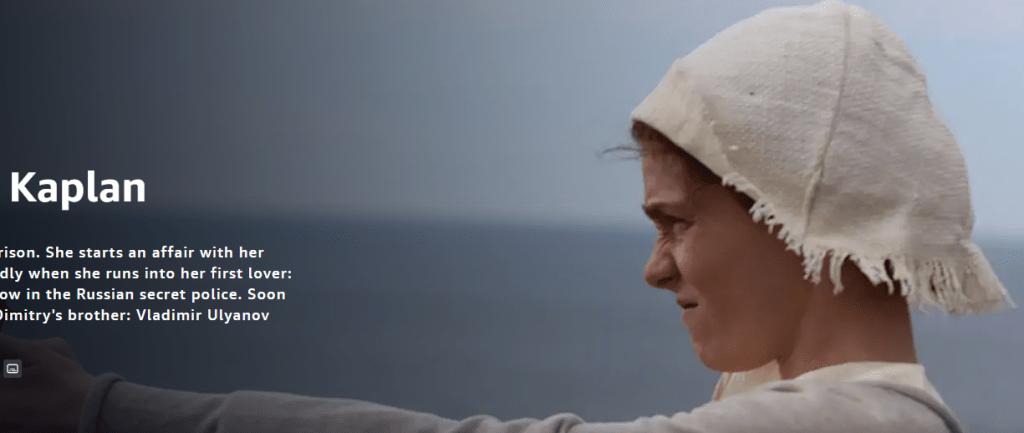
It’s a scientific fact that 99.99% of what’s available on streaming services is complete tosh. However, some curious things do turn up and Her Name Was Fanny Kaplan which is currently free on Prime is an example. It seems to be a Ukrainian telling of Kaplan’s story and a justification for her attempt to kill Lenin.
Fanny Kaplan was the revolutionary pseudonym of Ukrainian born Feiga Chaimovna Roytblat. If we are to believe this film’s account, she joined an anarchist group who were dressed as early period Duran Duran when she fell in love with their leader as they were robbing a posh shop she was in with her parents. This seems unlikely.
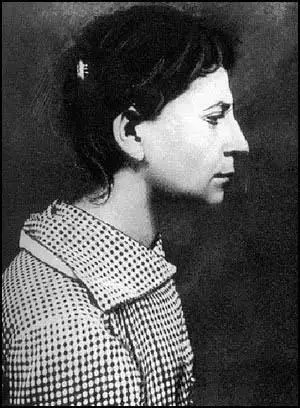
In one of the many gratuitous nude scenes, she is blinded when a bomb she was preparing exploded prematurely. That much is true, though it is unlikely that the Siberian labour camp to which she was sent had such a strong resemblance to a hippy feminist collective.
It is also true that she quit the anarchists, probably due to her views on soap and dogs on string being more correct than her views on individual terrorism, and joined the Socialist Revolutionaries (SRs) who shared the anarchist enthusiasm for assassinating government officials. You can watch the film a dozen times and be none the wiser about the politics of the period, still less what made her switch groups.
The film’s strongest feature is Olena Demianenko’s performance as Kaplan. Her problem is that she was given a script which presents a woman who took up revolutionary armed struggle as a fragile, hysterical wreck for much of the time. This doesn’t sit too well with a 28 year old woman who told the Cheka after her arrest:
“Today I shot at Lenin. I did it on my own. I will not say from whom I obtained my revolver. I will give no details. I had resolved to kill Lenin long ago. I consider him a traitor to the Revolution. I was exiled to Akatui for participating in an assassination attempt against a Tsarist official in Kiev. I spent 11 years at hard labour.”
It is apparent from that statement that she was politically and personally unbroken. We are invited to believe that she had an affair with Lenin’s brother, and even assuming that was true, there was really no need to show his arse during a shag. Lenin himself appears twice. The first time he exchanges a glance with Kaplan as he goes to a demonstration and the second time is after the shooting when he is presented as laughing manically and ordering mass retribution. It seemed to me that we were invited to compare him to Putin.
One of the many odd aspects of this film, which frequently has the production values of a TV soap opera, is that the assassination scene is lifted from what looks like an old Soviet film. There may be artistic reasons for this or it may just have been cheaper. We will never know.
Trotsky, who was the subject of a marginally more favourable depiction on Netflix, said of Kaplan “We could not close our eyes to the danger that threatened the revolution if we were to allow our enemies to shoot down, one by one, the whole leading group of our party.” She was shot at 4am and her body was incinerated in an oil drum, a level of brutality not uncommon in Russia at the time. The sole spectator was the Bolshevik poet, Demian Bedny, who watched the execution “for revolutionary inspiration.” He went on to write things like Enemies of the 5-Year Plan. However, there is significant doubt about her role in the shooting. If an organisation with a long history of assassinations decides to kill someone, they have probably worked out that it is best not to give the gun to someone who was frequently completely blind for days at a time.
The SR justification for killing Bolshevik leaders was the restriction on democracy and the banning of pluralism in post-revolutionary Russia. They were correct in identifying this as a danger to the revolution.
There is an excellent film to be made about Fanny Kaplan and her milieu in 1917 and 1918. This curiosity is not that film.

 Liam redux
Leave a comment