
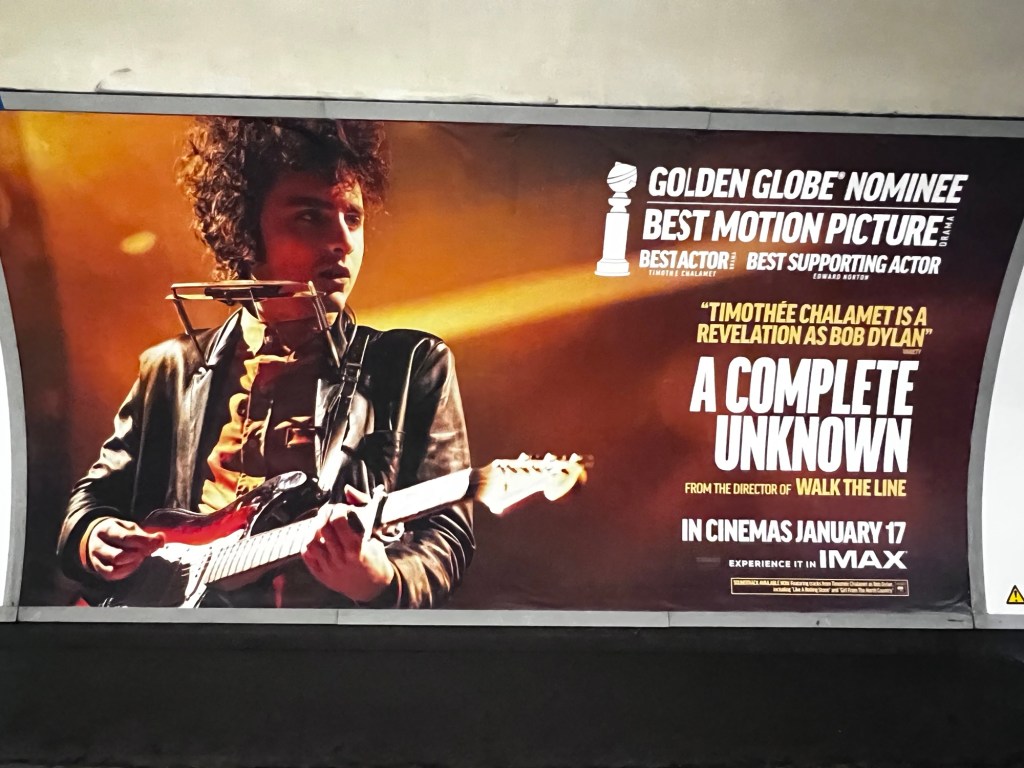
Having seen Bob Dylan as he nears the end of the road last year, a chance to catch a representation of him as he was starting out in New York in 1961 seemed like a way to avoid the coverage of the Trump inauguration. Dylan’s own radicalism is a distant memory and Trump’s return is the pulverisation of the progressive ideas that generation pushed through, so there is a sort of symmetry there. A useful account of the politics and key musical figures of the time and scene by Dean Cohen can be found here.
Timothée Chalamet seems to be in everything at the moment and his face is omnipresent on the sides of buses, in train stations and probably on those little mats you get in pub urinals in this heavily advertised film. Reviews have been mixed even in the same paper. It’s either “Chalamet does karaoke in a lifeless Bob Dylan biopic” or “a marvellous Bob Dylan biopic”. To be fair to Chalamet, Bob Dylan frequently does sound like he’s doing karaoke in his own shows. However, I’m on the side of those who say that this is a terrific film which evokes the New York of the time and Chalamet is outstanding as Dylan
Dylan seems to have been a bit of an arsehole in real life. Joan Baez certainly thought so. An anecdote in a documentary about him claims that he was crashing in the flat of someone who had a collection of incredibly rare blues and country records, and he nicked them. His treatment of women was worse and his treatment of Baez and Sylvie Russo in this gives a flavour.
The film has many plus points. It opens with a Woody Guthrie track and that’s the sort of thing that is sure to turn on new audiences to the poet of the American oppressed. Johnny Cash is given a pivotal role as an inspiration and mentor for the young Dylan, particularly when he rebels against the suffocating conservatism of the old folk music establishment personified by Pete Seeger. He was a drippy, soft Stalinist musical Corbyn who banged on about rainbows, peace and love.
Dylan’s early reputation relied on the quality of his song writing, and this film reminds you how many wonderful songs he produced in a few years. But he also to an extent rode on the coattails of the mass movements for civil rights and against the Vietnam War. He was loosely associated with them but, to my knowledge, hasn’t expressed a political view in decades other than his recent track Murder Most Foul about the Kennedy assassination. That said, I’m not one of those Dylan obsessives who can tell you what colour of socks he was wearing when he played Ontario in 1983.
An experience I share with Dylan is being barracked by a disappointed audience who, in our case successfully, wanted us driven off stage. His decision to play an electric set cheesed off a section of the audience at the Newport Folk Festival. But he was right and they were wrong. He could have carried on playing solo acoustic stuff or change with the revolutionary times and he was smarter than the aging reactionaries. You don’t learn that much about the inner man but the film is something of a manifesto for anyone creative who wants to do something new and different.

 Liam redux
Leave a comment