

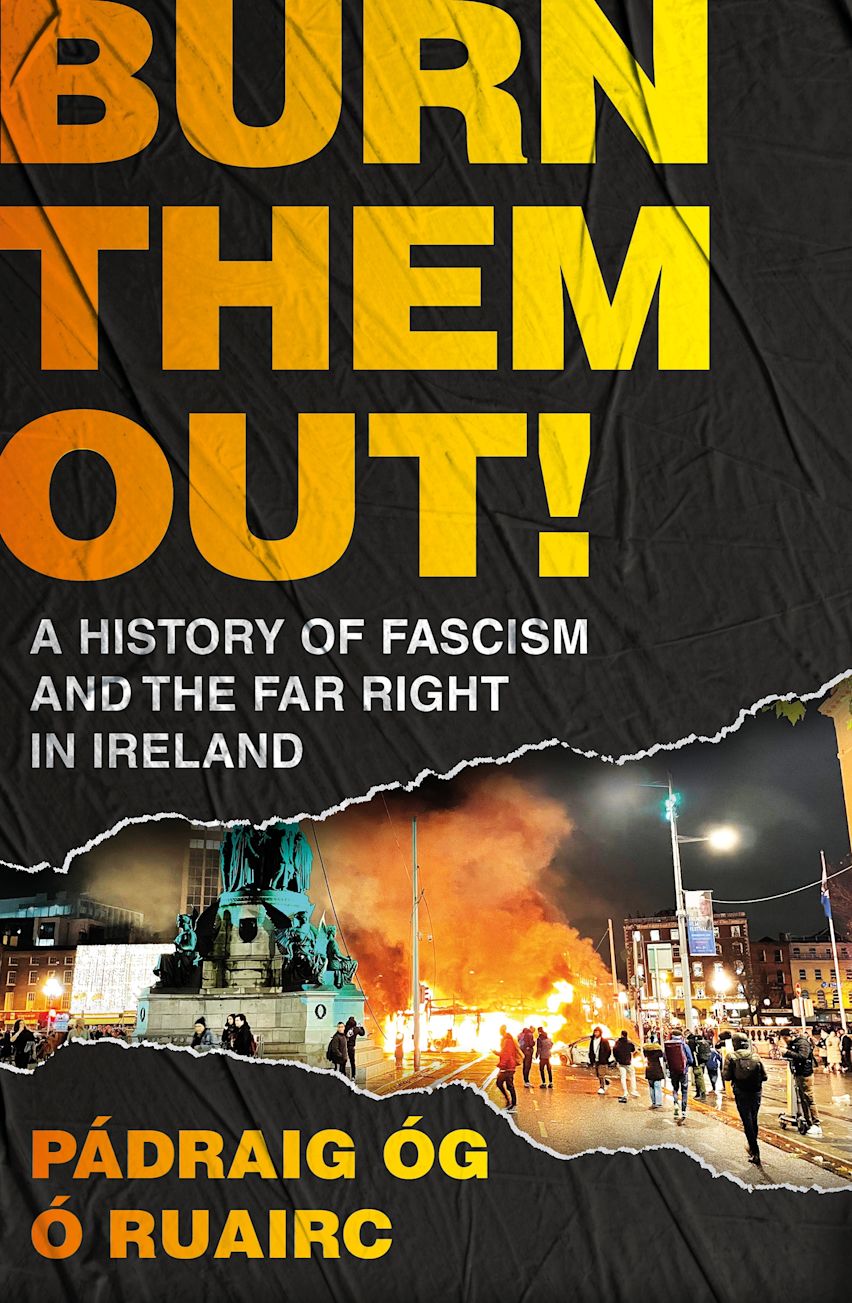
As I was finishing this new book by Pádraig Óg Ó Ruairc on fascism and the far right in Ireland, several hundred people in Ballymena were taking the title as an instruction and burning down the homes of migrants in the town. I can say with some confidence that if they had learned that someone with a name like Pádraig Óg Ó Ruairc was anywhere nearby, he’d have got a kicking too. Ballymena is the old heartland of Ian Paisley and the council banned Brokeback Mountain on the off chance that an evening at the cinema might turn everyone gay. You can’t be too careful about these things.
We will return to the violent far right in the six counties presently.
The mythic father of southern Irish fascism is Michael Collins. Think of him as a revolutionary Roxy Music, his early work was impressive and exciting before he went mainstream. In Collins’ case this meant that he led the counter-revolutionary Free State Forces in a civil war against those who opposed the partition treaty which he signed. Béal na Bláth, where he died in an ambush, has long been a pilgrimage site for the Irish far right who see him as the potential Irish military strongman because of his troops’ role in preventing land seizures and breaking strikes.
Eoin O’Duffy is the best known Irish fascist leader, and like many of these people, is both a sinister and a comical figure. He was a blustering, gay alcoholic, who despite having fought alongside Collins was a military incompetent. He sustained a wound during the War of Independence, not from the British, but by accidentally shooting off his own finger. The hundreds of men he accompanied to fight alongside Franco fought only one action and that was against Spanish fascists they had misidentified as Republicans. But let’s give credit where it is due. They did kill thirteen of Franco’s troops.
“The largest non-governing fascist movement in the world”
For all his movement’s absurdity O’Duffy managed to build what Ó Ruairc calls “the largest non-governing fascist movement in the world”. In a state of three million people it had a membership of 47 000 Blueshirts, the local version of Mussolini’s Blackshirts, and 12 000 Blueblouses in its women’s section. By contrast, the British Union of Fascists had 40 000 members. Another significant difference was that the Irish fascists of the 1930s robbed banks, had gun battles with the IRA and through their merger with Fine Gael had 60 TDs in the Dáil while Oswald Mosely stumbled from one electoral humiliation to another.
Irish fascism was a serious force in the 1930s and it had the enthusiastic support of the Catholic hierarchy. John Charles McQuaid whose biography is subtitled “the ruler of Catholic Ireland” said:
“It is in truth a favourite device of Satan to weaken reverence for the authority of those who command in the name of Christ. Jews, Freemasons, Protestants and communists lead this conspiracy. Jews are utterly opposed to Jesus Christ and all the Church means. You will find Jews engaged in practically every movement against our divine Lord and His Church… Jews and others who by deliberate revolt against Our Divine Lord have chosen Satan for their master.”
If we set aside the religious aspect, this is indistinguishable from what Hitler was saying. Ó Ruairc draws attention to levels of antisemitism on the Irish far right that I must confess I was unaware of. The Jewish population in the whole country was tiny, but consistently found themselves the targets of Catholic and fascist antisemites. The prejudice extended to the civil service which resisted efforts to admit refugees fleeing the Nazis on the basis that they were “a potential irritant to the body politic and this has led to disastrous results from time to time in other countries”.
Strange as it seems, a prominent target of antisemitism was Éamon de Valera who was referred to as a “half-breed” and a “closet Jew”.
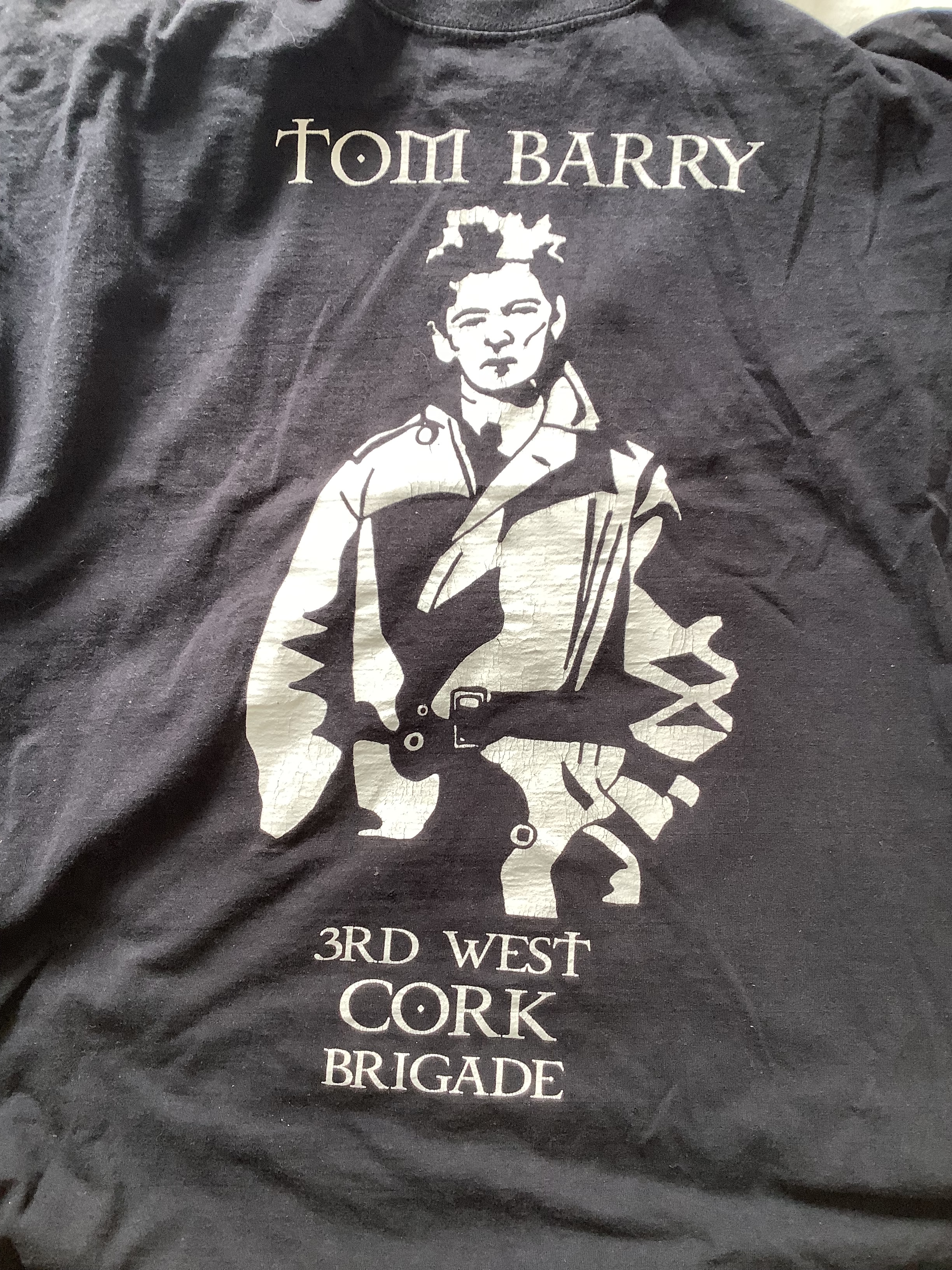
Tom Barry Abú
Irish Republicanism has a tangled history with fascism. The IRA tried to kill O’Duffy and legendary commander Tom Barry had a proposal that the organisation execute fascists defeated at an army convention. Several of its members went to fight the fascists in Spain, but the start of the war saw its chief of staff seeking aid from the Nazis on the stupidly nationalist principle that any help was welcome in fighting the British. Nothing came of it and Sean Russell died on a German submarine returning to Ireland with delusions of starting a war against the British. Irish Republicanism has been consistently anti-fascist since then.
Much of the rest of the 20th century was hard times in the 26 counties for a bewildering bunch of fascist micro-groups offering various permutations of Michael Collins nostalgia, anti-communism, Jew hatred, Catholicism, racism and mystical nationalism. Attempts by British groups to set up satellites came to nothing, from that point of view the British left was more successful. Things were very different in the north. We can disregard a couple of attempts to set up “ecumenical” fascist organisations, the far right has always had and continues to have a mass base in loyalism. This runs on a spectrum from outfits like Tara, to the UDA drug gangs, the Democratic Unionist Party which has flirted with armed organisations to Traditional Unionist Voice which has not very subtly been encouraging anti-migrant sentiment of the sort that results in houses being burned down and riots.
Burn Them Out! is an invaluable account of the early days of British fascism and really captures the breadth and depth of the historic and emerging currents in the Irish far right. Where I would argue it is flawed is that it does not make an attempt to analyse why the country produced “the largest non-governing fascist movement in the world” and why the southern state’s ruling class never had to force it into power. My view is that the revolutionary forces had been so thoroughly defeated in the south that such an outcome had become superfluous.
And a century after O’Duffy, Conor McGregor is being hosted by Trump in a deliberate humiliation of the Irish ruling class. He has his sights set on becoming president of the southern state with a mix of religion, thuggery and race hatred that would be familiar to the Blueshirts. This book could not be more timely.

 Liam redux
Leave a comment