

“The bureaucracies that ruled the mass organizations of the working class were able to insulate the masses from an adequate theory of fascism and effective strategy and tactics for the struggle against it. The price these bureaucrats paid was historical defeat and, often, physical annihilation. The price humanity paid was incomparably higher.”[i]
At about 27 minutes into her recent BBC interview Zarah Sultana was invited to say whether or not she believes that Nigel Farage and Reform are fascists. She took a while to reach the conclusion that Farage has “all the features of a fascist politician”, but her logic was unconvincing. Her arguments were:
“Nigel Farage has proven he is not on the side of working class people.”
“Reform is just another wing of the establishment.”
“They will deliver more privatisation, more deregulation, more tax cuts for the super-wealthy and more austerity.”
“They have attacked trade unions and peddle racism.”
When asked if Farage is in the same category as Hitler she said, “I have legitimate concerns about what a Nigel Farage government would do to trade unionists, to working class communities, to minorities, to LGBT people”.
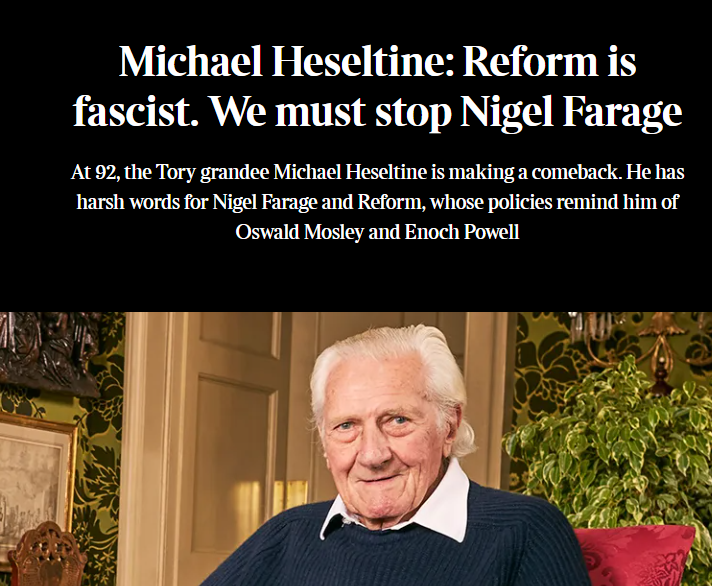
Understandably, she concludes “it’s important that we stop a fascist Reform government.”
She has had some criticism for this argument and has tried to push back against it using Michael Heseltine who is now the “liberal” patriarch of the Tory Party. He told The Times that Farage and Reform are the “reincarnation of Oswald Mosley and his fascists in the Thirties when it was the Jews [who were the target], and of Enoch Powell with immigrants in the Sixties”.
However, if you look at the criteria Sultana has identified they all to varying degrees can be applied to the Conservatives and Labour and not everything we find disagreeable is fascist. There are without doubt fascist movements active in Britain. Tommy Robinson’s recent massive demonstration proved that. Post-Farage UKIP is positioning itself as a new street fighting party flagrantly copying 1940s fascist iconography to advertise its aborted provocation in Tower Hamlets.
In the improbable event that I am ever invited onto Desert Island Discs, the book I would choose has to be Trotsky’s The Struggle Against Fascism in Germany. It is unparalleled as an example of how to keep a clear head in the most dismal of circumstances while offering some sort of reality-based hope.

In it he observes that “the big bourgeoisie needs a movement that can set masses in motion on its side, that can wear down and demoralize the more conscious parts of the proletariat by systematic mass terror and street warfare, and that, after the seizure of power, can totally destroy the proletarian mass organizations and thereby leave the conscious elements not only atomized but also demoralized and resigned.”
We can update to add that in the United States Trump and MAGA had victory gifted to them by the Democrats and are now using ICE as a modern version of the Brownshirts to use the resources of the state against the opposition.
Farage’s skill has been to position himself as the hard right firewall against these openly violent movements while dropping hints that he is listening to their base. That is why his star turn at the Reform conference was Lucy Connolly, a criminal who was sent to prison for encouraging people to burn asylum seekers to death. Words have consequences. Someone tried to do exactly that in Drogheda on Friday night.
Farage is doing what Thatcher did. She took the core racist, socially illiberal ideas of the far right and incorporated them into her party’s programme, something Michael Heseltine was quite comfortable with when he was in office. She was someone we could have legitimate concerns about, but she wasn’t a fascist.
It is easy enough to imagine a highly polarised British state after the next election, the one that Starmer seems determined to let Reform win. And it is easy to envisage a Reform leader consolidating an alliance with the Robinson fascist movement, but we are not there yet. As the quote at the top points out, tactics and strategy flow from theory. At the moment it is incorrect to designate Reform as fascist, even if everything else Zarah Sultana said about it is accurate.
[i] Ernest Mandel’s introduction to the 1975 Pelican edition of the Trotsky’s The Struggle Against Fascism in Germany

 Liam redux
Leave a comment