
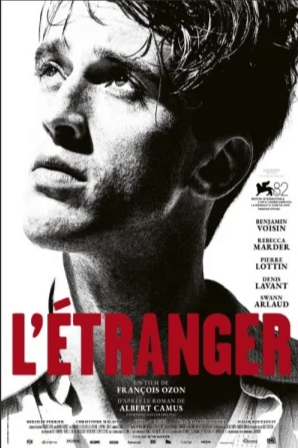
Robert Smith was so impressed by L’étranger, the 1942 novel by Albert Camus, that he wrote a song about it. You could get away with that sort of thing back then but it’s unlikely that a band would release a debut single called Killing an Arab these days. The Cure track closes this new film version by François Ozon.
It is shot in black and white with Morocco standing in for French occupied Algeria. Ozon says that he used black and white because it is cheaper than colour, but also because for French people now, their brutal colonial occupation of the country is always seen in monochrome archive photos and videos.
Meursault, the central character, played by an implausibly handsome Benjamin Voisin, has a job and a girlfriend. He engages with the world and has relationships, but his responses often strike people as odd or insensitive. At his trial much is made of his apparent lack of grief at his mother’s death. He, quite sensibly in my opinion, advises his girlfriend that since he’s in prison with a guillotine the certain outcome, that she should start seeing someone else.
He is reputedly based on Camus’ friend Pierre Galindo who is now understood to have had Asperger’s syndrome. Galindo’s personality is described as a “mixture of intelligence with behavioural oddities, emotional coldness, poor social communication, with lack of social grace, inability to converse and mix socially”.
What seems like a philosophical approach to life in a novel becomes something completely different when it is performed on the screen in front of you.
The novel’s opening is one of the most striking in 20th century literature: “Aujourd’hui, maman est morte. Ou peut-être hier, je ne sais pas”. “Mum died today. Or maybe it was yesterday. I don’t know.” Ozon recreates the shock of this by having Meursault blandly tell his thirty or so Arab cell mates that the reason he was there was “I killed an Arab.” It is the first of many indications that he is not aware of what is socially appropriate or even basic good sense.
In an interview with the magazine Lire, Ozon attributes a philosophical weight to Meursault that is no longer warranted by what we know of how some people with Asperger’s behave. He is not rebelling against an unjust world or giving his life and actions meaning. He was simply acting on impulses that were rational to him at that moment. In this case it meant he murdered a man because of the intensity of the sun.
Race is underplayed in the novel. The Arab population of Algeria were a backdrop to Meursault’s inner monologue. This is harder to do in a film, and we see that the French are occupiers in someone else’s country. The defence lawyer tells Meursault that he can avoid the death penalty if he is willing to lie, observing that he is not the first and will not be the last Frenchman to kill an Arab. It is unlikely that an Algerian would have been offered a similar deal.
Meursault refuses to lie to save his life. The traditional reading is that this was his assertion of his existentialist morality. He had made his choice and he would accept the consequences. A more modern interpretation is that this inflexibility was an expression of his Asperger’s.
The film has already been released in France and it has received positive reviews. A British and American release is apparently due with the dates to be confirmed. Most people who have studied French at post 16 level will have read the novel and the most pretentious of their friends will have too. Ozon stays faithful to Camus’s philosophical ideas, but there was perhaps a more interesting film to be made about how the world treats people who are neurodivergent. They are not necessarily making a grand statement, they are just behaving in the way they feel is right.



 Liam redux
Leave a comment