

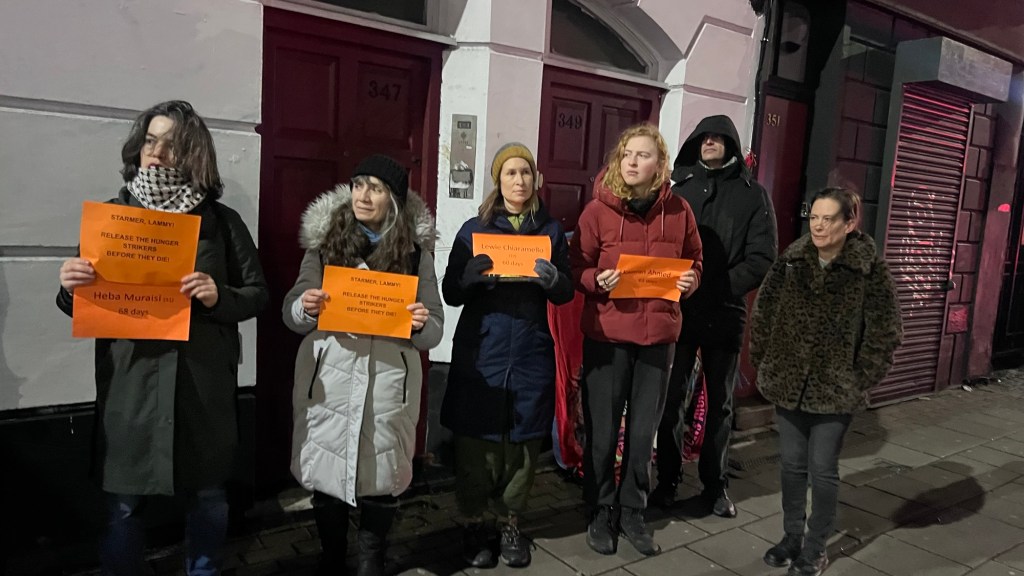
The starting point for any commentary on the hunger strike now being conducted by six jailed members of Palestine Action (PA) has to be admiration for their physical and moral courage. They are in prison because their internationalism and desire to prevent a genocide led them to conclude that they would do things which would inevitably result in prison sentences. They are political prisoners, prisoners of conscience. They feel that the only weapon of struggle they have left to them in prison is their own bodies.
The criminals in their story are the people who practically and politically enabled the destruction of Gaza and much of its population.
However, this solidarity with the prisoners and their motivations does not mean that we must agree with everything they have done or are doing.
Political hunger strikes are rare in British radical history. We have to go back to the Suffragettes to find anything comparable.
By contrast, the hunger strike is a tactic with a long tradition in Irish Republicanism and has been used repeatedly. Thomas Ashe died in 1917; Michael Fitzgerald, Terence MacSwiney and Joe Murphy died in 1920. Dolours and Marion Price were force fed for over 200 days and ten IRA and INLA members died in 1981. Everyone who survived a lengthy hunger strike would have lifelong health issues and every Republican prisoner accepted that death was a likely outcome.
For me, there are two crucial differences between the 1981 hunger strike and that of Palestine Action. The Republican prisoners had five demands based on their understanding of themselves as freedom fighters and they seem very modest in practical terms.
They wanted the right of prisoners to wear their civilian clothes at all times; the right to free association within a block of cells; the right not to do prison work; the right to educational and recreational facilities; and the restoration of lost remission of sentence. In fact, this was little more than a return to the situation in earlier years before the British state settled on an unsuccessful strategy of trying to get the wider public to see the Republicans as criminals.
Palestine Action’s demands are, with one exception, equally modest. They want an immediate end to censorship of all letters, books, and communications in prison, immediate release on bail for all remanded Palestine Action prisoners; the right to a fair trial; de-proscription of Palestine Action, ending the use of counter-terror laws to criminalize anti-war activism; and, perhaps most ambitious, the permanent closure of all Elbit Systems facilities in the UK, ending the British state’s complicity in Israeli apartheid and genocide.
The British state is unlikely to make a strategic break from Israel as a result of the hunger strike. As for the other demands, they are all easy for a government to enact if it wanted to, even one as militantly pro-Israel as Starmer’s.
Smashing H-Block by F. Stuart Ross is the book to read if you want a rounded appreciation of the 1981 hunger strike and what led up to it. More importantly, it is the book which captures the mass movement in support of the hunger strikers. The National H-Block Committee organised across the whole of Ireland. There were innumerable marches and many working class areas had local committees which were much broader than supporters of the armed struggle.
The PA hunger strikers have nothing comparable. It is not clear from the outside that they have any form of support network in the wider radical movement. Certainly, the Palestine Solidarity Campaign does not seem to have taken up their cause, though to his credit Jeremy Corbyn has. Press coverage, even in left publications, has been virtually non-existent compared to the justifiably sympathetic reporting of family members of people locked up in Iranian or Egyptian prisons.
The state is feeling under no pressure and it is hard to see how this ends well.



 Liam redux
Leave a comment