
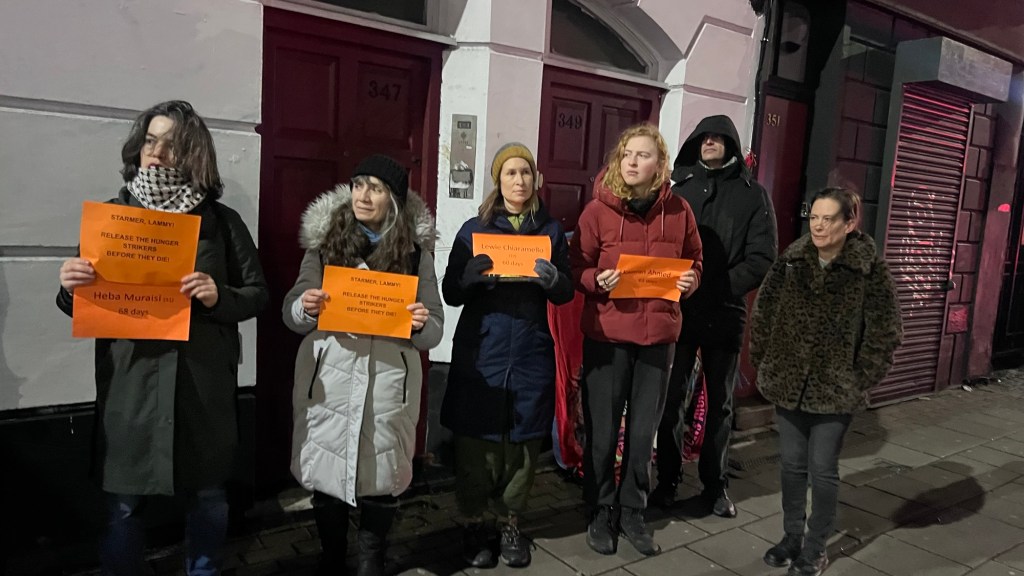
The main historical reference point for the Palestine Action hunger strike has been its 1981 Republican predecessor. My view is that Starmer’s government is behaving with a more deliberate cruelty now than Thatcher’s did. However, there are less well known instances of hunger strikes in the revolutionary Marxist tradition. In 1973 Michael Farrell and Tony Canavan, members of People’s Democracy imprisoned in Belfast by the British for organising a demonstration, were on hunger strike for thirty-four days before they were released. This account uses language that was considered normal back then.
Largely forgotten now is the hunger strike organised by Trotskyist prisoners in Stalin’s Vorkuta labour camp. In reality, it was an extermination camp for his Marxist opponents. It was part of a cluster of prisons which held an estimated 100 000 prisoners who rejected Stalin’s corruption of the Russian Revolution.
The orthodox Trotskyists considered themselves political prisoners. They refused as a group to work in the mines and limited their work day above ground to eight hours, and rather like the Republican prisoners, exercised a level of control over their barracks. It barely needs to be said that the Stalinist charges against them were nothing but fabrications and lies. However, these lies were widely broadcast by the Stalinised Communist Parties across the world.
In his excellent short book on Trotsky, Paul Le Blanc quotes Austrian Stalinist propagandist Ernest Fischer as later saying “ it is beyond my comprehension that I could have believed such lunacy”, describing it as “some primeval dragon intruding into a world which invoked Marx and Lenin, reason and the rights of man, a monster with power of speech, spouting the jargon of a demented bureaucracy”.
Conditions in the camps worsened as Stalin’s extermination campaign accelerated and the Trotskyists were obliged to fight back with the only weapons that remained to them. Their leader Socrates Guevorkian explained their reasoning in a speech which has survived.
“No compromise is possible with the Stalinist traitors and hangmen of the revolution.
Remaining proletarian revolutionaries to the very end, we should not entertain any illusion about the fate awaiting us. But before destroying us, Stalin will try to humiliate us as much as he can. By throwing political prisoners in with common criminals, he strives to scatter us among the criminals and to incite them against us.
We are left with only one means of struggle in this unequal battle: the hunger strike.”
The Trotskyist demands were as reasonable as those of the Palestine Action prisoners.
- Abrogation of the illegal decision of the NKVD, concerning the transfer of all Trotskyists from administrative camps to concentration camps. Affairs relating to political opposition to the regime must not be judged by special NKVD tribunals, but in public juridical assemblies.
- The work day in the camp must not exceed eight hours.
- The food quota of the prisoners should not depend on their norm of output. A cash bonus, not the food ration, should be used as a production incentive.
- Separation, at work as well as in the barracks, of political prisoners and common criminals.
- The old, the ill and women political prisoners should be moved from the polar camps to camps where the climatic conditions were more favourable.
Astonishingly, the Stalin dictatorship seemed to yield to the prisoners and the camp bosses were told to “Inform the hunger strikers held in the Vorkuta mines that all their demands will be satisfied.”
This was a deception. True to the logic of the purges, almost all the revolutionary Marxist enemies of Stalinism were murdered in the tundra by the GPU. For obvious enough reasons, organisations with a Stalinist origin have been keen to bury their memory but the hunger strikers of Palestine Action are in the tradition of the Trotskyists of Vorkuta and no less admirable.

 Liam redux
Leave a comment