
Way back when I was too unworldly to have an informed understanding of the sacrifice required by a vow of chastity, I thought it would be a good idea to become a Catholic priest and was convinced that I had a vocation. Things didn’t quite turn out that way.
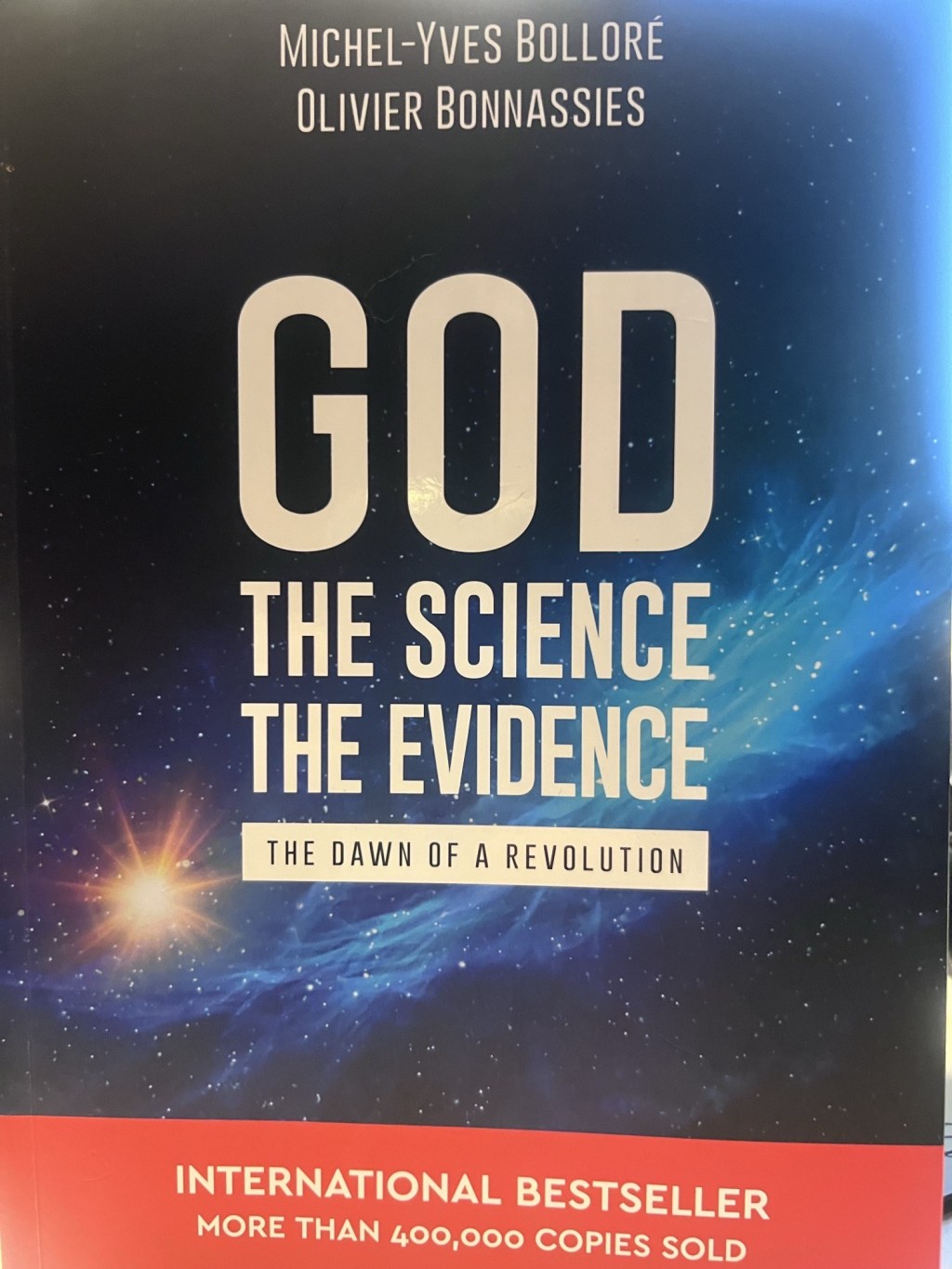
Nevertheless, I take a detached interest in religion as it is used by people as a way of understanding and interacting with the world. That is what prompted me to buy God: The Science, The Evidence by Michel-Yves Bolloré and Olivier Bonnassies, two French engineers. On the cover of my edition, it boasts that it has sold over 400 000 copies.
In some respects, it is good that a work which promises a review of the most up to date scientific thinking on the universe and its origins is so popular. The authors are not afraid to write things like:
“… beryllium 8. The most common isotope of carbon, carbon-12, forms within stars in a two-step process: first, two helium nuclei collide and combine to form the highly unstable isotope beryllium-8, which has a half-life of 0.0000000000000001 seconds.”
They range over biology, physics and chemistry before getting into philosophy and theology. They argue, among much else that “Many scientific discoveries favouring the existence of God are very recent.
- The thermal death of the Universe was not definitively proved until 1998.
- The necessity of a beginning to the Universe (Borde-Guth-Vilenkin theorem), dates only to 2003.
- The discovery of the fine-tuning of the Universe dates only from the 198os.
- The complexity of DNA and the intricacy of the smallest living cells -coupled with the improbability of life arising through pure chance-was discovered only in the early 1960s.”
So far so rational. They also remind us of the price paid by independently minded scientists under the Stalin dictatorship.
Three things fatally undermine the book, and it will take someone with a much better grasp of the science than me to push back on that.
Bolloré and Bonnassies devote a twenty-page chapter to the alleged appearance of the Virgin Mary at Fatima in Portugal to three children in 1917. That section is written with the militant enthusiasm of Catholic propagandists. Shortly after I had changed my mind on becoming a Belfast Father Jack there were claims that around thirty statues of Mary were moving in different parts of Ireland, something even the Catholic Church at the time admitted was improbable. Quite apart from anything else, accepting that it was the actual mother of Jesus means that the post medieval construction of the Mary cult was not a product of history and that the Catholic translation of the Greek word for “young woman” as “virgin” in the Bible is right.
That rather absurd chapter is preceded by one which is undiluted Christian Zionism. A hint that it might have been coming is given in a preface to the book which is composed of quotations from people who were probably approached to write a bit of supportive blurb. David Reinharc, editor of Israel magazine, says that it’s a bit of a pity the book isn’t a defence of the Jewish idea of God but welcomes it “at a time when the boat of Judeo-Christian Europe is sinking”, the current unifying idea of the European and American far right. After going through the tragedies and victories of the Jewish people and the Israeli state, the authors ask the question “Can the fate of the Jewish people be explained with a materialist historical narrative?” Apparently, the Holocaust and the eradication of the people of Gaza are part of a divine plan which defy human explanation.
There is no point dealing with suffering and the conflict with the idea of a loving god, but the one thing the authors avoid like a vampire shuns the crucifix is the huge amount of Biblical scholarship which demonstrates beyond doubt that the Christian Bible is full of inconsistencies, contradictions and borrowings from other intellectual traditions. Listen to a couple of episodes of my favourite podcast the next time you are making dinner and you will be left in no doubt.
There are stylistic problems with the book as well. Maybe it is a feature of French writing to rig together huge numbers of quotes to prove your point. The chapter One Hundred Essential Citations from Leading Scientists gives you a flavour of the method and you will do better than me if your eyes don’t glaze over.
With a bit of luck an enterprising publisher has already commissioned a couple of boffins to respond to Bolloré and Bonnassies on the science. It is beyond doubt that they have thoroughly researched those sections of this work. However, it is so flagrantly a product of the Christian Zionist movement that it undermines its own credibility.
A near mint copy will be appearing in one of my local charity shops quite soon.



 Liam redux
Leave a comment