
“In order to be effective, Social Democracy must take all the positions she can in the present State and invade everywhere. However, the prerequisite for this is that these positions make it possible to wage the class struggle from them, the struggle against the bourgeoisie and its state”. (Quoted in Tony Cliff, Rosa Luxemburg (London: Bookmarks, 1980), pp. 21—22.)
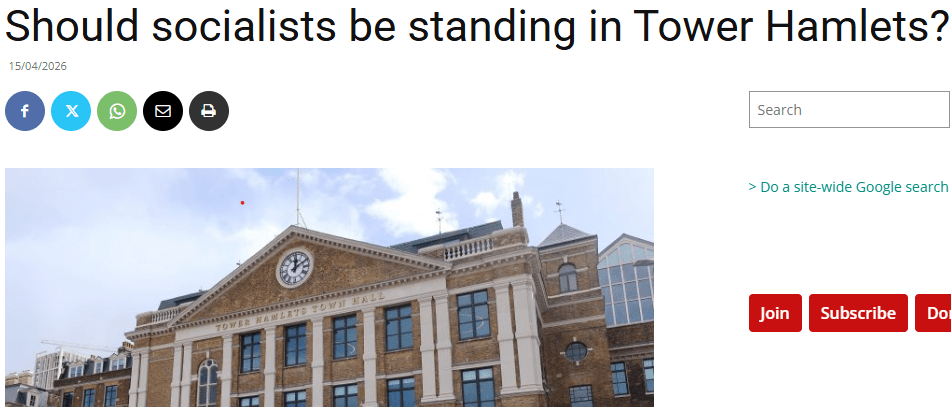
Respect’s leadership is predicting that the organisation will win significant numbers of councillors in the local elections in May 2006. Several of these will be individuals and small groups in some councils. Their role will be limited to making propaganda over cuts, the war local issues and using these opportunities to raise Respect’s profile, recruit new members and establish links with new networks of possible support. However in Tower Hamlets there is a chance that it will be the largest or the second largest group on the council and in Newham it is likely to win a significant number of elected representatives. These councillors will face challenges of a different magnitude as they make the switch from propaganda to offering an alternative view of how local government can be run. This is all the more true because the notion of local councillors organising and leading opposition to government plans over anything apart from relatively trivial issues has largely been forgotten. Respect councillors in east London who choose to fight Labour’s agenda will not be able to rely on many like-minded councillors in other areas of the country. National Secretary John Rees’ public declarations that people who want to be Respect councillors should be prepared to go to prison give an idea of how intense a serious fight against neo-liberalism may get if it is carried through to its conclusions.
Cycle racks outside supermarkets
Most of the time though the job of a councillor can be as soul destroying and tedious as politics gets. Some people are born with an aptitude for train spotting and council chambers across the country are filled with aging men who can get passionate about finance sub-committees and cycle racks outside supermarkets. Socialists though should take a different approach to administering the local state and Rosa Luxemburg’s advice to German Marxists quoted above still holds true. The first job of Respect’s councillors must be to use the council chambers as an arena of class struggle. Local government has been at the receiving end of Blair and Brown’s neo liberal politics and offers plenty of scope for militant pro working class politics.
The councillors of the three major parties would claim that their priority is to administer their area as cost-effectively and efficiently as possible. Some of them might even claim that politics has no place in the council chamber. This is utter tripe. Even the most self consciously technocratic New Labour councillor is bringing a big dollop of politics to the post and it is always of the privatising, neo-liberal variety. The other sort of councillor, the one who wants to “listen rather than lead” almost invariably ending up listening to the council officers and civil servants from John Prescott’s office who tell them that they have to out-source public services and privatise.
It took a fierce fight inside the Labour Party to root out the resistance to privatisation and cuts in local government but the end result of it has been that most Labour councillors are now Blair/Brown loyalists or are too cowed to offer any opposition to what is happening in local government. Housing is a perfect example of this. The Conservatives effectively stopped the construction of council homes. Labour has taken this further. Not only has it not resumed the building of affordable social housing it is trying to force councils to get rid of their existing housing stock and transfer them to “not for profit” housing associations. As George Galloway often observes when he speaks on the issue, it is a scandal that the party, which had the building of decent homes for working people as almost a founding principle, has now turned its back on the very idea. In Tower Hamlets Respect has earned a strong profile as the party which is opposed to stock transfer. Galloway and the organisation’s councillor Oli Rahman are frequent speakers at council lobbies and meetings on estates which are fighting transfer. As a result some of the activists from these campaigns have been drawn towards Respect.
Liverpool 1984-5
The high-water mark of struggles led by councillors was in 1984-5 in Liverpool when Thatcher turned her sights on local government. This struggle was led by Labour councillors who were strongly influenced by supporters of the Militant newspaper, forerunners of the Socialist Party. Those events warrant an article in their own right but Tony Mulhearn’s description of the way the councillors operated is worth repeating. Mulhearn was a Liverpool councillor at the time:
“The sheet anchor for the magnificent stand of the 47 councillors was the District Labour Party (DLP). This body comprised delegates from constituency parties and branches, trade unions, the youth and women’s organisations, community groups, the Coop, the Labour Group and the Liverpool MPs. The DLP determined policy which the council was required to implement. Its decisions were reached after full and democratic discussion, with the participation of delegates and organisations. At the height of the campaign it was normal for in excess of 100 delegates to attend. When extended meetings where held (this is when all party members were invited to attend), some 600 party members would vote on policy, those not delegates were considered as a consultative vote.” (http://www.socialistparty.org.uk/2003/315/index.html?id=pp6.htm)
At the heart of this method of operation was an understanding that there had to be a real dialogue between elected representatives and those who had voted for them. A long discussion is possible about mistakes the Liverpool councillors may have made in their fight with Thatcher. But what needs to be taken from the experience is the relationship between the councillors and the working class and oppressed. One of the differences between Liverpool’s Labour Party and Respect is that at that time Labour was still seen as an arena in which this struggle could be conducted and it was the natural reference point for the majority of union branches, tenants’ groups and women’s groups. It also had structures, like the district party or the general committee in which these organisations could receive a hearing and make their wishes clear to the councillors and MPs. This pressure from workers, youth and tenants was the essential balance to the demands from the Labour leadership, the party’s right wing, the government and right wing press that the councillors capitulate.
At present there is not a Respect group in the country with anything resembling even the embryos of these structures. Most Respect branches do not have the mechanisms in place to keep even the sort of oversight on their future elected representatives that the Labour Party still retains. But there is more to their role than oversight. Respect’s councillors are going to need a large amount of support. Very few of the people who have been selected as Respect candidates have any experience of the position. While many are longstanding members of the Socialist Workers Party several are new to this type of politics and will not have had the political grounding or understand how important an organisation’s support can be. Respect has not yet developed its own political culture or traditions and there is no recent experience of serious local government struggle that the new councillors can relate to. So should the Respect group on Tower Hamlets council be in a position to cancel all the borough’s current PFI contracts, massively expand youth provision, stop the outsourcing of council job
s, begin a programme of building council homes and re-possess those that have been given to housing associations it will come into immediate conflict with the law. An isolated group of councillors will find it hard to stand up to this by themselves and would immediately have to begin to establish a base of support in the council unions, on the estates and in the youth if they are to even partially implement such a programme.
Class power
Local councils, like parliaments are one of the ways in which the ruling class dominates society. When Respect councillors start acting on the anti-capitalist mandate that their voters give them they will find themselves in conflict with the ruling class, its judges, press and civil servants. The ruling class will then try to do what it always does when it sees a threat to its power and try to strangle local democracy by fining councillors, banning them from service and putting teams of “troubleshooters” in place to run a borough in a manner more in keeping with their neo-liberal agenda. This is the conflict that Respect is facing and for which it needs to start preparing.




 Liam redux
Leave a reply to maeve66 Cancel reply