
Pig stealing was my ancestors’ preferred form of resistance to colonial landlordism in the 1830s through to the 1850s. The transportation records from the period show that loads of them were sent off to Australia. There are a couple of dozen of their descendants in the Sydney phone book. It’s obvious to me, of course, that what the ruling class called pig stealing, vagrancy and larceny was an unwritten attempt to collectivise property and expropriate the bourgeoisie. They were probably also setting up free healthcare schemes and literacy programmes too,
Ken Loach’s new film is, for my money, is best. Even though the goodies lose. He and his screenwriter Paul Laverty manage to make the theory of permanent revolution as vivid as real life. It’s there in the debate in the courthouse where the IRA commander takes the side of the moneylender and when the two sides discuss where the support for the revolution must come from. The love interest, something of little interest in any film, is kept to a minimum too. Bread and Roses was almost ruined by the romance. It’s not something comrade Loach does well.
The film isn’t that popular with supporters of the British Empire and that’s a good thing. It’s not well liked by liberal Ireland either. Las night I was in a pub in Belfast with a friend. We were joined by an acquaintance of his who is something in the glittering world of the arts in Belfast. He found it unfair in its depiction of the British forces and couldn’t believe that people who had once been so close to each other could fall out so bloodily. I was going to tell him about the split in Workers Power as a modern illustration but I don’t think they are shooting each other. Yet.
The contemporary relevance is striking. Every recent intervention by British imperialism has been presented as the arrival of emergency contingents of social workers and aromatherapists. In real life it looks like Loach’s film. (Say what you like about the Israelis they don’t leave any doubt. They just say “you are scum, we hate you and want to kill you”). As well as providing a commentary about 21st century imperialism the film has a strong critique of 21st and 20th century republicanism. No one familiar with recent Irish history can fail to see the paralells with the pro-treatyites’ awe and fear of Churchill and Adams’ awe of Clinton and Blair. Even the cosying up to local capitalism was there, though at least even the pro-treatyites would have drawn the line at nominating Ian Paisley for Prime Minister at Stormont.
There is a terrific ambush sequence at the end of which some of the IRA men are upset by the loss of one of their own, even though they have just wiped out two truck loads of British troops. The commander rallies them by reminding them that they must repay the imperialists with a savagery which equals their own. It could be the road to Basra.
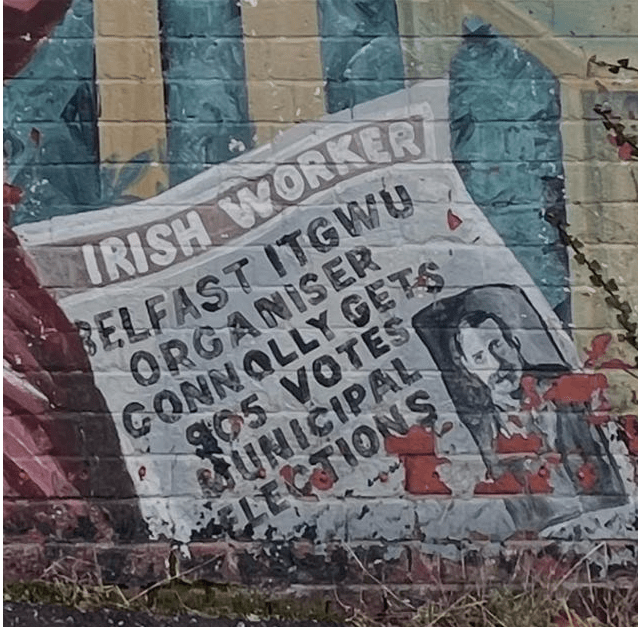
In Belfast and every square inch of wall is commemorating something or other. Portraits of the hunger strikers are on every lampost. The site of Anderstown barracks is now an INLA memorial and there are murals everywhere. It reminds me of the war monuments erected in English towns after the First World War. It also reminds me of Irish revolutionary nationalism’s inability to learn anything from its own cyclical history of war and capitulation. The IRSP were out postering last night. Their appeal to the workers in the Falls Road bus depot is a poster showing two AK47s with the slogan “stand by the Republic”. With thinking like that we could have The Wind That Shakes the Barley part two in another hundred years.

 Liam redux
Leave a reply to Anonymous Cancel reply