Alan Thornett and John Lister

This is the text we submitting to the Respect NC tomorrow. It is not a voting text but a contribution to the discussion. We will also be putting a resolution to the meeting tomorrow which will be for voting. We will send it out later.

We welcome the issues raised by the letter George Galloway has sent to the Respect National Council, which in effect opens the pre-conference discussion for the Respect conference in November. In fact we have been raising many of the issues ourselves. Some of them we raised at the Respect conference last year. Now Salma Yaqoob, too, has submitted a strong statement echoing similar core points to those raised by George.

We are aware that there has been a discussion between the SWP and George Galloway and others over the letter and that there is a wider and escalating debate taking place around it. There is a dangerous dynamic to this debate, in which we understand some people have tried to reject the substantial issues raised in George Galloway’s letter by presenting it as a challenge to working class politics in Respect, and accused him ­ and anyone supporting his criticisms ­ of adopting what is termed “communalist” politics. Although we have only been marginally involved in this debate, we are very concerned that this line of argument has been raised – it is one which could divide Respect if it is pursued.

Salma’s text very capably rebuts any allegation of “communalism”. But the clandestine debate has always been a false one, because there are actually no communalist politics, or anything close to it, in George’s letter. On the contrary it is an argument for the building of a broad-based organisation more effectively than in the past.

In our view any attempt to use this or other diversionary issues to divert from the valid critique which George Galloway has raised over the situation in Respect can only undermine future prospects for building it as a broad-based left alternative to New Labour.

Many of George’s points are valid and merit a serious and constructive response. In particular we agree with him on the following:

1) There is going to be an early general election – either in the autumn of this year or in the spring of next year. Brown is likely to take advantage of this favourable situation – the crisis of the Tories and the Brown bounce – particularly since it might not last long.

2) Yet Southall demonstrated – if demonstration was needed – that Respect is in no shape to effectively fight an election. Its membership has indeed declined and many of its branches are moribund. The lesson from Southall is that Respect cannot succeed in a new constituency unless it has built a base in that constituency well in advance.

3) The objective conditions which produced Respect, and the space to the left of Labour, remains in full-force, as shown by the Shadwell result. Brown leads a right-wing, anti-working class, neoliberal government, which has continued the Blairite relationship with the employers, and is even more hostile to the unions, as his pay freeze makes clear. His scandalous appointment of Digby Jones and other right-wing Tories makes this clear enough. Brown is worse than Blair on civil-rights and is equally supportive of US imperialism and its wars. Trident will be replaced just the same.

4) Despite the politics of new Labour, Respect has not fulfilled its potential politically or organisationally. We have long said that a membership of 2,000 or so, for an organisation with a Westminster MP, a presence in local government, and remarkable name recognition, is ridiculously low. Membership has declined from 5,000 in 2005 ­ an awkward fact that was denied, rather than addressed, at the last conference. The potential for development has been shown, however, in key localities, not only in East London but in Preston, Birmingham and Sheffield for example, as George’s letter and Salma point out.
Respect needs to build itself as a national organisation. This means a stronger national profile and much more attention to building local branches. It needs effective fund-raising.

In our view in the longer term the strategic issue is whether Respect should be a political party or a loose coalition. We have argued that the loose coalition model – or “united front of a special kind” or whatever – does not work. We believe that challenging for political power taking on all other political parties and dealing with all the problems that arise needs the structures of a political party: This does not mean that we believe Respect is, or could sensibly be declared to be, a party in any sense at the present time. A process of development is required to make this a possibility. Meanwhile we agree that even as a coalition Respect could be far more effective, proactive and dynamic: we agree with both George and Salma when they underline the need to organise Respect as a coalition in a much more coherent and inclusive way, and to raise its profile.

There are numerous factors behind the present impasse Respect has reached, and George rightly points to some of them:

a) There are serious problems of democratic functioning in Respect, which is a barrier to recruitment. This includes the functioning of the office and the selective implementation of decisions. (There are numerous examples of this, for example: The officers agreed on several occasions that the full acronym – respect, socialism, peace, environment, community, trade unionism – should be used on all publications. This failed to happen in most instances. The original proposal for a trade union conference with a big priority towards organising it jointly with the TU left and the CPB was never pursued).

b) There have long been problems with Respect’s profile at public events and demonstrations. The Manchester paper has certainly been a positive development in this. We agree with George when he says: “In every area of activity we need to encourage our members to focus on recruitment, fundraising, establishing the profile of our candidates and unashamedly promoting Respect as the critical force in the wider reconstitution of the progressive and socialist movement”. The weakness on this is partly because Respect is one of the few organisations on the left which does not have its own paper, even though our meetings, conferences and rallies are seen as venues to sell newspapers from almost every other current on the left.

c) Respect has failed to respond to the failure of the Labour left to mount a challenge to Brown in the leadership election. This issue was discussed (at our instigation) at the last National Council, at which numerous suggestions were made by us, by George and by other NC members: – but none were implemented and nothing has happened. The Morning Star/CPB organised a conference to discuss the new situation, as did the RMT: but Respect – which has been the most important left initiative for many years – has done nothing.

The recent Morning Star article by Rob Griffiths, raising the issue of the need for a new party, is an important development. We have to promote a dialogue with such potential allies and build their confidence in what we are doing. We cannot simply say “here is Respect, it is the best thing around (which is certainly true) and you should join it”. We have to show them that we are a serious, active, inclusive, campaigning organisation. If Respect is to seriously build itself, it has to convince those coming from the labour and trade union left that there is a democratic space within Respect in which they can function.
Also — – partly as a result of Respects failure to promote itself as a convincing alternative that can win support from trade union leaders — – the RMT is considering standing candidates in the GLA elections. We should welcome this development — but do everything it can to reach an agreement with the RMT for a joint slate in these elections.

d) It is difficult to comment on the financial points George makes. There has always been a lack of transparency in financial administration which has made the functioning of the organisation and democratic decision making very difficult. The NC rarely takes a financial report, and never a detailed one. Yet “off-message” proposals are often met with claims that “there is not the money” while others go through.

There are also issues on which we would go much further than George does in his letter:

The first of these is the wider issue of democracy, particularly the accountability of elected representatives – and we welcome what John Rees is now saying about this. Respect members have to be confident that our elected representatives function under the direction of the elected bodies and in line with agreed policy, with differences of opinion managed collectively. Far too often we find out what George is doing – ­ appearing in Big Brother (the most controversial with many of us); not standing for Parliament next time; standing for Parliament next time; standing for the European Parliament, etc ­- from the media, and not through Respect, and when it is already to late for a collective approach.

The NC has no involvement, that we are aware of, in what George does in Parliament. We need to connect the work in the councils and in Parliament more directly to the leadership bodies. Officers or NC members are unable to take responsibility for what the organisation does in these important areas of work unless they are well informed about it.

2) We need to get rid of the slate system for elections of Respect’s leadership at conference and introduce a method which is less alienating to independents. Respect needs to be super-democratic if it is to attract experienced people who are fed up with the Labour Party. Respect structures need to be less vertical with more connection with the branches, which is why we proposed, at the last conference, a delegate based National Council.

3) On profile, Respect’s own regular national publication would give substance and direction to local branches between big events. Set-piece rallies are very good, but how to build Respect effectively when the rally is over, particularly in the weaker areas, is not so clear.

4) Respect has to have a political life separate from its participating organisations. Its leading members have to be in a position to make building Respect a genuine priority in their political work, and prioritise building a collective, inclusive leadership that sets out to draw together the strengths and the talents of all the currents and independent forces that rally to Respect. In our view that means taking on the character of a political party which can collectivise political experience.

5) There is the issue of political profile (policy and programme), which is not mentioned in George’s letter.
Respect must have clear socialist politics. This does not mean that we have to mention socialism in every sentence, but Respect has to be within a consistent socialist framework. The current leaflet for the GLA campaign is politically bland and does not mention socialism at all. The same with the London broad sheet published in the Spring. It has no mention of socialism beyond the masthead and no mention of the environment from cover to cover. Almost all of it would be acceptable to a Lib Dem (apart from anti-privatisation) and all of it would be acceptable to the greens. If we are not politically distinct from the greens what is the point?

It would be a big mistake to go into the coming election, facing Gordon Brown, with this type of election material. Any left party wanting to make its mark under these conditions will have to have clear and distinct socialist politics on which to build the campaign.
It will also need strong material on the environment and on climate change if we are to challenge the greens and connect with young people across the country. Respect has strong positions on climate change in its policy document – but the issue has remained marginal in most Respect literature.

The debate on “communalism”

We can have a legitimate debate around new constituencies (sections of the working class) won to Respect – particularly when they are minority communities with which the left has no experience. There may have been over emphasis on particular communities to the detriment of others – that can be discussed. And political concessions may have been made (dropping of an adequate socialist profile for example) in the course of this that can also be discussed. But this is not “communalism”. It is an outrageous charge, which should be withdrawn.
Moreover Respect came out of the anti-war movement, recruited from the anti-war movement, and won its electoral base from the anti-war movement. It was a major breakthrough, unprecedented on the left, into minority communities in East London, Birmingham and Preston in particular. Bringing sections of new radicalising communities into a left-wing organisation was never going to be easy.
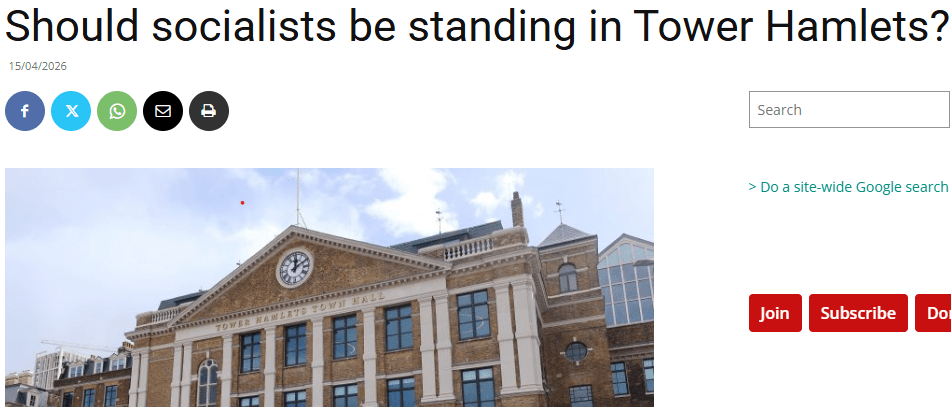
We gather there is now much debate around the situation in Birmingham and in particular Tower Hamlets – where apparently there are major problems. It is hard for us to make any judgement on these disputes. None of these problems has been brought in any understandable way into the meetings of the NC. There were a few reports on the work of the councillors but the battles in Tower Hamlets now being referred to were never raised. No doubt there are problems and conflicts: but such problems are probably inevitable when such breakthroughs are made by the left into new sections of the working class – whether minority communities or not.
The question is not whether there have been and will be political problems and disagreements: the question is whether political steps were taken to discuss these problems openly and bring about a common political development. Was there discussion on the issues involved? Has Respect developed any systematic political education on a more general basis? The answer, unfortunately, is no.

Practical steps

The organisation has been going backwards and now faces a crisis. No change is not a viable option.
The conference in November needs to build a new and broader unity in the leadership bodies and make the necessary changes which can take the organisation forward and build it as a broad, active, high-profile, campaigning party to the left of New Labour, which in our view should also run an active publicity machine and a high profile campaigning publication. This would present a strong and credible appeal to the left in the trade unions, the demoralised left in the Labour Party and to the Morning Star/CPB. Any other answer threatens to undermine all of the gains that have been made so far, and all of the good work that has been done so far at national and local level to build Respect.

Technorati Tags: , , , ,

18 responses to “George Galloway's letter – where we stand”

  1. Is Salma’s letter online?

    And will there be reports of the NC?

    Like

  2. Salma’s letter has not yet been published anywhere so far.

    SR’s position is broadly correct.

    the question of accountabity of elected representtaives is fully bound up with the question of internal democracy. It is much harder for elected representtatives to break disciplione when the policies have been arrived at by a democratic and inclusive process in which their voice was heard.

    But why on erath should anyone follow the diktats of a politicall group where the poilitical priorities are decided behind closed doors.

    I hope that the NC is reported, because that is an important confidence building step for people like me who might reconsider joining that we are at the beginning of a process, not at the end of it!

    Like

  3. There are three points I would make responding to Alan Thornett and John Lister’s document.

    Firstly, it is a lack of ambition to presribe the potential breadth and pluralism of Respect. Yes of course the RMT and the CPB/MOrning Star should be approached, engaged with. But the potential for a Left-of-Labour party given the headlong rightward rush of Brown is much, much broader than this. If Respect turns from an amalgam of one small combination of far left groups and individuals into an only slightly broader one it won’t be much of an advance.

    Secondly. yes Respect needs to evolve into a political party. But we cannot be satisfied with the traditional ways of organising; a paper, one committee after another, formal structures of accountability that rarely work and often actively reduce participation and consensus-builiding. THe principles for organisation should be participation, pluralism and practicing prefigurative politics. On this basis the forms of organisation will almost certainly evolve in entirely new ways because no existing political organisation has been properly committed to these principles.

    Thirdly, and this is linked to these principles they are surely right to pinpoint the need for policy development, issues that will make Respect distinctive. I am less hung up on calling it ‘socialist this’ and ‘socialist that’ what is more important is that a practical idealism frames our policies, rooted in community activity. It is this ‘local turn’ which would help to make Respect distinctive and they are strangely silent on the absolute necessity of community activity in large measure framing Respect’s political profile.

    THeir contribution is immeasurably better than anything offered by the SWP to date but just because they’re on the right track doesn’t mean those absolutely committrd to pluralism, participation and the prefigurative shouldn’t push them further.

    Mark

    Like

  4. very interesting

    it will not go down well with either camp – maybe thats the point.

    i think the letter should have been much stronger on the opportunism of the swp that created this mess. their desperation for a short cut to electoral success led them to drop socialist class based politics and into alliances with ‘community leaders’ and various small business people and religious ‘leaders’. these people delivered the votes for respect in many areas. just look into leicester south and yvonne ridley for a good example.

    why were people with no socialist politics, no class politics, not even with any radical politics, and sometimes with conservative social views, ever recruited and selected as candidates? answer – to secure ‘good’ votes. pure electoralism and opportunism, which the swp once attacked others on the left for!

    the lesson is this. opportunism leads to disaster.

    if a section of respect breaks with opportunism and wants to build a real democratic socialist party then thats great. i can’t see who within respect currently will make this break though.

    unfortunately i believe that the isg will be very much on the side lines within respect and ignored by all wings. maybe, just maybe, a few swpers might engage with them. i guess that’s their aim though. i’m not sure if there are any independent socialists in respect, and if there are, they wont be delegates to conference!

    anyway its all interesting stuff. more signifficant though will be the rmt initiative and any labour left developments.

    ks

    Like

  5. Salma’s document here:
    http://www.socialistunity.com/?p=748

    Mark is correct about the “socialist” thing, I had intended to mention that myself.

    The task of the moment is to recognise that we are all in a very bad way, politically, organisationally and ideologically. To a certain degree the vainglorious pretenctions of the left groups protects them from this harsh reality becasue they are just large enough for their disputes to

    The task is to shift the overall political context to be more favourable for progressive politics, and many who may not yet see themselves as socialists can be our allies in that task.

    So yes, I welcome the small business people, and non-socialist politics, as all part of the mix.

    Like

  6. A different take on the Galloway document and Rees’s reply:

    Since George Galloway launched his offensive on the SWP leadership of Respect in early September, debate has raged in Respect, on blogs and websites, in the local and national press etc. Yet Socialist Worker and other SWP publications remain silent on the question. The inability of the SWP to engage in open debate with its supporters, as well as those in Respect speaks volumes about its attitude – it is the “not in front of the servants” approach of a bureaucratic leadership.

    Clearly the SWP leaders had hoped that they could sort out the problems with Galloway behind the back of the members in a meeting earlier this month, instead Galloway came out fighting demanding that John Rees must go. Now we appear to be heading for a bust-up. What lies behind the dispute?

    If Respect was growing, going from success to success as the SWP claims, Galloway would not have written his “crisis document”. But Respect is in decline – its membership fell by a third between 2005 and 2006 to only 2,160. Galloway points out that Respect got less votes in the recent Ealing Southall by-election than it got in one ward in the constituency in 2005 local elections. In his own words “Whole areas of the country are effectively moribund as far as Respect activity is concerned. In some weeks there is not a single Respect activity anywhere in the country advertised in our media.”

    He criticises “amateurishness” and wrong priorities like the Fighting Unions campaign and is particularly incensed at elected representatives being harassed to go on a Gay Pride event. He proposes a new “high powered elections committee”, stuffed with his supporters, sidelining the SWP dominated officers group, and a new National Organiser, to sideline John Rees as National Secretary. Galloway wants an “election” party, an effective vote-gathering machine, and wants it under his control.

    SWP leaders have issued statements internally to their members, blaming Galloway for an unnecessary struggle, and have recently issued a reply to his document to Respect’s leaders. In it they defend work with Fighting Unions and attending Gay Pride (after all they say respect is “constantly under attack” for not supporting LGBT rights – perhaps something to do with Lindsey German’s famous comment at Marxism about not letting Gay rights become a “shibboleth” standing in the way of broad alliances with Muslims in Respect).

    They also suggest that Galloway is out of touch and ill informed about Respect’s organization and finance, and reveal that most of the people he wants on his high powered election committee never turn up to leadership meetings. They say this is part of a wider problem of lack of accountability of the elected representatives of Respect “The work of our elected representatives is rarely effectively reviewed by the democratic bodies of Respect, not least because, with a few honourable exceptions, the leading elected figures in Respect rarely attend them or report to them. … Important media and political initiatives, which have a profound effect on Respect, are taken with no consultation or prior discussion.” A coded reference to Big Brother one assumes.

    This is all very well but how come the SWP leaders have just discovered it? Indeed even in Respect critics have been pointing these things out. Why does it take an attack from Galloway to get the SWP leaders to bring out these real problems (which of course would have never seen the light of day but for Galloway’s offensive)? The reason is that the SWP leadership was part and parcel of all these developments, instrumental in them. They allowed Galloway to be the unaccountable star celebrity from Respect’s very inception, defending his “right” to an income of at least £100,000 a year against calls for Respect’s elected representatives to take no more than the average wage. They allowed him to make anti abortion statements in the middle of election campaigns without contradiction and to support pro-Life motions in parliament. They had decided that defending gay rights and women’s rights were not going to stand in the way of linking up with and drawing in local and national Muslim figures.

    The SWP central committee also endorsed the idea that local Muslim leaders and small businessmen were welcome in the non-socialist Respect, after all this was a broad coalition (a so-called “special united front”). Yet now they suddenly complain that “We believe that the constant adaptation to what are referred to as ‘community leaders’ in Tower Hamlets is lowering the level of politics and making us vulnerable to the attacks and pressures brought on us by New Labour.” And who started this “adaption” in terms of politics and principles when they launched Respect – the SWP. What they are really complaining about is that their own preferred candidates are being pushed out in favour of prominent local leaders and businessmen who can “deliver the votes” of their communities.

    What we are seeing is the falling apart of the whole project of Respect that the SWP leaders themselves put together, it is a case of “the chickens coming home to roost”. Now, with its former allies on the offensive, the central committee is quickly “discovering” all these problems, preparing its alibi for the SWP members when four years of work goes up in smoke. No one on the left, no one in the SWP should be fooled by these manoeuvres. Rees, German, Banbury, Callinicos et al should be held to account by their members – its time to throw out the Respect turn and the leaders who originated it.

    Like

  7. interesting post

    ks

    Like

  8. Thanks for explaining how rubbish the SWP and Respect are Stuart. Now give us an assessment of how brilliant the Labour Party is, especially after John Mc Donnell’s triumph.
    The issue here is trying to identify the means for creating the anti-capitalist alternative to Labourism. Alan and John try to do that. Your solution seems to be giving some SWP fulltimers their P45s.

    Like

  9. Liam, why is it that suddenly you’ve become snarky and rude to all of the people you previously got on with politically with no problems? To me these are the responses of a man not wholly convinced of his arguments. You’re doing a lot of damage to your credibility. I think you need to step back and think before blasting away at me and others simply because we are pointing out that you’ve made a dramatic U-turn. Whatever you think of Stuart’s arguments, he and his organisation have been consistent in their analysis of Respect whereas you have not.

    I mean you attack Stuart for not attacking the Labour Party! PR aren’t in the LP and actually have written quite a bit on the McDonnell campaign and it’s failure.

    Anyway, I expect more from you than this holier than thou we’re-doing-the-work-and-your’e-doing-fuck-all
    attitude Liam.

    Like

  10. Liam says “The issue here is trying to identify the means for creating the anti-capitalist alternative to Labourism. Alan and John try to do that.”

    The problem is Liam that the project of Respect is doing no such thing, and its leaders never said it was. It is building a “broad, progressive coalition” ie a reformist alternative to Labour. Worse it is trying to do it on a cross class basis, welcoming small business men and “community leaders” who are often part of the exploiting class (exploiting their extended family and other workers) or political opportunists, who jump on any vehicle that gets them control or influence in the council (the municipal pork barrel). And this is nothing new, it was always why small business men or their mates stood for councils.

    Is the Labour left any better? Well the McDonnell campaign had a more worked out left reformist programme than Respect and drew in considerable TU support during the campaign. His failure to get on the ballot reflected the right wing nature of the Labour MPs, including Compass etc, rather than the fighting potential of his campaign base. And I would much prefer this base to the ageing CPB Stalinist rump that the SWP seems to think are going to rescue Respect.

    Liam might be irritable now with critics of Respect having rejoined it, but he wasn’t a few months ago when he had not a good word to say about it. If Liam thinks there is a principled fight going on in Respect he is mistaken – all sides in the current dispute agree on the populist and reformist project of Respect, whether or not they think the word “socialist” should be more or less prominent in its electoral material.

    Like

  11. Stuart is right on a number of points. Until this discussion opened up I shared the nearly universal view that Respect was finished. It may be the case that it does not have much of a future. That is one of the things that will worked out in the course of this debate and at the upcoming conference.

    It’s also true that Respect hasn’t declared itself to be the means for creating the anti-capialist alternative. I think it is one of the components of such a party and it has been the consistent thrust of SR’s participation to move it in that direction.

    Does it have a strong petit-borgeois element? Yes. So does the Labour Party in Tower Hamlets too. A point I have often made was that the unwillingness of Respect’s leadership to have serious arguments about politics allowed this section too much freedom. But it looks as if there is going to be an abundance of serious discussion about politics in Respect in the near future. That’s why it’s worth engaging with it.

    Like

  12. Stuart,

    When you say: “Liam thinks there is a principled fight going on in Respect he is mistaken – all sides in the current dispute agree on the populist and reformist project of Respect, ”

    Are you implying that no-one could be principled who is a “reformist”? And in your terms being “populist” means what exactly?

    It seems your vision is somewhat impoverished. The failure of McD’s campaign went beyind his failure to get the backing of enough MPs, he also failed to gain the backing of any major union, nor did he even get close to doing so.

    Tis is becasue McD’s campaign was trying to regroup the hard left within the party and the unions, instead of recognising that we are no longer in the 1980s, and that constituecncy is too small to base progressive politics upon.

    Like

  13. “Tis is becasue McD’s campaign was trying to regroup the hard left within the party and the unions, instead of recognising that we are no longer in the 1980s, and that constituecncy is too small to base progressive politics upon.”

    Andy, What is this obsession that lefties in the LP are stuck in the 1980s? I could very well say the same about building the left alternative to Labour. Doomed! And also, McD campaign did get the backing of ordinary TU activists but was betrayed by the union bureaucrats.

    And people are leaving the LP but weren’t membership figures dropping for Respect? Then how do you think you will be able to entice them back into the fold? From one alpha-male to another?

    Think you need to improve your analysis of the TU leaderships/bureaucracy.

    And my politics don’t depend on what decade I am in…
    I don’t cut my politics to fit 1980s fashion (to misquote Lillian Hellman)
    I base my politics on where it is the best to fight New Labour and that is in the belly of the beast!!

    Like

  14. It is just a short hand Louise, perhaps it might be more accurate in some ways to say that the labour left is still stuck in the 1950s.

    The question relates to the degree to which traditional working class organisation impacts on broader politics, and facing up to how it has changed.

    In fact of course in many unions the “bureaucracy” is to the left of much of the membership. The “Bureaucracy” does have its own social base in the labour movement and its own institutional interests, and broadly these are opposed to the agenda of New labour. However, their lack of self awarness means that although there is a politicisation from some unions like the RMT, GMB, PCS, and even T&G over specific policies (PFI, council housing) they have less impact on overall politics than they could. Currently the political voise of organised labour is weaker than it should be becasue they look to labour.

    Now the Labour Party also has a bureaucracy, but its social base is not that of organised labour, but based upon the state, which is why it has moved towards “triangulation” towards swing voters, rather than addressing the working class base. This illustrates the different class interests of the LP and the unions.

    You analysis is deficient becasue you confuse the TU bureaucracy with the Labour party, not realising that these are largely autonomous. Indeed it is recognistion of the fact that the official structures of membebrship are not very importnat that has led the unions to accept the changes to conference. they know that their political influence is only weakly expressed via the official link with the LP, and they can directly speak to govt by picking up the phone.

    TU involvement with the LP at every level is atrophied.

    The problem with McD’s campiagn is that it actually had very limited appeal to ordinary trade unionists, most of whom never even heard about it, which is why it was impossible for the left to swing support from the big unions. You say that the ordinary members were betrayed by bureaucrats, but this isn’t at all true is it?

    Was there a single major union where the membership expressed a desire to back McD, but the officials blocked it? Indeed McD probably had more support from union officials than from the lay membership of the unions.

    Now you say that the best place to conduct a struggle against new labour is in the LP. BUt you have yet to give a single example of a success coming from that strategy,

    And when pressed you have said you are not seeking to influence policy, or win left positions in the official structures of the party, but are just networking people together. But if that is your strategy you have effectively left the LP yourself and gone into a form of internal exile. because within that strategy it is only an accidental feature that you happen to be LP members.

    And I don’t want to be rude, but it is foolishness shirley to say that you politics doesn’t depend upon the decade. There has to be a strategic evaluation of the overall political context.

    You need to read a little more Gramsci, and a little less Trotsky!

    Like

  15. Well, that’s certainly put me in my place and didn’t really need the lecture, hectoring and rudeness about my so-called political deficiencies.

    And I haven’t time to dissect what you have said but the LP and TUs are not separate entities they are linked.

    And I read what I want.

    Like

  16. How is it hectoring or rude.

    I am just explaining why i think you are wrong on this issue.

    I tried to do this in a political and not a personal way. If you think it was too personal then I apologise,, but I am only resonding to your own arguments.

    I think you have an incorrect political analysis., and I have tried to explain why that analysis is mistaken.

    Like

  17. Andy: I don’t see it as personal just that your debating style can be over bearing and hectoring. And a tad patronising. Just believe you need to think about it and how it comes across with a bit more sensitivity etc.
    Can be off-putting and put me off responding etc, that’s all.

    I am not perfect and worry how sometimes I come across but I try not to lecture or patronise

    Like

  18. Ok well I’m sorry if i come over like that, but i never claimed to be a nice person.

    But given that you are on the editorial board of Briefing, it is reasonable to question you about your political assumptions.

    If we hone this down to one area of dispute. You say my analysis of the bureucracy is wrong or incomplete or whatever.

    The you say “the LP and TUs are not separate entities they are linked.”

    This needs fleshing out, becasue i don’t understand how you see the lineage between the TU official structures and the LP’s own structures.

    Of course there is some exchange of personel.
    But how does it work in your opinion?

    Like

Leave a reply to Andy Newman Cancel reply

Trending