
Here is the SWP Central Committee statement on recent events. There are one or two statements that you may feel do not accord with your own experience.
Saturday 3 November 2007
An attack on the left in Respect
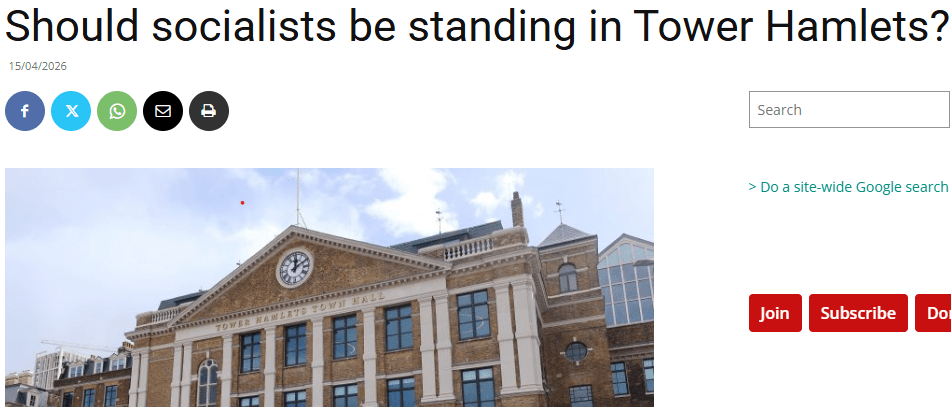
George Galloway has launched a series of attacks on the Socialist Workers Party in recent documents and interventions at meetings. He has been trying to win people to sign a document claiming “Respect is in danger of being completely undermined by the leadership of the Socialist Workers Party” . It alleges that the SWP is trying to fix the outcome of the Respect conference by “blocking delegates” in Birmingham on the one hand and voting for delegates “at completely unrepresentative meetings” in Tower Hamlets on the other.
At a Tower Hamlets meeting he claimed the SWP was trying to control Respect “by Russian doll methods” and said that Paul McGarr and Aysha Ali (both local SWP members) were “Russian dolls” .
Such allegations are false. They can be refuted simply by talking to many non-SWP members in Respect, as well as the SWP members against whom they are directed. The aim of these allegations is not simply to destroy opposition to a particular course on which Galloway wants to direct Respect — a course markedly to the right in some areas to that at the time Respect was launched four years ago. It is also to besmirch the name of the Socialist Workers Party, thereby damaging our capacity to play a part in any united campaign of the left.
It is sad that someone like George Galloway, who has been subject to so much witch-hunting in the past from the media — and who has always been defended by the Socialist Workers Party on such occasions — has chosen to witch hunt an organisation of the left, using the sorts of claims that have always been used by the right against the left in the working class movement. But that is what he has done. He is told at least one person that this is a “fight against Trotskyism” .
A few people on the left might be taken in by his claims. But serious activists know that our members do not behave at all as he purports, however much they may disagree with some of our politics. For the Socialist Workers Party has a long record of working over a wide range of issues with people and organisations with different views to our own.
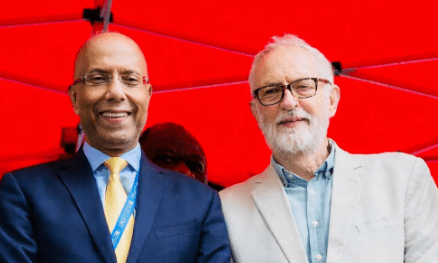
This is something widely accepted on the left. So even Peter Hain, now a senior government minister, recalled in a recent radio programme being able to work harmoniously with us inside the Anti Nazi League in the late 1970s. He described our party as being the dynamic driving force within it, but said we were able to work with people who were committed to the Labour Party. Today members of our central committee play a leading role in the Stop the War Coalition alongside Labour Party members like Tony Benn and Jeremy Corbyn, as well as Andrew Murray, a member of the Communist Party of Britain, and people who belong to no party.
A record of fighting unity and open, honest argument
There is a reason we have such a reputation. It is because we follow the method of the united front as developed by Lenin and Trotsky in the early 1920s and further elaborated by Trotsky faced with the rise of Nazism in the early 1930s. This method is based on the opposite of manipulating votes or rigging meetings.
The method of the united front arises from recognising that exploitation, war and racism hurt the mass of working people, whether they believe in the efficacy of reform to change the system or believe, like us, that revolution is the only way to end its barbarity. This has two important consequences
(a) The possibility of fighting back against particular attacks and horrors depends on the widest possible unity. The minority who are revolutionaries cannot by their own efforts build a big enough movement ourselves. We have to reach out to draw into struggle over these questions political forces that agree with us on particular immediate issues even if they disagree over the long term global solution to them.
(b) By struggling over these things alongside people who believe in reform, the revolutionary minority can show in practice that its approach is the correct one and so win people to its ideas. As Rosa Luxemburg wrote more than a century ago, the revolutionary understanding of the need to confront the present system is the best way to win even meagre reforms within it.
It was this understanding that means that throughout its history the Socialist Workers Party and its predecessor, the International Socialists, have worked alongside other organisations and individuals — from the Vietnam Solidarity Campaign in the late 1960s, through the Anti Nazi League in the late 1970s and again in the mid 1990s, the Miners Support Committees in 1984-5, to the Stop the War Coalition and Unite Against Fascism today. It was the same approach that led us to initiate a campaign in defence of Arthur Scargill in the early 1990s when he was subject to a vicious, lying witch-hunt by the media and the Labour right wing — and most of the rest of the left failed to stand up for him.
Of course, there have been times when people have attempted to throw mud at us as revolutionary socialists. But the mud has never stuck because we have no interest in manipulation. We cannot fight back without persuading other forces to struggle alongside us, and we cannot win some of those to our approach without reasoned argument. People have known we have always been open about our politics at the same time as going out to build unity with those who do not agree with us. They have known that we do not attempt to smuggle in our own views by the back door or impose them on others.
We have no interest in such manipulation, since it would act against both goals we have in the united fronts. It would restrict any united front to the minority who are already revolutionaries, so preventing it from being effective. And it would prevent us from being able to show in practice to people who are not revolutionaries that our ideas are better than the various versions of reformism. It would be like cheating at patience.
This does not mean we have ever avoided organising ourselves to put across our politics in the united front. Anyone with a particular political approach, whether reformist, revolutionary or even anarchist, does this in practice to put across the particular point of view they share, even if they sometimes try to deny doing so. We have always seen argument as important to win people to policies that make the united fronts effective.
So the founding of the ANL in 1978 involved having to argue against those in many local antiracist committees who did not see confronting the Nazis of the National Front as a central priority. Again, a few of the celebrities of who initially supported the ANL when it was a question of wonderful anti-Nazi carnivals announced they were breaking with it when the question arose of stopping the Nazis dominating the streets. If the SWP as a party had not argued with activists right across the country for the positions we had developed, the ANL would never have been able to inflict a devastating defeat on the National Front.
Much the same applies 23 years later when Stop the War coalition was formed after a highly successful central London meeting, initiated by the SWP but involving other people like George Monbiot, Jeremy Corbyn, Bruce Kent and Tariq Ali in the aftermath of 11 September and the beginning of bombing of Afghanistan. The first organising meeting after this was nearly a disastrous sectarian bun fight as various small groups tried to impose their own particular demands. It was only the capacity of the SWP as an organisation to act to draw together constructive forces round minimal demands we all agreed with that enabled the coalition to for forward. If some of the sectarian demands had been imposed (such as treating Islamism as if it were as big an enemy as US imperialism) Stop the War would have been stillborn.
Our comrades had to argue for an approach that would involve the maximum number of people in the movement while not diluting in any way its opposition to the war being waged by the US and Britain governments. Far from SWP members behaving like “Russian dolls” , our capacity to work out through debate within our organisation what needed to be done and then to win others to it was a precondition for creating one of the most effective campaigning organisations in British history. This did not stop one small group at the second organising meeting denouncing us for supposedly trying to “take over” the coalition, using much the same language that George Galloway regrettably uses today. On that occasion other people who were serious in fighting against the war could see what nonsense that was and how correct our arguments were.
In a previous incarnation George Galloway used to praise the SWP for our capacity to get things done, such as building the broad based but principled Anti War movement of which he soon became a leading member. Now for some reason he believes his own interest lies in supporting those who want to drive us out of Respect.
The politics of building Respect
This method of the united front has underlain our approach in Respect all along.
Back in 2003 the anti-war movement was at its highest point. We had seen not only the 2 million demonstration of 15 February, but also the series of demonstrations all over 300,000. Many activists came to the conclusion that there needed to be a political, anti-Blair, expression for the movement.
We shared this general feeling. But we also saw a wider need for a political focus to the left of Labour. If this did not happen, disillusion with Labour could end up as it had repeatedly in the 20th century when demoralisation within the left and the working class led to a swing to the right of benefit to the Tories and, even worse, the Nazi groups. Our duty to the left as a whole was to try to create a credible alternative electoral focus to Labour. We had tried with only very limited success to promote this through the Socialist Alliance. We now saw the feeling against the war as providing much bigger possibilities of doing this.
The left focus would not be a revolutionary one, but attempt to draw in the diverse forces of the anti-war movement — revolutionaries, of course, but also disillusioned supporters of the Labour left, trade unionists, radical Muslim activists, and people from the peace movement. It was a project that only made sense to us if we could involve large numbers of people who did not agree with us on the question of reform and revolution.
To this end, representatives of our leadership were involved in open and frank discussions with various other people interested in the same project. Then the expulsion of George Galloway from the Labour Party precipitated the putting of the project into effect.
Our approach was that of a united front. We agreed on a minimal set of points that were the maximum that our allies — and many thousands of people activated by opposition to the war — would accept, but which were fully compatible with our own long term aims. Hence the name which was given to the new organisation, Respect, the unity coalition, was less than the full blooded socialist position we would ideally have preferred but which would have put off other people who wanted some sort of anti-war, anti-racist anti-neoliberal alternative to New Labour. The initials of Respect summed up these points (Respect, Equality, Socialism, Peace, Environment, Community and Trade unions — with socialism as one clear point among them).
Respect did not set itself up automatically. Once again there had to be a political fight to get this united front off the ground, and the SWP was essential to carrying this so as to get the widest possible unity. There needed to be a political argument inside the SWP (with a few people at a special national party delegate meeting in January 2004 opposing the project or its name). Our members also had to argue much more widely, with people tinged with Islamophobia who objected to working with Muslims. We also had to argue with people on the socialist left who objected to working with George Galloway, claiming his past record ruled this out (he had, for instance, never been a member of the Campaign Group of MPs and ruled out Respect MPs accepting a salary equal to the average wage).
We said what mattered at that moment was not what he might or might not have done in the past, nor what the level of an MP’s salary was. The key thing was that he had been expelled from New Labour as the MP who had done more than any other to campaign against the war. As such he was, at the moment, a symbol of opposition to New Labour’s involvement in the US war to very large numbers of people who had always looked to Labour in the past. Precisely because the SWP was a coherent national organisation we were able to carry these arguments across the country in a way in which no-one else involved in the formation of Respect was able to. Galloway clearly agreed with this when he enthusiastically agreed to John Rees being nominated as national secretary of Respect, just as Peter Hain and others had once accepted a member of the SWP central committee being national secretary of the Anti Nazi League. Both recognised that a “Leninist” organisation could fight to build unity among people with an array of different political perspectives in a way that a loose group of individuals could not.
We have shown our commitment to this ever since. So in the London Assembly and European elections of 2004, we strove to ensure that the Respect lists were much wider than the SWP, even in areas where the SWP members were a large proportion of Respect activists. There were sometimes quite sharp arguments inside the SWP about making sure non-SWP members were candidates. We recognised this was essential to making Respect into a real “unity coalition” of the anti-New Labour left. In line with this approach we worked as hard for George Galloway in the London election for the European parliament as for Lindsey German on the GLA list. And we worked as hard in parliamentary by-elections that summer for Yvonne Ridley in Leicester as for John Rees of the SWP in Birmingham. It was the willingness of SWP members to work in this way alongside others that produced the first electoral breakthrough for Respect in Tower Hamlets, when local trade unionist Oliur Rahman became a councillor with 31 per cent of the votes, followed soon after by SWP member and housing activist Paul McGarr beating New Labour to come second in the mainly white Millwall ward with 27 per cent of the vote. No one mentioned Russian Dolls then.
In the general election of 2005 the diversity of Respect in Tower Hamlets and Newham found expression in the candidates for the seats in the boroughs — one SWP female, two non-SWP people from a Muslim background, and George Galloway. SWP members showed their commitment to Respect as a broad coalition by working for all the candidates, but especially for George Galloway. In Birmingham our members worked very hard for Salma Yaqoob.
The pattern was repeated in the council elections of 2006. We fought to make sure lists of candidates were mixed in terms of ethnicity, gender and religious beliefs. In Birmingham, Respect stood five candidates — two Muslim women, a Muslim man, a black woman and a white woman in the SWP. In Tower Hamlets and Newham the SWP members argued for mixed Muslim and non-Muslim candidates wherever possible and other people accepted the argument.
The elections results were a great success for Respect in these areas, winning 26 per cent of the vote and three council seats in Newham, 23 per cent of the vote and 12 seats in Tower Hamlets, and a seat for Salma Yaqoob in Birmingham.
Defending Respect as a project for the left
But just as with the Anti Nazi League in the late 1970s and Stop the War in 2001, the very success of Respect created political problems — and Socialist Workers Party members at meetings and conferences had to try to find ways of dealing with them.
One was in the results themselves. The successful candidates were all from a Muslim background, despite the substantial white working class vote for Respect and the mere couple of hundred votes that stopped non-Muslim candidates winning in Tower Hamlets. This led to opponents of Respect to spread the idea that it was a “Muslim party” . The other problem was that electoral success led to something familiar to people who had been active in the past in the Labour Party but completely new to the non-Labour left — opportunist electoral politics began to dominate Respect.
There were even cases when people said that if they could not be Respect candidates they would stand for other political parties — and one of the Respect councillors in Tower Hamlets did switch over to Labour after being elected.
For such people their model of politics was that increasingly used by the Labour Party in ethnically and religiously mixed inner city areas — promising favours to people who posed as the “community leaders” of particular ethnic or religious groupings if they would use their influence to deliver votes. This is what is known as Tammany Hall politics in US cities, or “vote bloc” or “communal” politics when practiced by all the pro-capitalist parties in the Indian subcontinent. It is something the left has always tried to resist.
We seek people’s support because they want to fight against oppression and for a better world, not because they stand for one group.
But it became clear in the course of 2006 and 2007 that there were people prepared to use these methods in order to gain positions in Respect. There were cases where a lot of people joined Respect just before a selection meeting, turned up at to vote a certain way — and were never seen again when their nominee failed to get a candidacy. In Tower Hamlets members were signed up in large numbers by a few individuals.
Then came the selection of Respect candidates in Birmingham in February 2007. The balanced list of the year before disappeared as seven middle aged men of Pakistani origin were chosen for the “target” seats in which it was thought Respect might stand a chance. In one seat, Moseley & Kings Heath, 50 people joined in the week leading up to the meeting and a recruitment consultant was nominated instead of a woman member of the SWP. Clearly some Respect activists had fallen into the trap of believing it could advance by doing what our opponents had always accused us falsely of doing — acting as a cross class party whose horizons were limited to representing just one “community.” In the aftermath, the Pakistan-born sister of one of our members said that although she had voted Respect previously she would not do so again because it was a “communalist party” . No doubt New Labour or the LibDems had spread this slander, but events of the ground could seem to confirm it. This is in a city which is mixed ethnically and religiously. To run a Pakistani dominated list was to put us in danger of cutting ourselves off from building a coalition that could appeal to people of all origins.
Principled socialists had no choice but to argue against such things. They represented a fundamental shift of sections of Respect away from the minimal agreed principles on which it had been founded — a shift towards putting electorability above every other principle, a shift which could only pull Respect to the right. So it was that Socialist Worker ran a short piece criticising what was happening in Birmingham, and, a week later, a letter by Salma Yaqoob defending them.
Developments in Tower Hamlets also forced principled socialists to take a stand. There was soon an argument within the newly elected Respect group on the council as to what its stance should be. A number of them, none of them at that point in the Socialist Workers Party, objected to what they saw as the drift to the right of the majority of the group and their failure to use their positions to agitate and campaign for the Respect’s positions.
The issues became sharper in the late summer of 2007 when one of the Respect councilors resigned his seat in Shadwell. There was a selection meeting which got heated when a young woman, Sultana Begum, dared to stand against Harun Miah, and the SWP members decided that she was the person with the sort of fighting spirit best suited to represent what Respect should be. Making this choice was one of the alleged crimes of the SWP referred to by George Galloway in his first missive against us in mid August — even though SWP members, after losing the vote then worked flat out to win the seat for Respect. Our real crime, its seems, was that we argued out politics openly and vigorously as socialists should, and refused to be dragooned into being “Russian dolls” for George Galloway’s friends.
Saint George and the Trotskyist Dragon
The mystery in this account may seem to be to some people why George Galloway should have turned so suddenly against us if we had not made some serious mistake.
We can only surmise what his motive might have been. But his record is clear. He behaved marvellously immediately after his election by going to the US Senate and denouncing the war in front of the world’s television cameras. But after that his role very rapidly became rather different to that of the “tribune of the oppressed” that people in Respect expected from such a talented MP. There were complaints that he tended to leave much of his constituency work in Tower Hamlets to those whose salaries he paid out of his MP’s allowances. Instead he achieved the dubious record of being the fifth highest earning MPs, after Hague, Blunkett, Widdecombe and Boris Johnson) with £300,000 a year. Some Tribune of the People!
He dealt a blow to everyone who was preparing to campaign for Respect in the 2006 local elections: he absented himself from politics for weeks to appear in the despicable “reality TV” show Celebrity Big Brother. Every active supporter of Respect was faced at work with people on the left saying they would never vote for us again and taunts from our enemies about cats.
Socialists in the SWP had to come to decision as to how to react to such things. The pressure was particularly acute during the Big Brother weeks, with leading Respect members like Ken Loach and Salma Yaqoob wanting to denounce him.
Fortunately, as a “Leninist” organisation of “Russian dolls” we had our annual conference just as Big Brother started and were able to agree on a general reaction, which every one of our members tried to argue in their workplaces, colleges and schools. It was that appearing on Big Brother was stupid and an insult to those who had worked to get him elected. But we also said that it was not in the same league as dropping bombs to kill thousands of people in Iraq and Afghanistan. We had for this reason to continue to defend him against witch hunts from New Labour and the media. And defend him we did, at meetings of the Respect leadership, in an article putting the case in Socialist Worker and through statements on television by John Rees and others. We never, of course, got any thanks from Galloway for this, nor did the many thousands of Respect activists who were persuaded to stand firm because of our arguments. Yet it is probably fair to say that if the SWP had not chosen, as a matter of principle, to defend him, then Respect would have suffered a disastrous split.
Nevertheless, there is no doubt that the Big Brother farce hit our electoral vote that May. Galloway never once acknowledged the damage he did. Instead, he seems to assume that the left can be built largely through a media career. In the months after the Big Brother fiasco he turned to a career as a late night talk show host, interspersed with jokey television appearances with people like a granddaughter of the Queen.
Yet now he has the gall to complain that the Socialist Workers Party is “undermining” Respect and that people have to sign up to help him kill the dragon of Trotskyism.
Despite his increasing preoccupation with his media career throughout most of 2006 and the first half of 2007, Galloway was still capable of letting us have occasional glimpses of his old skills at denouncing imperialism. He was still an asset to the left, even if a diminishing one, and we in the SWP reacted accordingly. We never imagined he would suddenly blame us for resisting those who were pushing sections of Respect in the direction of electoral opportunism. So we continued to try to get him to speak on Respect platforms, even if media commitments limited his availability, and defended him against a further attempted witch-hunt from New Labour.
Then he suddenly did lunge into the attack with the document of mid August, which anyone capable of looking a little below the surface could see was directed against us. The document appeared when New Labour suddenly began to hint there might be a general election as early as October. Galloway had said two and a half years before he would not stand again for his seat in Bethnal Green & Bow. But he did show a desire at the time to stand in the other Tower Hamlets constituency. That required him to win votes.
So his document was based in part on electoral arguments. Respect had done poorly in the Ealing & Southall by-election. This could be explained by people with a modicum of political analysis by the timing (it was called and two and half weeks notice), by the fact that it was in the middle of the short-lived “Brown bounce” of the new prime minister, and by our lack of roots in the area. But Galloway contrasted it with the success of Respect in the Shadwell by-election and drew the conclusion that the only way to win seats was to follow the methods which had begun to take root in Birmingham and parts of Tower Hamlets. There was no future in appealing to workers on just class or anti-war arguments (despite the success of Socialist Worker members Michael Lavallette and Ray Holmes in the May elections) and there had to be a shift towards courting “community leaders” . The Socialist Workers Party was resisting such a turn, and so it had to be attacked. So also were attempts we had encouraged to reach out to new supporters through the Organising For Fighting Unions conference.
When we in the SWP and the left councillors defended ourselves, he accused us of aggression. At a meeting in the third week in October in Tower Hamlets he told some of our members (including his 2005 election agent) to “fuck off” . Some of his supporters made it clear they wanted to drive us out of Respect. From that point onwards there was only one possible way of keeping Respect alive in its original form — for us and the left councillors to fight flat out.
There was one particular sad thing for us in this whole sorry saga. It was that three Socialist Worker Party members — two of long standing, the third a more recent recruit and former member of the Militant — chose not only to line up with George Galloway but also to help orchestrate the attacks on the SWP and the left councillors in Tower Hamlets. Nick initially accepted the central committee’s decision that he should not take the post of Respect national organiser and then, in circumstances that made clear his alignment with George Galloway’s faction, reversed the decision.
We had no choice but to part company with the three and terminate their membership of the SWP.
What next?
A fight is on for Respect. The next two or three weeks will decide its outcome.
It is not a fight over personalities, but over politics. Do we try to build a political home for all those who are disgusted from the left with New Labour. Or do we allow it to shrink into an organisation for promoting a few political careers — and one media career — in a couple of localities.
We are determined to fight for Respect as it was originally conceived and for its future to be democratically decided at its national conference in November. The fight is important, in showing once again that revolutionary socialists can not only fight for our own principles, but can defend the notion of unity in struggle over particular goals of all those who suffer from the horrors of existing society. We know there are many, many people in the unions who have looked to Labour in the past and are now considering breaking from it. We know that despite repeated obituaries in the media, the anti-war movement is alive and kicking. We know that there will be struggles over the next three years against Gordon Brown’s attempts to cut the real take home pay of public sector workers. We have to keep alive the idea of united fronts to defend these things, and bring the most active people in all these fronts acting together to build a political focus to the left, within which revolutionaries and non revolutionaries can work together.
For that reason alone, we have to stand firm in defence of Respect as it was meant to be against attempts to deform it.
Central Committee


 Liam redux
Leave a reply to Mick Cancel reply