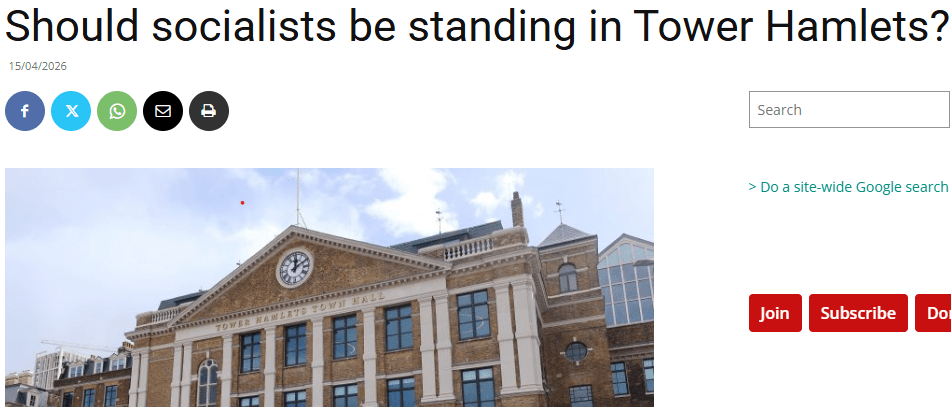
Or “Thornett slams Newman in furious row”. Not really. Alan has replied to Andy as part of the ongoing discussion on the London mayoral elections and I thought I’d lure in the gullible with a sensationalist headline.

Rejoinder to Andy Newman on Ken Livingstone

Alan Thornett

Andy is quite wrong to suggest that I have failed raised my views on Ken Livingstone inside Respect Renewal (RR) until “the 11th hour”. The only thing discussed recently inside RR on this subject has been whether to stand a RR candidate for mayor or not on this occasion. The decision was no, and I agree with it. All other discussion has been around the issue of standing a list for the Assembly, not about the mayoral election. I support the decision not to stand for mayor, not because it would be wrong in principle but because RR is not in a position to stand effectively on this occasion. If there is a discussion who RR should support for mayor on this occasion I will certainly express my views.

In fact I have always held the view, from the time Respect was launched, that it is perfectly legitimate to stand against Ken Livingstone. I have never argued anything else. Nor did anyone else as far as far as I can remember, not on the National Council (NC) itself. Several members of the NC expressed this informally. Lindsey German was selected unanimously at a meeting of London members with no alternative view being put.

The only thing which has changed now is that the Tories have found a right-wing populist buffoon as a candidate, and the Evening Standard is waging a witch hunt against Ken Livingstone. Livingstone has not changed at all. In fact in a number of important aspects his politics are worse now than they were in 2004. The witch hunt and the Tories do have to be taken into account, but as I have argued previously, that is not difficult under the alternative vote system.

Andy is also wrong to say that it is a matter of being either for Livingstone or against him. That is simply not the case. Respect’s campaign in 2004 was never conceived as an anti-Livingstone campaign ­ and as far as I can remember it was not. In fact it was specifically agreed that it would not be anti-Livingstone. It was organised as a positive campaign around what Respect stood for ­ in order to provide the left alternative the election and with a second vote for Livingstone. The Respect mayoral booklet in 2004 does not mention Livingstone, nor as far as I can remember did any of the other material. Of course it depends how important you think it is to offer a left alternative in elections where every you can.

It may well be that not enough emphasis was given in the 2004 campaign to cast a second vote for Livingstone­ though as Andy says there was a letter in the Guardian and various other things were done to make this policy clear. But there was a different balance of forces in that election. Although it was right to cast a second anti-Tory vote ­ the practical need to defend Livingstone against Steve Norris was not very great. Whether Steve Norris was as actually as benign as Andy suggests or not, few people though he was in with a chance. That was certainly my view. As I remember it even Livingstone himself made it clear that he had no problem with left candidates standing against him, providing they advocated a second vote against the Tories.

Vote transfers

It is true that only a minority of Respect first preference voters ended up casting their second vote for Livingstone. But this may not have for either of the reasons Andy suggests: i.e. that the inadequacies of this as part of the campaign or voter confusion. It is more likely to be that the votes being picked up by Respect were votes which would not have gone to Livingstone anyway ­ first or second preference. It reflects that fact that there is in fact a much wider left critique of Livingstone than Andy is prepared to accept – and this is the natural constituency for a left candidacy. This is certainly the case in the unions where a statement to the effect that “the unions will all be supporting Livingstone” need to be heavily qualified. It is likely that many of those who voted Respect in 2004 would not have voted at all without a left alternative to vote for. Nor is there any evidence that most second preference voters for Respect would have voted for KL if Respect had not been there. They more than likely voted Respect precisely because they were not prepared to vote KL.

Andy claims that the weakest point in my argument is transport. And there is a grain of truth in this, particularly if you choose to compare London busses with busses in other expensive cities rather than comparing Livingstone’s overall transport policy today with his approach during years at the GLC. I think Andy’s weakest point, however, is on the police. Andy does not even mention the shooting Jean Charles De Menezes, and I don’t blame him. If I was trying to scrape together a case for a first preference vote for Livingstone I would be sorely tempted to avoid it as well. But it is crucial. Livingstone’s attitude to this shooting is so grotesque that, personally, I would not give him a first preference vote on these grounds of this alone.

I was rather shocked that Andy thinks that the class bias of the police is something only recognised by the far left! Its not true. You simply don’t have to have been a miner whacked over the head at Orgreave to draw the conclusion that the police are on the other side of a class divide. When I was an active trade unionist it was hard to find anyone who though that the police were anything other than biased against working class people. I would be amazed if that was not the wide spread view in many trade unions today. It would certainly be the view of many of those subjected to stop and search by the MET today think that there is not a class bias involved as well as a racist motivation. Young, black, working class people are simply the main targets of the police in this.

Andy says that: “Ken Livingstone may be imperfect, but remains a left social democrat with a broadly progressive administration”. This assessment is dubious to say the least. Livingstone may be a left social democrat – of sorts: i.e. one with a huge discrepancy between theory and practice, but he is not running a “broadly progressive administration”. What is broadly progressive about it?

True Livingstone is not simply a new Labour politician. No new Labour politician would have done such the cheap oil deal with Hugo Chavez ­ though one or two of them opposed the war. But this does not get us very far. There is a long tradition of radicalism concerning far away places combining with conservatism at home. The fact is that his administration is indistinguishable from new Labour on a range of absolutely crucial issues. On the city of London and finance capital he has a big business agenda. On housing policy, planning and development he has a big business agenda. In fact he is repeated backing the big developers against local people when office development conflicts with local housing. The same applies to the privatisation of public assets under his control. Livingstone is far to the right of Attlee on all this, if Andy wants to go back that far to justify his actions.

Mixed economy

On transport policy (dare I say) and the Olympic games h
is actions are also in line with new Labour as he is the case with the police and “security”. And where is the difference in terms of his attitude to trade unions (which Andy minimises); at least as far as trade unions organising within his jurisdiction are concerned? How does all this add up to a progressive agenda? I can’t agree with Andy when he say that “as Mayor of London there is a certain rationality in pursuing finance capital”. We are talking here of the city of London, a major powerhouse of global capital and all its consequences. This is a big concession to make.

It is very difficult to ague with all this in mind that Livingstone is a defender of a mixed economy. To be a defender of a mixed economy today you would have to defend what is left of the public sector. It is also very hard to argue that his support for a multi-cultural society (even if you ignore where this fits into his support for the MET over Stockwell out of the equation) overrides all this.

And you just have to ask new Labour themselves what they think about it. They are completely happy. When KL was first elected mayor new Labour were horrified, because they remembered the Red Ken of the GLC. They changed completely when they realised what he was actually doing in office ­ and their new positive evaluation of him has never looked back. He is certainly their first choice now.

33 responses to “Major rift threatens Respect Renewal”

  1. This is all very well and usefully sets out why Ken is not ‘so red’.

    If this was part of an action call for workers to organise against privatisation of the underground, to organise rank and file action to support the RMT, to organise demonstrations against school privatisations and closures, against racist policing then all very well.

    But it’s actually an argument to vote German as number 1 whilst actually still saying vote for Livingstone as a number 2 choice- though he is silent on this here he does in an earlier article give Livingstone his support against Johnson even though he is ‘not supportable’

    “In fact giving Livingstone your first preference vote rather than your second would make no difference at all to the figures, you would still only be giving Livingstone one vote”

    http://liammacuaid.wordpress.com/2008/01/30/socialists-and-ken-livingstone/

    The point then as Thornet tacitly acknowledged in his earlier article is not to support a candidate on the basis of their politics as such or voting as a paper exercise but for socialists to relate to workers’ illusions- in this case that a vote for Livingstone is a way to fight against the right wing politics of Johnson- and to use the elections as a platform to begin organising a fight back against the reactionary politics of the capitalists- including Livingstone and Johnson.

    German’s campaign is unlikely to identify and organise resistance to capitalism, partly because it doesn’t even campaign on the basis of socialism or class struggle, has no union backing and is not linked with direct action class struggle campaigns.

    It’s just a list of worthy enough reforms not connected to why workers should fight for them or how workers should fight for them other than voting Lindsey. Instead of community and democratic control it argues for ‘local government control’. Hardly dynamic stuff! http://electrespectcoalition.org/index.php?option=com_docman&task=cat_view&gid=18&Itemid=27

    Whilst Respect Renewal may not be wracked by a major rift the muddle surrounding elections with neither side presenting a coherent view on why even intervene in elections in the first place does not bode well, I think.

    Jason

    Like

  2. This seems to sum up everything wrong with SR’s method very well.
    You end up arguing with Andy Newman about how good Livingstone really is (he’s crap).
    But that really isn’t the issue in determining whether socialists should support him.
    Socialists should support Livingstone because he has a mass working class base who want to stop the racist Tory Boris Johnson winning.
    That’s an elementary and entirely laudable objective and that’s the reason why socialists should vote Livingstone.
    It’s really not necessary to pretend he’s better than he is in order to do so.
    In fact quite the opposite.
    As for German’s candidacy, its truly irrelevent, although I hope that the SWP Respect do stand, as experience is the true test and it’ll maybe teach them the uselessness of the enterprise if they do really, really badly.

    Like

  3. Whats happened to the alternative left slate?

    Like

  4. It should be obvious that there is no place in Respect Renewal for the ISG. You should return to the fold. You were right about so many things in the past, against the SWP, and still have something positive to contribute. Some of your contributions since splitting have been better than we have had from the SWP, and I am sure the best of the SWP leadership recognise this. The Respect project needs change, and it has only started down this path, a path that was actually heralded by the ISG, in your criticisms of Galloway. The SWP cannot evade all responsbility for the split or tensions that lead up to the split. I don’t hink it wants to. It is essential to advocate a change in the approach to caucussing by the SWP in meetings that reduce Respect meetings to rubber stamping decisions taken elsewhere. This is a disasterous approach that was always going to lead to a split. Rational, fraternal debate within Respect can put an end to such practice.

    Like

  5. there should be one key consideration for socialists
    who will take London forward in a progressive direction
    the real world choice is between a racist neocon thatcherite and a left social democrat who has implemented many progressive policies and political initiatives ( which has more credit given the rightward moving political and global context, and still very popular despite media lies and distortions)
    the choice could not be clearer
    the social democrat should be supported
    only 1 in 8 second preferences play a decisive role in elections like that for mayor- due to the real world way these are used
    Socialists should acknowledge the real world-otherwise they have no claim to be scientific socialists (read the communist manifesto) and deliver progressive change (with limitations obviously- no revolution around the corner- whatever you may wish) and not play with the political leadership of the capital of this capitalist beast
    if socialists cannot recognize this reality- they should hide under a rock and re-read lenins left wing communism- until they lose their infantile illusions- or read trotskys the struggle against fascism in Germany- to show the kind of consequences that the left (both ultra and social democratic) and their infantile ways can lead to- not to say that fascism is imminent here….
    no, the bnp are a threat..but Boris as the executive mayor is the biggest threat by far to London in thirty years- everything should be done to stop this
    Idle propaganda and attacks on the only candidate that can stop Boris are utterly irresponsible and criminal politically

    Like

  6. Paul, I found an old Socialist Alliance receipt book the other day dating back to 2001. From 2000 till 2007 we tried to work effectively with the SWP. That was long enough to form a couple of conclusions and in the time since the split they have not altered their methods in the slightest. It’s nice that you’ve asked but no thanks.

    Like

  7. Actually funnily enough I think the Socialist Alliance was quite good- sure it had its faults and perhaps electoralism was one of those.

    But the strength it had was the left groups working together, not pretending they agreed on everything, having relative open and relatively democratic debates.

    I think we should try to resurrect this- not as the Socialist Alliance (think it’s been and gone) and not in the first instance as an electoral bloc but as a way of organising and debating together.

    Elections are not the be all and end all- fighting or taking positions on elections is (or should be) a tactic to win and organise workers to class struggle. The old slogan of the left used to be vote Labour but organise to fight or some such variation (‘with no illusions’ but crappy but implying the same thing) but these days it seems all too easy to fall into long debates about who to vote for or not and forget about organising to fight.

    The sort of initiative I mean is organising together a bit like the socialist unity group in Manchester with their idea of the convention of the left- RR are in this as well as various other non-aligned individuals and a couple of other groups. The SWP aren’t yet and possibly won’t be but would be more than welcome
    http://permanentrevolution.net/?view=entry&entry=1907

    Rather than dismissing the idea of working together in an organised and sustained way across a range of issues–not just single issue campaigns-I think it would be good to try it and not just in Manchester!

    Jason

    Like

  8. Liam is right. The ISG are wedded to GG and RR whatever the consequences- to gve up your press to GG will I think be in the future a tactic which is a disaster.. but time will tell.
    I think Thornetts article is good and sets out the choice very well. It is clear as Thornett states that Andy has to justify his position by not mentioning certain elements of Livingstones politics most obviously over the police murder. Andy thinks the Mayor should chase finance capital!!! What then is the point of being a socialist or a socialist representative. Lets set our sights a bit higher. A mayor who challenges the might of the corporations and banks would be very popular. Now even I know German will not be Mayor but then we have to have something better to campaign round than Livingstones neo liberal hogwash whixh is an attack on working class living standards as I am sure we all agree.
    The problem for the ISG is that thye have not fought for Thornetts position- no article in the paper, e mails sent out backing Livingstone, Salma joint letter from her position in RR. The ISG are it seems going to be the left cover for GG slide to the right. Good luck.

    Like

  9. jj – saying that you spent several years trying to work constructively with the SWP in a couple of regroupment projects is not, in my book, the same as being “wedded to GG”. You can’t begin to imagine the utter sense of futility non-SWP Respect members felt unless you’ve lived the experience.

    Have you actually read and understood what we’ve been saying for the last six months? It’s not clear that you do.

    And on behalf of the defunct Socialist Resistance editorial board – thank you for your expression of concern for our lack of a press. We never knew you cared.

    Like

  10. I have to say that Alan gives an inadequate analysis of New Labour and Ken. There’s a qualitative difference between a NL hack and Ken, Ken doesn’t always follow the line (unlike the NL drone) therefore maybe amenable to pressure.

    Take, for example, Peter Hain who had a history outside the usual machine politics of NL. Ken and Hain had a history of campaigning on issues background. Yet Hain capitulated wholesale to the ideology of NL.
    Ken, on the other hand, is an inconsistent left social democrat who is in his own little maverick category.

    “True Livingstone is not simply a new Labour politician. No new Labour politician would have done such the cheap oil deal with Hugo Chavez ­ though one or two of them opposed the war.”

    I would genuinely like to know who Alan is refering to (“one or two of them opposed the war”) as it is unclear, do you mean Labour lefties like Corbyn and McDonnell or Robin Cook or John Denham? I think there were more than “one or two” who opposed the war.

    Like

  11. Livingstone is extremely consistant in pushing through the neo-liberal ideology of privatisation. If that’s not selling out wholesale to New Labour then I don’t know what is. Thornett is right, a vote for Livingstone is a vote for Brown and all the reactionary fellow travellers who preach the neo-liberal mantra.

    If you’re a socialist then the first vote has to go to German. Despite the split, we are all still trying to build a left opposition to Labour. Let’s not squander a chance to relate to the thousands of workers who are sick of neo-liberal policies by challenging Livingstones drift to the right.

    Like

  12. Alan writes:

    I was rather shocked that Andy thinks that the class bias of the police is something only recognised by the far left! Its not true. You simply don’t have to have been a miner whacked over the head at Orgreave to draw the conclusion that the police are on the other side of a class divide. When I was an active trade unionist it was hard to find anyone who though that the police were anything other than biased against working class people. I would be amazed if that was not the wide spread view in many trade unions today. It would certainly be the view of many of those subjected to stop and search by the MET today think that there is not a class bias involved as well as a racist motivation. Young, black, working class people are simply the main targets of the police in this.

    Firstly, there have been hardly any confrontations between the organised labour movement and the police in twenty years, which has weakened the understanding of the role of the cops in the movement.

    And to articulate the idea that the police are “the other side of the class divide” as Alan puts it, requires that your political concept of how the world works is one based upon class. I don’t think Alan fully appreciates the depth of defeat that socialist ideas and organisation have had.

    While there is indeed a feeling that the police are biased against working people, that consciousness can coincide with broad support among the working class for the existance or even expansion of the police. Any electoral work talking to older labour voters in particular makes this quite clear.

    And it is noticeable that the strongest voices in support of re-electing Ken are london’s BME communities, who are on the sharp end of racist policing.

    Should Ian Blair have resigned over the de Menzezes killing? Probably. But don’t mistake the concern from the political far left over this issue with that of most working people – bearing in mind that the shooting came in the hysterical post 7/7 atmosphere. The call for Ian Blair to resign was mainly an opportunist one by the right wing.

    Is Livingstone’s administartion progressive? Well you there are two bit fault lines in politcs, neo-liberalism and the racialisation of politics.

    Over neo-liberalism, Linvingstone has a compromised record on privatisation, but doesn’t actively promote it, he just accepts that set of rules from central government. Ray says that Livingstone “is extremely consistant in pushing through the neo-liberal ideology of privatisation. ”

    I have never read an ideological defence of neo-liberalism froom Livingstone. Does ray mean policies? then why say ideology?

    That makes him less good than he might be, but different from new labour who actively evangelise for the market. Add to this the not insignificant support from the mayor’s office for an ideological alternatve to neo-liberalism, over the war and Chavez. The idea that Livingstone’s support for Chavez can be squared with Livingstone being new labour shows that Alan has lost his bearings a bit on this.

    The war is also part of the neo-liberal Washington consensus, and Livingstone has never waivred in his opposition to it.

    With regard to race, Llivingstone has competely stood against the tide.

    Like

  13. Well you there are two bit fault lines in politcs, neo-liberalism and the racialisation of politics.

    should read

    Well you there are two BIG fault lines in politcs, neo-liberalism and the racialisation of politics.

    Like

  14. Why hasn’t the anti working class nature of congestion charges introduced by Livingstone been mentioned? Is it because to middle class lefties it’s vaguely green and therefore should be supported?

    Like

  15. “Why hasn’t the anti working class nature of congestion charges introduced by Livingstone been mentioned? Is it because to middle class lefties it’s vaguely green and therefore should be supported?”

    Come, come- you haven’t been reading closely enough!

    I mentioned it here http://liammacuaid.wordpress.com/2008/02/10/campaign-against-climate-change-trade-union-conference-report/ (admittedly a different thread but it’s still a mention!)

    “Others, including myself, disagreed. In the absence at least of other measures a congestion charge is simple a regressive tax on working class commuters many of whom have to travel by car to work. If say a £5 daily charge was introduced in Manchester for example this would amount to an effective 15% pay cut for those on minimum wage or about 5-7% on the average working class wage. A much better solution would be to have free public transport under local democratic control and other measures such as free bikes for workers, safe cycle lanes and perhaps electric car share schemes. If working class management planning committees needed also to adopt a congestion charge to limit road use then this could of course be considered as other options would be available: I suspect however that if high quality other transport options were available then this wouldn’t be needed. After all, spending an hour and a half a day in a metal box in crawling traffic is hardly anyone’s idea of fun whereas a combination of cycling and letting the train take the strain is so much more relaxing!”

    In terms of policies Livingstone is pro-capitalist and anti-working class. However, certain voters have illusions in him certainly against the racist Tory Johnson- the important point is to organise a fight-back and see how best we can do that.

    If we had a serious socialist organisation then we could either stand our own candidate or go to mass working class meetings and argue for working class candidates on a socialist program. If those meetings or union branches rejected this and decided to call for a vote for Livingstone then socialists would I think say vote Livingstone then if that’s what you think but most importantly let’s demand and organise now for a fighting action programme to make sure we fight against capitalist policies of privatisation, war, destructive climate change, racism and exploitation.

    As it is we are in a much worse position, with confusion and demoralisation all around, socialists and reformists alike punch drunk from the defeats (some so drunk they think they’re on a winner) wandering around in a daze looking for home.

    In these circumstances I think more important than whether you vote Livingstone or even German is to make sure we do get organised in the communities and workplaces.

    However, millions of workers will still despite all the confusion recognise that Johnson is most obviously the candidate of the right-wing rampant capitalism and therefore vote Livingstone, however reluctantly and however crap he actually is.

    In the current fight, given that there is no socialist or class struggle candidate representing a substantial part of the working class in struggle then vote Livingstone but organise to fight on a whole raft of issues- against privatisation, for free public transport under users’ control, against racist policing, for London run by the working class in struggle, I’d suggest.

    Jason

    Like

  16. I am for the congestion charge. It is a progressive measure, not a regressive one. The bigger and more polluting the vehicle, the higher the tax. It would be lovely if we had workers control of public transport and lovely little bike lanes and all the rest of it, but in the short term, this is a good way of dealing with the biggest polluters. The claim by some on the left that this is akin to the poll tax is because they can’t see the wood for the trees. How many working class people do you know who drive around Humvees and gigantic SUVs through Central London? Very few if any. And if they do want to buy one of these monster vehicles on credit, they will rightly think again.

    Of course this needs to be coupled with pressure to cease production of these highly polluting vehicles altogether but this is a useful stopgap measure.

    I don’t believe that anyone has a “right” to own a vehicle and we shouldn’t see the defence of vehicle ownership in society as some kind of working class “right” that is supposedly being infringed upon by green legislation. It’s a sign of the malignancy of the Thatcher legacy that individual ownership of vehicles is somehow associated with individual status and freedom. We shouldn’t buy into it on the left.

    Like

  17. Perhaps if it was targeted exclusively at larger vehicles but the various congestion charges proposed would hit working class commuters hard. I will admit to a lack of knwoledge of the London one, though as I’d never travel to London in a car and it does seem to have realtively good network of public transport- much better than other cities, though ridiculously expensive!
    (I beleive the locals have the option of something called an oyster card- nothing so posh up north I’m afraid).

    Without at least further subsidies for public transport would be an effective pay cut and it is regressive a sa charge in the mathematical technical sense that it hits low income groups harder as a proportion of income.

    Like

  18. I suppose with the exception that the poorest third don’t have cars- so it is a regressive (technically) tax once people have a car, unless only lux models are targeted. Anyway I’ve no set view.

    Like

  19. I agree with TWP. And told Jason so at the weekend. He wasn’t convinced ;-(

    Like

  20. There are many on the left, such as Andy, who believe that class is no longer relevant when deciding who to support in elections. As long as the candidate has a commitment towards anti-racism or green issues then they are electable.
    All socialists should reject this arguement because it’s based on single issues and indicates nothing about the politics of the candidate. When I stated that Livingstone has completely bought into neo-liberal ideology I am referring to his belief that PFI is preferable to publicly funded services.
    Livingstone is anti-working class because he supports the fat cats and feathers their nest at the expense of workers. Socialists cannot be ambiguous about this and that’s why German is campaigning for issues that will benefit workers not The City of London.

    Like

  21. TWP: “I don’t believe that anyone has a “right” to own a vehicle and we shouldn’t see the defence of vehicle ownership in society as some kind of working class “right” that is supposedly being infringed upon by green legislation.”

    A lot of people are, however, dependent on cars. Even those who regularly use trains to get into city centres. Due to the big growth of out of town shopping centres, they’re also dependent on cars for most of their weekly provisions. This is true of almost all waged workers who aren’t in the low-wage casual economy.

    It’s also the case that public transport in London is seen as a rather intimidating experience by many people, particularly women. Commuting on the tube in rush hours isn’t too nice either. Travelling on night buses is only for the young, the pissed, and the brave.

    So, rather than attacking car ownership per se, I think it’s better to support measures designed to reduce the unnecessary use of cars, but not make peoples lives more difficult
    Defending congestion charging is one way, but any Socialist Campaign in London should also be calling for:

    * More frequent, smaller buses

    * Subsidised licensed cabs for the elderly and disabled.

    * All overland urban train routes should have a cycle compartment to encourage people to use bikes to and from stations.

    * Electrify London buses
    Reintroduce Trolley buses and trams. These aren’t exactly new technology, but were eliminated from London by diesel buses. Environmentally they’re far better and proven methods of carrying large numbers of passengers.

    * Make inner city bus and tube travel free.
    This would reduce car traffic at a stroke, but requires heavy subsidies and investment in infrastructure to cater for the increased traffic.

    None of this is rocket science, but it cuts against the grain of privatised transport and restrictions on the powers of London government. It needs to be part of any socialist election manifesto, underwritten by progressive taxation policies aimed at bringing public transport back into full public ownership and control. Most People would support such measures organised workers would give them their active support.

    Like

  22. The congestion charge is a tax on the poor just like the TV license, council tax and VAT. The reason some workers travel by car is because it’s much cheaper and easier than using public transport. The congestion charge has been a failure because the traffic on London’s roads has increased rather than decreased.
    Public transport in London is expensive, overcrowded and unreliable. Until Livingstone does something about this (for example implimenting some of the ideas suggested by prianikoff) I doubt that people will stop using their cars.

    Like

  23. “I agree with TWP. And told Jason so at the weekend. He wasn’t convinced ;-(”

    Still not ;-). I agree on this with prianikoff and Ray, though I’d concentrate oin a campaign for better public transport under the democratic control of the transport users and workers, which is going to mean mass participation, demos, strikes, class struggle.

    Like

  24. Following Jason,

    Surely the ISG should be fighting for RR to adopt transitional demands for the GLA elections, demands that pose the question of power like workers and commuters control of the transport network. Questions of the ineffectiveness of the GLA, its lack of power and decision making ability. Control of planning etc.

    The programme at the moment seems to be just sub-reformist stuff.

    Like

  25. Are people any nearer in confirming who will stand in what election, and under what name in the GLA Elections?

    I read on Lindsey German`s election site that Respect put out 1,000 leaflets last weekend in Tower Hamlets. Fine as it stands- but it pales into insignificance with what everyone else is doing. The BNP, quite belivably, claim to have put out 300,000 leaflets so far (inluding 10,000 in Hillingdon last weekend). They have already had mass leaflet drops in Havering, redbridge, Lewisham, Greenwich, Barnet and Merton to my knowledge

    If socialist candidates arent clarified, and a bout of hyper-activism undertaken- I can see very poor results in May

    Like

  26. I am following from afar. If I understand correctly, Respect Renewal does not yet have an official position on voting in the mayoral elections. But it seems to me that the fact that (I have the impression that) a majority of RR would want to support Livingstone as first preference tends to show that RR as an organization is to the Right of what Respect was… Now where have I heard that before ?

    Like

  27. John Mullen – in the 1970s and 1980s, the Militant Tendency always refused to support a call for a vote for candidates to the left of Labour, regardless as to the circumstances

    Did this put them to the right or the left of the CPGB who did stand candidates against Labour?

    Like

  28. John, *as an organisation* Renewal will be running against Labour in the GLA elections (where galloway might win), and that’s more telling than it’s not decision to not take part in the Mayoral election (which it cannot win). Goig for victories rather than defeats seems quite a useful approach.

    Like

  29. The poll on this blog favours German (1), Livingstone (2) by a huge margin. I imagine that those who favour Livingstone are doing so from a reformist position ie vote Labour otherwise the Tories will get in.
    We’ve heard this arguement so many times before from the Trade Union leadership and the left within the Labour Party who believe that there is no other option except Labour.
    If Johnson beats Livingstone it will be because of Livingstones move to the right. No amount of special pleading for a Livingstone vote will deter workers from voting against him and for Johnson unless socialists offer an alternative.
    Of course Johnson is homophobic and racist and we don’t want him elected but if Livingstone had stood up against PFI & Ian Blair and for RMT workers then perhaps there wouldn’t be so many Londoners who are disillusioned with him. It’s still not a foregone conclusion that Johnson will win so the scare tactics of the reformists are fueled by a rabidly anti-Livingstone media.
    The notion that victories are the reason to stand in elections is a typically reformist one. Victory is everything and the campaign means very little to reformists. Socialist see things differently. The campaign is the ideal way to offer an alternative to neo-liberalism and to draw people to a left alliance outside of Labour . That was the reason Respect was set up in the first place but now some of those who split from Respect are voting New Labour. If that’s not a move to the right then I don’t know what is.

    Like

  30. Ray – I voted New Labour last year to try to keep the tories out as I have done almost every year for the last 30 years.

    There was no Respect candidate in my ward. The local SWP have argued in Respect for the last four years for limiting the number of candidates and standing only in a tiny number of ‘winnable’ wards. Does this represent a move to the right by the SWP, or by me?

    In Tulketh ward, Preston, the SWP have argued for a vote for Labour on 1st May to keep the LibDems and Tories out, despite the fact that they stood a candidate in a by-election on 14th February.

    Does that represent a move to the right by the SWP?

    Like

  31. Obviously a preferential vote system changes the game. In a first past the post, the decision to stand against Labour cannot be on the same political base. But with preferential, when it is possible to have a voice (not win, of course) it is generally best to stand, or to look irrelevant…

    Like

  32. http://www.bbc.co.uk/london/content/articles/2008/02/22/lindsey_german_feature.shtml

    meanwhile, some good publicity for Respect mayoral candidate Lindsey German from BBC. Respect also confirming Michael Gavan to be the Respect canddiate for City and East.

    Nothing heard of Galloways alleged “progressive list” for the GLA List seats

    Like

  33. Prinkipo, the SWP have never argued that Respect only stand in winnable seats. Lindsey German did not win in 2006 yet she stood as a candidate. If you examine the local elections in Newham, Tower Hamlets and elsewhere, Respect has stood in many unwinnable seats. Kevin Ovenden stood as a Respect candidate in an unwinnable seat in TH.

    The SWP have been part of alliances that have stood candidates on numerous occassions over the years where some have won and others haven’t. As I stated before, revolutionaries use bourgeoise elections to propagandise against the system and the political parties that support it. If we win that’s a bonus but it’s not the only aim.

    The way to build support in an area is over a period of time. It doesn’t happen instantaneously. Sometimes we stand to test the water. If there’s a chance that Labour will beat the Tories and Lib Dems then we’ll vote for them but this isn’t an automatic right. As for your assumption that Respect will not stand in Tulketh ward that can only be verified by Respect.

    Like

Leave a comment

Trending