Scoo bap a doo bap a scooby do de bap a bap a bap scoo
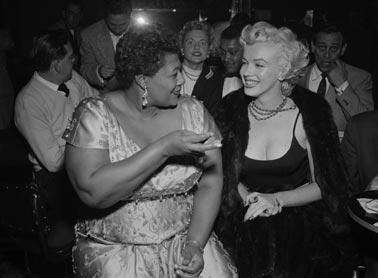
6234marilyn-meets-ella-photo Permanent Revolution’s London social secretary is well connected in East London’s art scene and he managed to snag some tickets to see Bonnie Greer’s new play Marilyn and Ella at the Theatre Royal in Stratford.  I was asked along to make up the numbers and had anticipated a demonstration of the appropriately revolutionary way to act in the theatre – try to unionise the ice cream sellers, boo when one of the characters talked about her manager, break down the barriers between actors and audience – but it didn’t happen. There’s a bit of Menshevism creeping in comrades.

A profound hatred of jazz makes me completely unqualified to comment on the subtleties of the performances by Nicola Hughes as Ella Fitzgerald and Wendy Morgan as Marilyn Monroe. Nicola in particular has an astoundingly good voice, the sort that makes you resentful of your own atonal croak.  It’s a variation on the morris dancing conundrum. A lot of work has gone into it and the performances are technically superb but it just doesn’t turn you on. It’s worth pointing out that the members of the audience who had come because that was their musical cup of tea reacted very enthusiastically to the show so don’t put any weight on my opinion.

In 1955 Monroe (pictured right) pulled all her strings to get Fitzgerald a five night residency in a Los Angeles nightclub, the Mocambo. Hardly worth writing a play about. That’s moot. This was where the stars hung out but admission was denied to African Americans either as guests or performers so Monroe was firmly identifying herself as a liberal anti-racist. This was at a time when Fitzgerald and her band were a top selling act but still finding themselves refused hotel rooms in southern state and harassed by cops. Greer presents Monroe as a woman who had become intensely restricted by the persona that had been created by and for her and was now trying to evolve herself into a serious actor and film maker. Her obsession with Fitzgerald’s work drove her to work behind the scenes to get the gig.associated press_marilyn_monroe_seven_yr_itch_L
The play tended to take a “History Channel” view of the era, the event and the process. The Monroe character mentions the Civil Rights Movement which was just beginning at the time and how stars like Burt Lancaster and Tony Curtis wouldn’t want to be associated with the colour bar. That’s how the audience is reminded of the historical context but Greer gives the impression, unintentionally I think, that it was Monroe’s celebrity endorsement, even at a time when her own career was waning, which opened the doors for Fitzgerald’s talent. That is a bit of a paradox. From her TV performances Greer would seem to share the loathing of celebrity culture that is demanded of readers of this site.

Writing a musical about an historical event is one way of bringing a new audience to a subject. In fact as part of Socialist Resistance’s new media strategy we are working on an ecosocialist grime opera. The trouble is that public historical experience seems to be becoming increasingly restricted to around a dozen topics – World War Two, the Romans, Ancient Egypt… and at the same time nothing is quite validated unless celebrities are involved. Welcome to Marilyn Monroe, an anti-racist avant la lettre.

5 responses to “Marilyn and Ella at the Theatre Royal, Stratford East: Celebrity anti-racism”

  1. I was meant to see this with a couple of work colleagues (very cultural!) but couldn’t make it in the end. I have read various reviews of this play so it’s interesting to read your take.

    Also, Marilyn was married to Arthur Miller and was supportive (problematic for her own movie career) when he was subjected to McCarthyism and witch hunts.

    But as an actress she was never taken seriously reduced instead to a “dumb blonde” again this represents the sexism and double-standards in Hollywood then and which still exist today.

    Like

  2. “A profound hatred of jazz” – is this similar to the Nazis hatred of jazz? That is, that jazz is a corrupt noise made by black people, a sign of the degeneracy of the US?

    Unlikely, Liam is on the left. Much more likely is that Liam hates jazz because he has never seriously listened to the revolution in music that some people call jazz.

    Problem is, this music is difficult. It demands you pay attention. It demands you question. It demands your involvement, whilst apparently hiding from you. A bit like Marxist theory, or anything serious.

    If you are to understand this music, you must begin by admitting that you don’t. Marxists like Sidney Finkelstein and Frank Kofsky offer you an impeccable entry. Val Wilmer may not be a Marxist, but her analysis is brilliant and readable.

    Actually I think jazz is easy to appreciate. The first time I listened to John Coltrane I thought that it was unlistenable. The second time I listened to John I wasn’t so certain. The third time I felt I had discovered a new universe of sound. Let the penny drop – these are musicians who have created a new art, perhaps the most representative of the 20th century.

    I refuse to believe that Liam has listened to Duke Ellington and not been moved by his compositions. Or that Billie Holliday’s triumphs of interpretation leave him cold.

    And what of the black nationalist avante-garde? Can he not hear how these musicians strain to translate the liberation struggles of Afro-Americans, creating art that is ground breaking and sublime?

    So you hate jazz? You hate the breath-taking panoramas of the Art Ensemble of Chicago and sun Ra?

    And perhaps Ella’s scatting gets on your nerves – surely not her problem.

    But what about the knife-edged politics in Abbey Lincoln’s voice in Max Roach’s “Freedom Now Suite”?
    Or what about the new music like Terence Blanchard’s magnificent composition “A Tale of God’s Will”, his response to Katrina?

    Let’ s admit it Liam, there’s nothing profound in your hatred, if it is hatred.

    I would venture it is more like profound ignorance – which, if you admit it, is possible to change. Don’t tell me you are afraid to change?

    Like

  3. StevieB – it just does not do it for me. It’s the plinkety plonk randonmess that I find unbearable. Dance is the same – just a bunch of unassociated movements.

    Let’s put it down to philistinism and The Ramones.

    Like

  4. I don’t think it’s necessary to like jazz in all in various forms any more than it’s necessary to like rock music to be considered culturally rounded.
    Personally, I like a bit of trad jazz and some of the more free form compositions but over all I wouldn’t stick it on my turntable that regularly.
    I don’t think it’s a requirement to educate ourselves about every cultural form unless it interests us in the first place.
    For example the current hegemony in contemporary art is for abstract work but that doesn’t make it progressive or elevate it in comparison to more figurative work. Yet the establishment champions abstract art despite the huge popularity of figurative painting. Compare the popularity of the ‘From Russia’ show at The Royal Academy with the rather disappointing attendance at some of the recent abstract shows at Tate Modern.
    We need to be wary of feeling compelled to like a form of culture because someone tells us it’s will elevate our consciousness or rescue us from philistinism. I think it’s important to trust our own judgement. But I do agree that having a broader outlook can open up cultural treasures we may have overlooked otherwise.

    Like

  5. Jazz? I can sympathise with Liam’s dislike of it too.
    But the argument that this has anything to do with race or politics is pretty absurd.
    I listened to and played blues from my early teens and saw all the great blues musicians like Muddy Waters, Sonny & Brownie, Junior Wells, Little Walter, Sonny Boy Williamson and their white imitators.
    Jazz pretty much developed out of the blue note.
    I like John Coltrane, Billy Holiday, Charlie Christian and I once saw Miles Davis on the same bill as Van Morrison.
    But on the whole, Jazz tends to be……. boring.

    Like

Leave a reply to prianikoff Cancel reply

Trending