CiderYoung people murdering each other now appears to be a feature of life in modern Britain. The standard policy response is criminalisation and more powers for the police. Ryan Ferguson sets the issue in a wider context and offers some pointers to a socialist response for an article in the June issue of Socialist Resistance. I’m not sure I agree with all of it.

It seems to me that there is something uniquely unpleasant about being young in big British cities. Neighbours with teenage boys live in a state of permanent anxiety whenever their son leaves the house. There is an almost incomprehensible loyalty to postcodes as a territorial marker and casual violence is a constant undercurrent. That does not seem to be the case – and I’m open to correction here- in other parts of Europe.
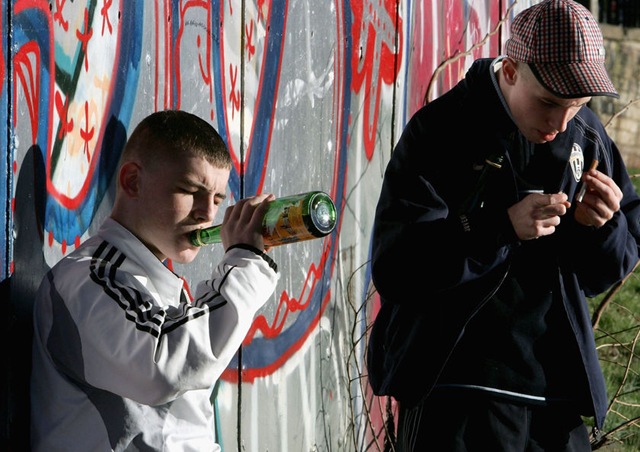
 

One way of approaching a discussion about young people, alienation and crime would be to configure it with a proposed sense of ‘realism’. Young people commit most crime, this can be seen from the criminal justice data, and the source of this criminality lays somewhere between the structures imposed on them by capitalism, the poverty and deprivation that has characterises the lives of many young people, the alienation this causes and the embedded dislike of the police and other authorities in local areas.

The necessary prescription is then to produce a series of policies that address both the atomisation and alienation that working class youth face and to provide the resources at a local level that would divert them away from criminal activity.

The problem with such an approach is that it accepts the construction of youth crime and alienation from the perspective of those who have power in society, reinforces the dialogue that views youth crime as a particular and specific sort or problem that requires specific and particular solutions that are, in the main, supplied by criminal justice institutions.

The notion of ‘crime’ for the most part operates as a construct that focuses on the harms in society that are perpetrated by the powerless. Looking at those regulated by the criminal justice system we see overwhelmingly the young, the poor, disproportionately black and minority ethnic and those with mental health and educational problems from working class backgrounds – for the most part that part of the working class that is easiest for the system identify and round up – particularly those with mental heath or behavioural problems.

Home can be the most dangerous place

Of those in prison 94% are there for non-violent offences – that is over 75,000 of the 80,000 at any one time. The 5,000 mainly young men in prison for violent offences represent less that half of one percent of the sustained inter-personal violence that takes place in society. Academic research shows that 99.5% of acts of serious violence in society do not trouble the criminal justice system – the overwhelming majority of which takes place in private, both physical and sexual, are committed by heterosexual men in the home against their partners and children and by the serious organisational violence experienced by those at work which, it is estimated, outstrips by some distance the public violence that is reported to and the focus of the criminal justice system.

So whilst we should be concerned about intoxicated young men inflicting pain on each other on Friday nights as part of a general aspect of a particular construction of masculinity and the behaviours of boys on the street that range from graffiti to assault for material gain with much else in between, these are problems which pale into insignificance next to the serious harms that take place in society. Even the violence associated with the illegal drugs trade whose customer interface and market security functions are staffed by young men and boys, fails to wreak one per cent of the social havoc, violence and harm of the legal drugs trade in alcohol and tobacco.

In this context anyone seeking to debate young people, crime and alienation should do so first by challenging the dominant constructions about who is harmed and why and by whom and exactly who is alienated and from what. For example, the elderly disproportionately express fears about what young people are doing on the streets and fears of being mugged. Yet they are the least likely to be the victims of such an event.

The numbers of elderly attacked and murdered by unknown youths are so small that it is not possible to do a serious analysis. However, the numbers subject to adult familial assault, inter-personal theft, and abuse both at home and in care homes should be an issue for concern. For the most part the intra-familial alienation and power inequality that produces such an outcome is not seriously considered.

“Social murder” of the elderly

Describing the conditions of the working class in Victorian England Engels described the early deaths due to the terrible social conditions experienced by the working class as ‘social murder’. The mugging and ‘social murder’ of the 20,000 elderly who die of cold annually because they cannot afford to heat their homes should be a subject for serious discussion; the fact that millions of elderly live in one room in the winter because they cannot afford to heat all of their homes creates mass alienation. Alongside this the projection of fears onto young people need to be challenged through a dialogue that expresses working class solidarity rather than any narrative that encourages inter-working class antipathy.

This, of course, is not to discount the harm that is caused by the criminalisation of drugs, the fear experienced when being threatened by a young male on the street, nor the devastation caused to a family or community by the recent spike in murders of young people on the streets of the poorer parts of London. The point is, though, that they are part of a much broader picture of serious social harm in a capitalist society riven by inequalities of gender, ethnicity and class of which young people are, in the main, are the victims of unequal power structures.

Placed in the context of this broader picture, the harms perpetrated by young people should be understood less as a response to a felt alienation from society and more as an apprenticeship in a society that is riddled with and held together by such harmful processes perpetrated by both individuals and organisations. Whatever youthful activity society finds uncomfortable and liberal opinion may put down to ‘alienation’ or ‘anomie’ is usually behaviour modelled on the activity of adult society.

For the most part young people are not alienated in the popular sense of the term but are simply beginning to participate in the multiplicity of harmful events that take place on a daily basis in the type of neo-liberal and patriarchal society in which we live. That they are the objectified subject of an inordinate amount of liberal policy hand wringing and authoritarian criminal justice intervention results from their lack of power rather than the harm they cause.

Any political break from this political impasse needs to start from two places. First, the left must articulate a policy that explains that working class young people are some of the least harmful actors in society – the facts are present to do this. Second it must develop a local policy that challenges the idea that criminal justice is the first port of call to deal with local area problems. The anxieties that people feel about local public safety can be challenged by acts of working class solidarity rather than waiting for the flashing blue light that inevitably arrives too late. It is not police neighbourhood watch committees that are required but the organisation of class solidarity of the street, but for such an approach to become a national phenomenon requires a mass left wing party to organise it.

9 responses to “Young people – where is the danger?”

  1. The figures show that the murder rate has gone up over the past 35 years, but the precise details are very important.

    “Prime Suspect: Murder in Britain
    by Danny Dorling

    Contains a very good analysis of the statistics between 1981-2000
    The main finding being that the murder rate has nearly doubled in the past 35 years.
    However this has been largely a result of the big increase in amongst young and poor males.

    “For all males aged between five and 59, murder
    rates have increased significantly. At the extreme they have
    doubled for men aged 20 to 24 over the course of these two decades.
    The increase in the murder rate of men, and particularly young
    men is enough to more than outweigh the decreases that most
    groups have experienced over time.”

    “The increase in murder was concentrated almost exclusively in the poorer parts of Britain and most strongly in its poorest tenth of wards. By the 1990s the excess deaths due to murder in the poorest half of Britain amounted to around 200 per year, that is
    murders that would not occur if these places experienced average rates. Just over half of that number related to excess murders amongst the poorest tenth of the population. The rise in murder
    in Britain has been concentrated almost exclusively in men of working age living in the poorest parts of the country.”

    Click to access 17_10_05_murder_report.pdf

    In a seperate study Professor Danny Dorling, of Sheffield University found people in the poorest areas were six times more likely to be murdered than those in the richest.

    “This is because poverty is the “key component to what makes one place more dangerous to live in as compared to another”, he concluded.

    “The poorer the place you live in the more likely you are to be murdered.”

    While the top 10% richest Britons are now 4% less likely to be murdered than in the early 1980s, the report said the poorest 10% are 39% more likely to end up as murder victims.”

    http://news.bbc.co.uk/1/hi/uk/4348238.stm

    Like

  2. “Prime Suspect: Murder in Britain
    by Danny Dorling

    Contains a very good analysis of the statistics between 1981-2000
    The main finding being that the murder rate has nearly doubled in the past 35 years.
    However this has been largely a result of the big increase in amongst young and poor males.

    “For all males aged between five and 59, murder
    rates have increased significantly. At the extreme they have
    doubled for men aged 20 to 24 over the course of these two decades.
    The increase in the murder rate of men, and particularly young
    men is enough to more than outweigh the decreases that most
    groups have experienced over time.”

    “The increase in murder was concentrated almost exclusively in the poorer parts of Britain and most strongly in its poorest tenth of wards. By the 1990s the excess deaths due to murder in the poorest half of Britain amounted to around 200 per year, that is
    murders that would not occur if these places experienced average rates. Just over half of that number related to excess murders amongst the poorest tenth of the population. The rise in murder
    in Britain has been concentrated almost exclusively in men of working age living in the poorest parts of the country.”

    In a seperate study Professor Danny Dorling, of Sheffield University found people in the poorest areas were six times more likely to be murdered than those in the richest.

    “This is because poverty is the “key component to what makes one place more dangerous to live in as compared to another”, he concluded.

    “The poorer the place you live in the more likely you are to be murdered.”

    While the top 10% richest Britons are now 4% less likely to be murdered than in the early 1980s, the report said the poorest 10% are 39% more likely to end up as murder victims.”

    Like

  3. Britain is facing a crisis of child-on-child violence and the prevailing attitude appears to be one of incoherent fire-fighting. Hard-hitting viral campaigns, metal detectors in schools, and tougher punishments for carrying weapons, are all good strategies which will hopefully have an immediate impact on violent youth behaviour, but they are simply prescriptive, stop-gap solutions.

    Whilst we welcome these new measures to protect young people, we are acutely aware that they do not address the root causes of conflict and violent behaviours. Young people are using violence, fear and exclusion to intimidate and threaten others. It is bullying in its most extreme form. When bullying goes unchecked in our schools and communities, the breeding ground for gang culture prospers.

    There have been 28 teenagers stabbed to death already this year. We also know that this year at least 20 young people will take their own lives because they are being bullied. Whether killed by another youth, or dying at their own hands, too many young people are being bullied to death.

    What we need is a comprehensive, joined up, coherent strategy to educate our young people in conflict resolution, anti-violence and anti-bullying behaviour. Intervene early against bullying and we can affect the growing culture of knife crime and gang related behaviour. We know that poor inter-faith and inter-community relations, truancy, and violent behaviour are all linked to bullying. As a result, fully-inclusive anti-conflict and bullying prevention work is essential if we are to significantly address this dystopia in which our sons and daughters, brothers and sisters, friends and neighbours, are being murdered and terrorised by someone else’s children.

    Beatbullying realises that this is not a problem that can be solved in months, so where is the comprehensive five-year strategy from any of our political parties? The problem bridges all areas of society, so we need a cross-departmental response from Government. At the moment, despite the promises and the prescriptive acts, the lack of a long-term, joined up response based on education and prevention, is beyond belief. We need leadership and a strong Government must stand up for our youth now.

    Education is the key, but the responsibility cannot lie solely at the feet of the teacher. Beatbullying and a coalition of expert organisations, can deliver proven conflict resolution, anti-violence and anti-bullying programmes into every school, intervening early to prevent the escalation into the youth crimes and murders we are witnessing on our streets every week. Beatbullying has calculated that it will cost £45million over five years, to deliver this work into schools and youth groups across the UK, reaching every child in this country.

    The viral campaign launched yesterday will cost £3million, in the hope that it will shock youngsters into stop carrying knives. Who knows how many it will reach, or how effective it will be. It’s time to look beyond trying to patch up a problem with disjointed, prescriptive acts, and deliver a preventative solution to benefit every young person, and society as a whole, over the next five years.

    Like

  4. While I don’t discount the real fear among adults and young people about knifings I think this is also a product of sensationalism from New Labour and the media that’s meant to further demonise young people, especially black and asian teenagers.

    Naomi Klein’s new book, “The Shock Doctrine”, looks like interesting reading and may shed some light on how to address the media hysteria on this issue.

    Like

  5. There’s a short film about, “The Shock Doctrine”, here:

    http://www.naomiklein.org/shock-doctrine/short-film

    Like

  6. And a review here

    ttp://www.permanentrevolution.net/?view=entry&entry=1960

    Like

  7. Well of course 28 deaths by stabbing is shocking enough whether or not the number is rising.

    I agree though with Ray that moral panics around this issue are not useful and agree with Tony.

    The solution to some extent has to be in young people’s self-organisation. We need activists in the community to propose solutions and demand resources for them rather than panic policies.

    Like

  8. sorry meant to say agree with Tony that this is a serious issue- not on points like needing strong government- I think by contrast we need string organisations of young people actiing for themselves and, if necessary, against the government.

    Like

Leave a reply to Tony Holmes – Beatbullying Cancel reply

Trending