
The recent industrial action (to say nothing of what happened in Respect) got me thinking about the question of bureaucracy. This is a piece for issue 3 of Socialist Resistance. As always I’m open to positive suggestions to improve it.
 This year has been the first time that many thousands of workers from young local government staff, to tanker drivers and teachers have had their first ever opportunity to go on strike. And they always say two things. The first is “why didn’t we do this earlier?” The second is “wouldn’t it be better if all the unions did this at the same time?”
On the first point they are right to ask the question. Most trade union leaderships make their members have indicative ballots before moving to a vote on taking action as a way of delaying it or trying to prove that there is no stomach for it. When action does come it seems that the leaders don’t want to make it effective. They restrict it to a day or two and seem to wilfully prevent it from developing any momentum.
On the second point the answer to the question is “yes”. Combined union action is always more effective. UNISON and the National Union of Teachers could have broken the government’s will to cut their members’ pay by sustained joint action. Other forms of joint action include refusing to cross another union’s picket line are almost always the focus of an explicit taboo from every union’s headquarters. A rare honourable recent exception to this is Jeremy Dear’s advice to members of the National Union of Journalists reminding them of this union tradition and recommending that they observe it.
Is there any way to explain this apparent unwillingness to fight and win that most trade union and leaders of parties that claim to represent working people display? This is a problem that Marxists have tried to understand since the nineteenth century and have developed a theory of working class bureaucracy to clarify it.
National unions do not spend the majority of their time organising strikes. They fill it with a whole range of other activities – some of it only tenuously connected to their core function of defending members’ jobs, salaries and working conditions. They offer insurance, mortgages and run large administrative offices. Of course any organisation which has a membership of tens or hundreds of thousands requires a professional staff to collect money and provide specialised support services. A huge task like that can’t just be done by voluntary workers in their spare time. Parallel with the administration every union has a group of elected and appointed officials who mediate between workers, employers and government. These are the general secretaries, their deputies, treasurers, chairs, regional officials and many more besides. Together they make up the bureaucracy in a party or union.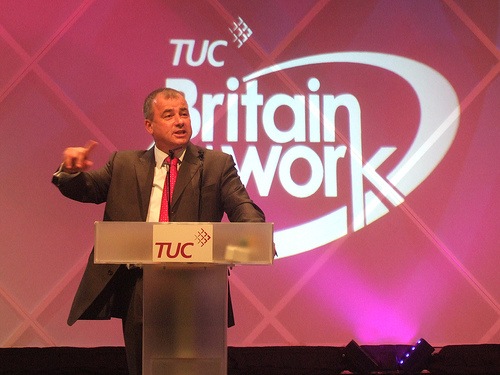
Demagogy – an indispensable skill
This separation between the workers they represent and the bureaucracy mirrors the division of labour in capitalist society. Workers don’t have the free time to dedicate themselves to fulltime union or political activity and often have to rely on union or party staff to keep them up to date with developments. These officials have access to a lot more information than the average worker about wage negotiations or the political situation and with this knowledge comes power and an aura of authority. The Italian socialist Antonio Gramsci remarked that many of the individuals who rise to the tops of unions often do so because they combine administrative competence with the useful skill of demagogy. They can claim to have the full picture and understand the real complications and will do so in a way that often makes it difficult for rank and file workers or party members to challenge. Gradually the people who are supposed to be the servants of the members have a vast amount of autonomy inside the organisation. They know how to use the rule book to get what they want and will not think twice about using it to keep the members in line. The members’ main duty is to passively obey the officials and obediently strike, not strike or suffer passively as instructed. The rhetoric about conferences being the sovereign decision making body of an organisation with a strong bureaucracy is transparently false to anyone who has ever sat through a trade union or Labour Party conference. Deals are stitched up behind the scenes and when conference makes a “wrong” decision it’s just ignored until the following year.
Another consequence of the division of labour in capitalist society is that individuals end up seeing the thing that they are doing as an end in itself. The union treasurer sees her job as solely that of keeping the union on a sound financial footing. The prospect of members taking industrial action which could result in a court stealing the union’s money is the last thing someone in that position wants. This caution is understandable. The union’s offices and bank accounts have been won as a result of previous successfully struggles. However these gains are both partial and reversible. The working class is still exploited in its workplaces and, as the current round of pay cuts demonstrates, the capitalist state’s first instinct is to make the working class pay for capital’s troubles. For the bureaucrat though the organisation is synonymous with the working class. What is good for the union or the party is good for working people and for most bureaucrats there is no clear line between what benefits them as a group and what benefits the organisation.
Unofficial action – the bureaucrat’s nightmare
Members’ passivity is the customary justification that bureaucrats offer when they are challenged about the dominating positions that they hold. But the quickest way to get the bureaucrat out of the office is when members do start acting for themselves. An unofficial strike is a bureaucratic nightmare. It gives rank and file members a sense of their own power and at the same time denies the paid official her or his vital function of mediating between workers and management. Recent industrial history in Britain is punctuated by industrial action cut short as soon as the union officials arrive and they are not reluctant to use disciplinary sanctions against members who are unwilling to defer to their superior wisdom. Demoralisation, scepticism and lack of workers’ confidence are a bureaucrat’s best friend. A decline in militancy allows them to tighten their grip on the organisation which sets in motion a cycle of enhanced bureaucratic control. Effectively the bureaucracy is policing its members on behalf of the courts and the employers.
Even the earliest socialist organisations were alive to the risk of bureaucratisation. Marx and Engels were able to learn some valuable lessons from the experience of the Paris Commune which signpost steps a workers’ state or organisation can take to avoid the problem even in a society where the working class hold power. In The Civil War in France Marx
proposed that all proceedings of government be completely transparent. This can apply with equal force to any working class organisation. Decisions should not be made in secret and contending points of view should be freely aired. To prevent officials becoming autonomous Marx argued that they should be subject to the right of recall at any time by the people who elected them. This proposal is always vigorously opposed by union officials who both enjoy the sense of prestige that goes with their position as well as the more intellectually rewarding work that they do.
As if the prestige and the mental stimulation were not reward enough there is usually a significant difference in salary between trade union officials and their members – and that’s before the expense accounts are included. In social democratic parties MPs do not give their salaries to the party and that too creates a gulf between them and other, less affluent party members. The revolutionary Marxist solution to this is that the officials of workers’ organisations should receive wages equivalent to those of a skilled worker. No imagination is needed to see how enforcing this rule on trade union officials would make them a lot less willing to accept below inflation pay deals.
A fact of life
In a capitalist society the bureaucracy in working class organisations is an inevitable fact of life. The problem is a real one is based on social conditions and material interests as much as the bad intentions of some individual union leaders or officials – real as these often are.
The trade union bureaucracy is a strongly conservative tendency and the struggle against it is essentially a fight around democracy. Through this struggle it is possible to create some protection against the bureaucracy’s influence. The struggle has to be based on an analysis which takes into account the needs of that union’s members and the working class as a whole. As several recent divisive pension deals have shown trade union leaders are willing to split their members by negotiating settlements which privilege one group of workers over another.
Providing an alternative analysis is a prerequisite for building class struggle currents inside the trade unions which are willing to challenge the bureaucracy’s arguments and strategic decisions. Networks of activists who are self-confident and are willing to provide a fighting leadership to protect members’ standards of living in the face of rising fuel and food prices and New Labour’s pay cuts are the nucleus of a real opposition to neo-liberalism




 Liam redux
Leave a reply to charliemarks Cancel reply