
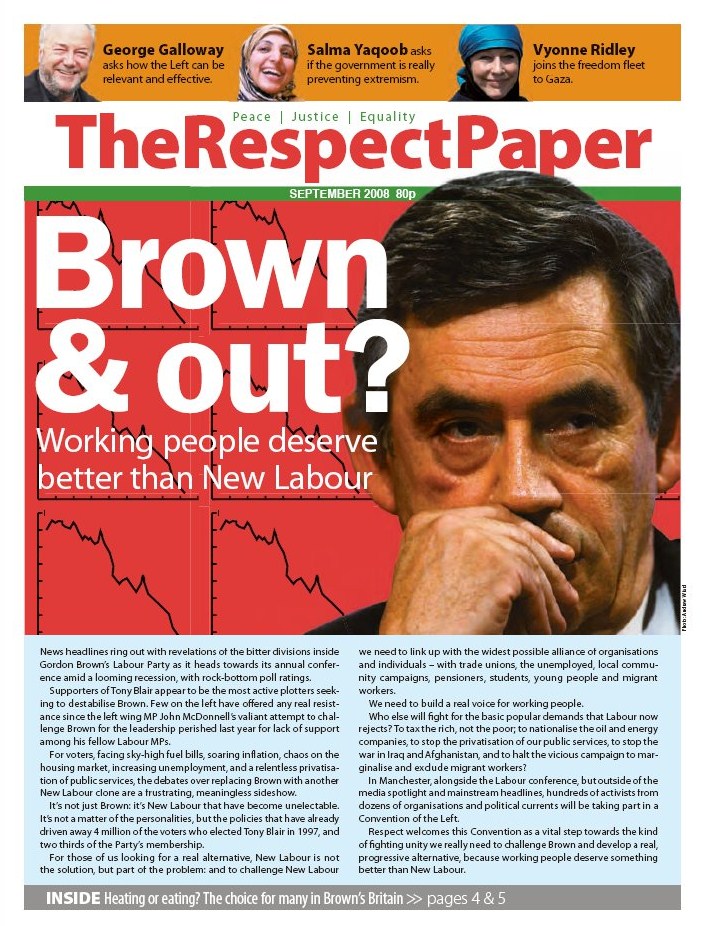
 The new issue of Respect’s paper has has come out.
You can download the pdf here.
I will donate the price of a pint of London Pride to Fuller’s Brewery on behalf of everyone who points out the egregious spelling mistake inside.
The new issue of Respect’s paper has has come out. You can download the pdf here. Respect paper September 08 I will donate the price of a pint of London Pride to Fuller’s Brewery on behalf of everyone who points out the egregious spelling mistake inside.
The new issue of Respect’s paper has has come out.
You can download the pdf here.
I will donate the price of a pint of London Pride to Fuller’s Brewery on behalf of everyone who points out the egregious spelling mistake inside.


Dyslexic so can’t spot the spelling error, but I can see that this paper looks good, a real step up from the last one – well done everyone involved and see you at the convention of the left.
P.S. noticed the Karen Ressiman letter in the paper, a cause def’ worth supporting, and thought I’d let people know that I’ve just herd that see has been elected to Unison Exec’. Maybe she can give them all a good beat down for removing her legal support!
LikeLike

Joseph,
That’s excellent news about Karen’s election.
The paper is getting there, despite the odd seige!
There’re a number of good articles – Azmal Hussain’s calling for the unionisation of the restaurant industry on Brick Lane and beyond was an especially nice piece.
LikeLike

err there is a spelling mistake on the front cover as well.
Vyonne Ridley?
Buy me Jack Daniels? 🙂
LikeLike
oops, buy me a Jack Daniels thats should be.
LikeLike

There’s also about 20 errors in Vyonne’s article, granted these are lies rather than typos but errors nonetheless
LikeLike

Surely there is a problem inasmuch as Nick Wrack says that the workers need their own party, but neither George Galloway, Salma Yaqoob or Yvonne Ridley – the three people featured on the banner of the paper – agree?
LikeLike

Why is that a problem, bill j?
LikeLike
Please try and have some good faith Martin, Vyonne clearly believes what she says so is not ‘telling lies’. If you dispute the accuracy of her statements feel free to write a letter to the paper with your specific factual disagreements.
Bill J, sorry but that’s in accurate. I don’t know about Yvonne (her sometimes eccentric thinking tends to escape me) but Galloway and Salma both argue that we need a party for the working class – they may differ from you however on a) the composition of the working class and b) what constitutes working class concerns. Its fair enough to argue over that but to try an hive off notions of the working class and socialism for your hard left perspective is dishonest.
LikeLike
To clarify:
1) by “in accurate” I meant inaccurate.
2) I think that Yvonne’s thought is eccentric when it comes to the notion of socialism, on what she says in her article in the current Respect paper it all seems pretty much on correct to me.
LikeLike
Well I concede I do have a hard left perspective, that doesn’t impinge on the facts however, after all Salma Yaqoob did write;
“There are other businesspeople who both live and work in our communities, and who retain a close connection with the community they come from, and who have the same interest as their brothers and sisters in confronting racism, opposing war, and seeing good representation for the disadvantaged areas they live in.”
http://www.socialistrenewal.org.uk/articles/Y/Yacoob/020108.htm
One of her strengths is her clarity. Salma wants a party that unites the disadvantaged poor with business people who live and work in our communities.
That is not a working class party.
LikeLike
You quote that passage out of context – Salma is discussing Respects support rather then its active or ideal composition. It is worth noting that small traders may be worse off then skilled workers – they are a layer that historically have been seen as able to go either way (towards fascism or socialism) but to suppose that acknowledging that some will support a workers party means that one is advocating a ‘cross-class alliance’ is daft.
To put it in context also from that article;
“Our support does not come primarily from the small, or not so small businessmen, seeking to advance their interests. It comes overwhelmingly from those who experience poverty and disadvantage.”
“But, in tandem with this poverty and disadvantage, is racism. Irrespective of their class background, Muslims are constantly aware of the discrimination and prejudice they face. It is no less real for the self-employed taxi driver, or the owner of a small grocers shop. There is anger throughout the community at this racism, compounded by anger at the blatant double standards of Western foreign policy.”
LikeLike
I provided the link so that people could read the rest of the article if they wanted.
I simply wanted to establish that Salma Yaqoob does not call for or argue for a working class party, she wants a party “irrespective of class background” as she explains in the quote you provide.
As I said before she at least has the admirable quality of clarity.
LikeLike

When I read your comment, Joseph, I thought fair points.
A workers’ party would in fact appeal to the small business people- plumbers, shopkeepers, and taxi drivers etc- to identify with the working class rather than big business Bill’s quote I thought may actually misrepresent matters.
Until that is, I read Salma’s piece in total. Bill is right on her clarity. She’s quite a good writer in that regard.
If you read the piece as a whole while she is clear and principled in her opposition to racism and imperialist war.
However, she is also quite clear that it is an alliance between different sections of the community- not an appeal from a workers’ party based on the organised working class.
“What we have achieved is the creation of an alliance which emphasizes universal themes of justice and equality. Within this there will be all sorts of ideological (and theological) views. But they are united by the defence of the rights and freedoms of all. It is an alliance that has advanced support for progressive social causes.”
Now may be that’s fair enough. Salma doesn’t claim to be a socialist let alone a revolutionary as far as I am aware.
However, socialists argue that society under capitalism divides into contending classes- the working class and the ruling class. For us we should be quite clear about the need for the working class to run society, the expropriation of big business.
Take the gas and electricity hikes: we support progressive reforms like windfall taxes and price caps but lament that they only scratch the surface of the problem. We need nationalisation under workers’ control not only of utilities but all goods and services. This cannot just be introduced by above by parliament or decree but needs active class struggle and working class direct action and organised defence of our gains.
Working with Salma in Stop the War is good- we need to appeal to activists such as her in united fronts and win them to our politics if possible and have a fraternal discussion amidst joint action where we don’t agree.
Excellent- exactly the sort of thing we need to do. I am not against in principle working in electoral alliances with reformists- far from it. If such an alliance represented a move in working class communities that was leftward moving and empowering people to come into struggle, if it had a real and active base amongst the organised working class- it would be essential.
It would also be essential for socialists to argue for socialist and working class politics in a friendly and listening way- not assuming we have all the answers but also not patronising our fellow activists by pretending to be something we are not. Still less trying to control the organisation through machinations and temporary and unprincipled alliances.
I think Respect at its start would have had the potential to be a campaign with a real base. Or more precisely the Socialist Alliance was – it could have drawn in the hundreds of thousands of antiwar activists from different working class communities including many from a Muslim background. But it didn’t and it no longer- to me- has that potential.
This is no slur on the many decent and hard working activists within it.
The current flux on the left with the Convention of the Left, with upcoming strikes, the deep unpopularity of Labour and Brown and a layer of union activists perhaps being winnable to a left of Labour alternative and certainly an organised fight back means that there is still potential.
And if a real formation some months down the line comes out of the left forums thrown up by the Convention and struggles come to fruition I am sure Respect members will enthusiastically participate.
And as long as they are genuine- not simply trying to control it, trying to corral any movement into an adjunct of Respect, if they are open-minded and willing to discuss ideas within an open democratic working class movement then their participation will be very welcome.
LikeLike
A very positive review for the Convention of the Left in The Guardian-
http://www.guardian.co.uk/politics/blog/2008/sep/18/labourconference.labourleadership
LikeLike

Well i think this issue of the paper is again highly problematic.
Good to see a paper that can give space to Abjol Miah, Salma Yaqoob, George and Yvonne Ridley.
But there is far too much editorial weight given to one particular left current.
For example, three seperate articles by Alan Thronett, JOhn Lister and danny McInosh all say the same thing about the union link with the labour party.
Ironically Thornett keeps saying that he would like the CPB to be in Respect, but there is no reflection on the paper that some of us in Respect support the CPB’s position on union funding to the labour Party.
I get the impression that the paper is a factional tool of the ISg in Respect – that privilages their perspective, without even recognising that there are other memebrs who disagree with it.
LikeLike

You should write an article, Andy. I doubt very much whether they would refuse to print it.
I haven’t read the Thornett and Lister pieces yet (I have difficulty with pdfs on this PC!) but is there anything in them which doesn’t correspond with the general majority position in Respect?
LikeLike

Andy’s reading of the paper is rather curious, apparently willing himself to find something to argue with. The piece from Alan Thornett, for example, to which he takes exception, makes no reference to the Labour link, and talks only about the debate at the TUC over industrial action.
My article, explicitly billed as a “Talking point” and introduced as a “personal view” was tabled among a number for debate at the previous National Council meeting, and for possible inclusion as NC motions to the Respect Conference on October 25.
In the event, there was no time at that meeting to debate motions, but several NC members from varying political views declared the view that there was nothing hugely controversial about any of them. It seemed to make good sense to get the debate going via our newspaper at the Convention of the Left in Manchester, rather than wait until after that unique gathering, and Labour conference, were over and try to crank up a discussion with a narrower audience.
Originally, in the context of planning a much larger (24-page) paper my article, and supporting material from Danny McIntosh on the history and scale of the union link, and on the Warwick agreement, were planned to take up 2 pages: in the event one of Danny’s articles had to be held over to make space. (incidentally the switch to 16 pages was to ensure we could afford a special full-colour issue, targeted at the Convention of the Left, where the question of the Labour Link is an especially appropriate one for debate).
I was very much hoping that the opening up of this discussion would attract a series of responses and replies, obviously including replies from those, like Andy, who hold different views. But to start off any debate somebody needs to put a point of view and argue for it. Nobody defending the Labour link as it is has bothered to spell out their views so far, perhaps feeling happier to let sleeping bureaucrats lie, so the debate had to begin from the angle of seeking a change.
I don’t see how this could realistically be described as favouring one political current: the article is not ISG policy, and has not even been discussed by the ISG: it has not, as far as I know, so far been adopted by any organisation, although I freely admit that my inspiration for writing it and proposing the line to the National Council came not from the ISG or from any current of the left, but from a new debate opening up in a UNISON branch for which I edit a newspaper, where a retired member, out of the blue, fired up a debate on the Labour Link.
This is the sixth issue of The Respect Paper, and there is no reasonable way in which the editorial team can be argued to be biased in favour of one political current. We have not yet succeeded in getting as many as we would wish to write for the paper, but we have never refused material proffered by supporters of Respect, and have gone out of our way to widen the base of contributors, and the range of issues and localities covered: this is one reason why I for one remain unconvinced about keeping the paper at just 16 pages.
This particular paper has half a page each of Galloway, Salma, and Abjol, a spread of international coverage from Yvonne, a page from economic expert Bob Oxley, 2 one-page articles from Nick Wrack on fuel prices and on the Convention of the Left plus two thirds of a page on our Conference, and the remainder is divided up on a variety of issues and contributors . In that context a page from me introducing a new debate, backed up by half a page of largely factual information from Danny does not seem too unreasonable.
So what we hope is that Andy, anyone who agrees with him or the CPB or who has other views on how to tackle the problem of the unions’ political link, will take a few minutes to write up their views and let us have a debate article or at very least a letter on for the next issue, and that the debate can open up in the months ahead. The question won’t go away, and we have to be part of the solution if we are not part of the problem.
Surely it’s better to have a debate about a real issue of politics in the workers’ movement that to whinge about who starts it? Let’s see your views in print, Andy as part of the debate.
And let’s have a little bit of generosity of spirit towards the handful of us on the editorial team, who work very hard to try to make the paper as broad and representative of Respect as we can. We want as many as possible on board.
If you are not in it this time, Andy, it’s because you did not submit anything to it: let’s put that right, and let’s see all those who support Respect helping us to make the paper a flagship for the organisation, and a focal point of genuine and serious debate, helping us attract, inform, educate and recruit new members, build new branches, and give a lead to a floundering labour movement.
LikeLike
Thanks to the postman, i now have a ‘real’ copy of the Respect paper and have read the pieces Andy questions.
Firstly, the Lister piece is the main article here and whislt it is billed as a personal view, there is nothing in it which would conflict with the position of the old Socialist Alliance (as set out in Matt Wrack’s excellent pamphlet) or, perhaps more pertinently but less fully-formed, in the Respect manifesto- below-
“New Labour’s open embracing of the employers’ agenda has created a deepening crisis of working-class representation – which Respect is seeking to address.
A debate has opened up in the unions over their relationship with New Labour. This has focussed on whether the unions should continue to bankroll New Labour, through their political funds when New Labour organises against them, and attacks wages and working conditions.
The Rail Maritime and Transport union (RMT) – the union that took the initiative to form the Labour Party 100 years ago – has been expelled from it for supporting Scottish Socialist Party candidates. The Fire Brigades Union (FBU) conference voted to disaffiliate from New Labour in protest at the government’s disgusting behaviour during the firefighters’ dispute.
We support these unions in their rejection of New Labour. We support the democratisation of union political funds to allow backing for left of Labour candidates. Respect stands with the unions and their members against current attacks on jobs, conditions, pensions and employment rights.”
I would say that on this issue at least, the ISG articulates a pretty mainstream view within Respect and one shared with many others on the left.
LikeLike

I have to say that there seems to be a serious issue about timing in this dispute about the Labour Link.
When the Socialist Alliance was first formed the idea of opening up the political funds to other parties made more sense. Blair and New Labour looked unchallengable.
All that has changed.
New Labour is now on the rocks and with it, Brown’s credibility as leader. It doesn’t follow that parties to Labour’s left will have mass appeal as a consequence.
The fact is, that no left of Labour parties in Britain have made a real breakthrough. One reason being that there’s never been a mass Communist Party in this country. So the situation is quite different to Italy, or Germany.
The SLP, SSP and Socialist Alliance all made limited gains, but not major breakthroughs. Respect is not in a qualitatively different league.
The RMT’s current situation now seems rather futile, given the electoral performance of the SSP and it doesn’t bode well for similar moves in the future.
But the Unions ARE in a very good position to be spearheading a campaign against Brown.
Not by backing opportunist challengers, but by promoting a clear programmatic alternative to the New Labour leadership.
People who argue for independent parties, while simultaneously covering Brown’s back and arguing for the “long haul” are adopting a truely bizarre position.
Deep down, they seem to believe that Brown and New Labour offer the best chance of beating the Tories in two years.
They also show very little confidence in the chances of their own “independent parties” gaining support in the near or mid-term.
Independence of Labour has never been a guarantee of political success. The ILP experience in the 1930’s showed that sectarianism towards the mass of Labour supporters rendered a large breakaway party useless.
It’s highly unlikely that the economic and political situation will be “business as usual” over the next two years. The Financial turmoil is a political turning point, after which, all sorts of unexpected qualitative changes will take place. Already we’ve seen the bizzare paradox of Bush’s government, following Brown’s, engaged in a massive nationalisation project.
This isn’t just a question of political zig-zags governed by the boom-slump cycle. The massive privatisations of the 80’s represented a qualitative change in the balance of class forces, the defeat of the unions in Britain and the collapse of Stalinism internationally.
That this situation has been called into question is of major significance politically, whatever the dubious motives of the Bush and Brown administrations. Even if they intend to re-privatise the toxic assets at the first possible opportunity, the situation is clearly not under control and highly volatile.
Clearly it will continue to swing wildly for some time, leading to lurches to the left and right and the possibility of new Military conflicts. Most significantly over NATO’s attempted expansion into the Ukraine and the attempts to overthrow the leftist governments Bolivia and Venezuela.
Lack of political clarity will destroy organisations that get these questions wrong. Those which adopt correct positions and clearly explain them will be in a position to win over large numbers of people.
People who are arguing for “the long haul” approach are entirely missing the opportunities opening up before the left. Breaking from left-sectarianism and adopting principled politics will be the key to taking advantage of them.
LikeLike

Martin – this one’s for you http://fromgaza.blogspot.com/
LikeLike
Thanks, it’s an interesting enough blog, particularly compared to the anti-esmitc rantings of Respect’s senior figures- although obviously it’s very limited in view.
Liam presumably as some sort of self-described trot you’d have some pretty severe criticisms of the anti-class nature of much of the anti-zionist movement including many of the activists such as Dr Mona, you seem to keep these to yourself though -as do the ISG as a whole- what’s going on there?
LikeLike
Have only just caught up with this after a few hectic days at work and home. Not sure there is anyting ‘depressing’ about people on the left agreeing to work in joint campaigns, including the one opening up over fule poverty and the windfall tax, demands for nationalisation under workers’ control, price caps etc., even if we at times disagree on standing in elections or even who to vote for (and who knows perhaps we can begin to agree on this in the future as well ut it’s not the main issue necessarily)
Jason
LikeLike

Martin, the Palestinian people are overwhelming proletarian. They are the core of the anti-Zionist movement worldwide. However, the nature of national oppression is that it crosses class lines. Since the self-determination of the Palestinian people as a whole has been denied by the Zionist state, it’s inevitable that te anti-Zionist movement crosses class lines. The ‘blame’ for that rests with the Zionist state and those who, like the AWL, support the right of the Zionist state to both exist and to “defend” its borders and its nature as an exclusionary and racist state.
Carlos.
LikeLike



 Liam redux
Leave a reply to Jason Cancel reply