
This piece has been sent to me by Will Brown from Bristol.
Will says “I’ve been running a couple of groups discussing the world economy in Bristol over the last year and have been transfixed by the events of the last 10 days. I’ve written something on the context, prospects and implications of Bernanke’s rescue attempt. My brother says its interesting and comprehensible – and he’s a professional dancer!”

Capitalism is unstable
Capitalism has been an unstable economic system since its appearance in Western Europe in the 17th century. From the Dutch tulip mania and the South Sea bubble, through repeated bank crashes and recessions of the 19th century to the great depression of the 1930’s. Three great crises have shaped the history of the second half of the 20th century, 1974/75, 1981/82 and 1990/91. In capitalist democracies political parties blame each other for the failures of the system which obscures the reality that the governments don’t run most of the economy and that the capitalist system is inherently unstable..
 Typical crisis
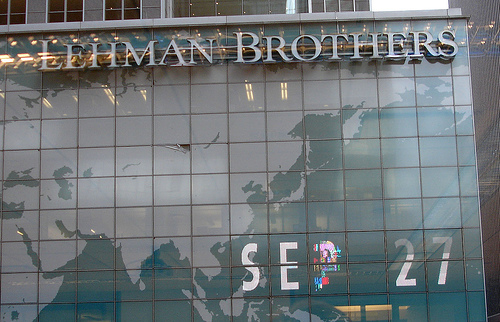
All of these crises have involved a combination of the following: a collapse in company profits, a savage contraction of credit, financial crisis and bank failures, waves of bankruptcy, collapses of housing markets and other asset classes, mass unemployment, cuts in public spending, currency crises. Every crisis also heightens political tensions within countries and between countries.
Who and what to blame
Various explanations have been offered for this. Some observers regard each crisis as an avoidable consequence of policy mistakes by governments and central banks. This doesn’t account for the way crisis keeps returning. Those who believe crisis is an endemic part of capitalism point to the way capitalism is based upon ferocious competition, greed and fear. This drives individual actors to ruthlessly pursue their own interests with no regard to the health of the wider system. Other familiar scapegoats include greedy workers, over powerful trade unions, communists, foreigners, Jews, Arabs and immigrants.
3 Reasons why I think the current crisis will be deep and profound
1) Peak oil and climate change: for the first time in human history the scale of economic production is threatening the planet. Key raw materials, notably oil, are beginning to run out. Capitalism has always been associated with continual growth in output (between crisis). Such growth is no longer sustainable. Is ‘sustainable capitalism’ possible?
2) The end the USA hegemony: The rise of China and India and the economic integration of the EU means that the USA no longer dominates the world economy as it has since 1945. This may mean problems. Many commentators are comparing the current situation to the great depression of the 1930’s. The UK had lost its dominant control of the world economy it had before 1914, the USA had not won the mastery it had after 1945. Without a dominant global power the capitalist system collapsed in grudging tension between rival countries: only the 2nd World War resolved this impasse. World War is no longer a realistic option
3) For the first time in world history virtually every human is integrated into one universal economic system – global capitalism. Every country will be profoundly affected by this crisis.
Particular features of this crisis.
A massive US housing bubble:
US house prices rose very high with very free and easy lending. The agents selling these mortgages to house buyers paid no penalty if the borrowers couldn’t repay – the new mortgages were bundled in their thousands and sold on to banks and funds. So when the market crashed nobody knew which banks were sitting on massive loss.
Risk Aversion:
Because these massive losses were invisible, all banks and funds stopped lending to each other: there has been a steady collapse of trust and massive risk aversion. Investors have withdrawn money from all but the safest investments – cash, gold, Swiss Francs and US Treasury bonds.
Hedge Funds and shorting:
Since the bank deregulation in the 60’s over ten thousand hedge funds have appeared. These are secretive and unregulated funds that invest money for rich people in return for a fee. They frequently take large bets on financial developments and often bet on asset prices falling by shorting or selling stock they don’t own.
BRIC growth:
Four Big Recently Industrialised Countries : Brazil, India, China and Russia. have seen spectacular growth. These four make up nearly half the world’s population, own and also use vast natural resources.
Explosion of Commodity prices: an interesting and controversial aspect of the crisis has been the explosion of commodity prices – basic foodstuffs (especially grains), oil, and metals such as iron ore and copper. There has been widespread belief that in part these rises ( many of these prices doubled in 12 months) resulted from speculation by hedge funds desperate to make money they were unable to make in falling stock markets. These prices have now fallen fast and hard as the crisis has made world recession and therefore a collapse in demand more and more likely.
What’s happened in the last 10 days
The two part publicly owned mortgage banks Fanny Mae and Freddy Mac see their share price crumble. The Federal Reserve feels obliged to nationalise them. Lehman Bros share price collapses. The Federal Reserve allows Lehman to go bankrupt. The giant insurance company AIG sees its share price begin to collapse. The Fed feels unable to allow it to fail and nationalises it. Merryl Lynch, the largest US stock broker and a big fund manager (known as the ‘thundering herd’) sees its share price begin to slide and immediately sells itself to the Bank of America. During these spectacular events the stock markets around the world fall precipitously. The Russian market falls by a quarter and is suspended. The bonds of all but the safest countries – Swiss, German and US – become virtually unsaleable. This represents extreme risk aversion. Nobody is willing to lend to anyone no matter what the rates. Banks around the world become desperate for dollars and the US central bank, the Fed, pumps $190 billion through the world’s banks. Finally: the two Americans trying to control the situation , Ben Bernanke chairman
of the National Fed, Hank Paulson – Bush’s Treasury Secretary decide that the US state has to bail out the whole US financial system. How this is to be done, who will pay, whether it will work and what the political consequences will be are unclear: even to Bernanke and Paulson themselves.
I’ve read the Financial Times enthusiastically over the last few weeks. All the FT journalists and guest commentators agree on a number of points:
1) These developments are of primary historic significance
2) They represent the end of the Thatcher/Raegan/Bush /Blair era – the dominance of free market ideologies and the unfettered activity of capital
3) There will be more government regulation in future
4) We have not seen the end of this economic crisis
5) The nearest historical parallels to these developments are the 1930’s
What will the USA do?
The plan appears to be that the USA will take over all the bad mortgage debt. How much will the state pay – how will the price for debt that is currently unsellable be determined? As the economy grinds to a halt further loans will go bad – the credit card debt of workers who loose their jobs, the bonds of companies that head towards bankruptcy. What will the government rescue? What will happen to the whole edifice of financial structure – hedge funds, collateralised debt obligations, rating agencies that have mushroomed in the last 15 years? What will happen to the existing shareholders of the banks that are nationalised? Will the US pay for all this by raising taxes, printing money or trying to make other countries pay? The dollar is the major foreign reserve currency in the world – the central banks of other countries hold most of their reserves in dollars. Some – especially China, Russia and Saudi have enormous reserves of dollars. Will the USA try to force them to bail out the US banks? If the dollar collapses it will threaten these countries foreign exchange reserves. The crisis started in the States but has affected the whole world. The central banks of the UK, Canada, the Swiss, the EU and Japan have been involved in these interventions. The top banking and political elites are taking action that affects the whole world.
Hank Paulson has called on other central banks to take similar action to support the Fed. Will the Fed bail out European banks that have bought failing debt originated in USA housing market? Germany and France that have repeatedly criticized the anti-regulation approach of the US and haven’t generated massive mortgage failures in their domestic economies. Will they be able or willing to help bail out the US? In the days before Lehman Bros collapsed billions of dollars from its London operations were repatriated to Wall Street leaving no funds to pay London workers after bankruptcy. The liquidators are taking legal action. This is a straw in the wind of the possible international breakdown that is threatened. Paulson and Bernanke are now at the Democrat controlled Capitol Hill trying to get support for their plans. Any hint of political deadlock will threaten further financial collapse.
Where will we be this time next year?
This crisis started in the USA and the US economy is 6 months ahead of the UK. In the US house prices are down by 20%. New house starts are down 2/3rds. Car sales are down 8%. General motors has shut factories and is on the edge of bankruptcy. Miles driven are down 5%. Retail sales are down a 3% However – unemployment only started rising rapidly in the last couple of months. It seems to me that rising unemployment will further damage demand and the financial system and that there is every likelihood that the current situation will develop into a recession at least as long and serious as the ones of the 1980’s. Since no one has had any power over the last 15 years except very rich, right-wing white people it will be interesting who they will try to blame for this disaster – presumably it will be ‘everybody’s fault for being too greedy’
The final word goes to the editorial of the international edition of the New York Times – not know as a bastion of militant socialism. After calling on congress to create jobs, extend unemployment benefits and increase local government spending the NYT concludes:
‘ The regulatory failure was grounded in the Bush administration’s belief that the market, with its invisible hand, works best when it is left alone to self regulate and self correct. The country is paying the price for that delusion.’
Will Brown
Totterdown
22/9/2008


 Liam redux
Leave a reply to prianikoff Cancel reply