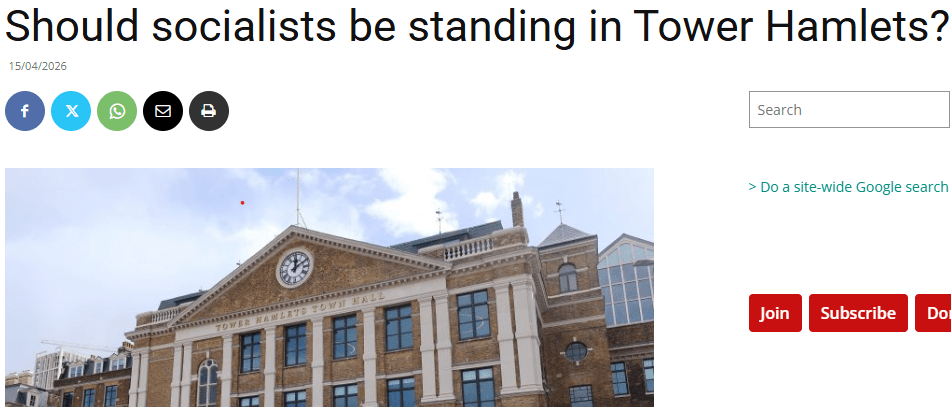
This piece by Nick Wrack if from the current issue of Respect’s paper.

  Just two years ago Gordonimage Brown said he could not find the money to plug the £1 billion deficit in the NHS. Now he’s bailed out the banks to the tune of £500 billion. Nothing could be clearer. When it comes to the needs of ordinary people Brown and New Labour couldn’t care tuppence. When it comes to big business, the bankers, city financiers and other rodents, they will hock their grandmother to get them out of a fix.

Unfortunately, it’s not just grandma who will have to pay. It’s estimated that the bailout is costing every taxpayer up to £13,000. This is on top of the £200 billion Private Finance Initiative debt that taxpayers will have to pay out to the corporate fat cats for generations to come.

Ordinary people will not benefit from this bailout. While the bankers and the shareholders will continue to be paid massive amounts (reduced a little for a short while to prevent a public outcry) we will be forced to pick up the tab.

On top of the credit crunch and the financial crisis is economic recession. Unemployment is rising to levels not seen for almost twenty years and is set to rise further. Despite being nationalised at a cost of £100 billion Northern Rock is now trying to recoup its money by forcing families onto the street. Repossessions rocketed from 491 to 4,201 in the last three months. In total there will be 45,000 mortgage repossessions this year. There’s money for the bankers who have cost the taxpayer billions but nothing for hard-up working families who struggle with rising fuel and food costs.

Gordon Brown famously (and ridiculously) claimed to have done away with boom and bust. Just in case he hasn’t learned anything from recent events here’s what the Economist magazine, the in-house journal for neo-liberalism, says: “Capitalism has always engendered crises, and always will.” (18/10/2008)

In boom, the rich get richer. And in bust, millions of workers, the unemployed, pensioners and their families are made to pay. That is what capitalism is all about.

And while the bosses and the politicians rail against public ownership most of the time, they’re not averse to taking a hand-out when the going gets a little tough. Just so long as they don’t have to pay for the crisis created by their system. Here’s the Economist again: “In the short term defending capitalism means, paradoxically, state intervention.” And that means worldwide state bail-outs to the sum of £2.5 trillion. An unimaginable amount but one that could be used to eradicate poverty, disease, deaths in childbirth; provide water, shelter and food for half the world’s population (over three billion people) who live on less than $2.50 a day.

If they can bail out the bankers, they can sort out the NHS, child poverty and public transport. But they won’t. This New Labour government, just like the Tories and the Liberal Democrats, have praised the bankers and the financial markets for years, extolling the benefits of unregulated markets and praising their contribution to society.

Instead of handing massive sums to the very people responsible for the mess, the banks, financial institutions and pension funds should be nationalised, along with the railways and the fuel companies and all the other industries and services privatised over the last thirty years. But instead of them being run in the interests of business, they should be run democratically by and in the interests of ordinary people who work in and use them. We want state intervention in our interests, not for the benefit of the super-rich.

Only in this way can we make sure that bumper bonuses and dividends are not paid out to the undeserving parasites who have sucked out profits at our expense. There’s no other way to ensure that interest rates are reduced and kept low. Instead of taxpayers subsidising the rich, the profits of the banks, fuel companies and other services can be used to fund improvements in our daily lives, such as free school meals for all children, free public transport and free prescriptions, dental treatment and eye tests.

There must be a guarantee that there will be no repossessions due to mortgage defaults. We need a massive programme of council house building, providing affordable homes and creating work for tens of thousands.

In this recession, the government must be forced to intervene to protect those threatened with unemployment. Any company laying off workers should be taken over and the jobs saved until suitable alternatives at trade union rates of pay can be provided.

The replacement of Trident nuclear missiles must be scrapped, saving £76 billion. The ID card scheme should be binned, saving another £4.7 billion. Corporation tax should be restored to 1979 levels, generating more than £12 billion every year. Income tax for the richest 10% should be increased, whilst those on £14,000 or less should pay no Income tax and VAT should be abolished.

Why should it always be the poorest who pay the most?

In the face of growing unemployment and mounting financial difficulties there needs to be united practical action across the left; to protect those at the sharp end. That’s why Respect is supporting the newly-formed Campaign against Fuel Poverty.

Anyone facing repossession should be defended and the bailiffs kept out.

The government continues to say there’s no money to pay low paid civil servants any more than a 2% pay increase. Wages must keep pace with inflation and action taken to prevent job losses. Respect will support all groups of workers who take action to defend their job, conditions and pay.

Capitalism is a system that causes chaos and misery for the majority in society. Some people say it’s ‘unbridled’ capitalism that is the problem. But you can’t put a bridle on a system so unruly. It’s a beast that can only be tamed by being put down.

We need a society in which the needs of everyone are put before the privileged lifestyles of the few.

13 responses to “"Capitalism – a beast that can only be tamed by being put down" claims Respect National Secretary”

  1. Just thought I’d share these two contributions I made on the Independent newspaper website:

    `Also will someone tell us why we are ahead of the US in recession that’s another first I think.’

    Could it be because those canny Wall Street guys packaged all the debt in nice shiny paper and sold it to the plonkers in the City of London leaving us holding the baby.

    The banks have been bailed out but are whitholding credit forcing everybody to liquise their assets to pay the stupid debts the bankers bought. They have had their amnesty it is time for ours:

    It is time for an amnesty on all personal debt: all morgages, personal loans and credit card debts to be written off immediatelly. Small and medium businesses too must have their debts written off whilst the large companies whose debts show this country is bankrupt must be nationalised. Nationalised banks should then release government credit and the private deposits directly and in a controlled manner to small and medium businesses and individuals who can demonstrate they could make good use of it for the benefit of society at realistic interest rates.

    Ron C Clair: It is nothing to do with `talking it up’. The banks won’t release credit, even though the government has made it available, to the busineses that need it so they are having to liquidise their assets by selling shares to pay their debts. This is what is driving the stock market down and ensuring not just a recession but a depression. It is nothing to do with `talk’ and everything to do with greedy bankers wipeing out the economy so they can buy it cheap with government and offshore money and then asset strip it. Eight million unemployed if the bankers get their way? Alternatively rip up the Debt Swap Certificates and initiate a debt amnesty and let the bankers pay for this one. To avoid the misery and costs of mass unemployment share the work by cutting hours in government departments and nationalised industry.

    Like

  2. From the NY Times:

    So When Will Banks Give Loans? (The banks’s dirty little secret)

    Like

  3. Just thought I’d run this one up the old flagpole and see if anyone salutes:

    It is increasingly clear that the banks will not release credit and are determined to drive the economy into recession. The `recapitalising’ and `deleveraging’ of the banks is being achieved at the expense of the people.

    In the face of this we should organise a Campaign for Debt Amnesty. It could be launched with an All Debts Are Off march.

    Mortgages, personal loans and credit card balances all to be repudiated but importantly the debts of small and medium enterprises to the banks to be wiped clean. Our debt ridden larger companies must be nationalised to prevent downsizing and mass unemployment. It could be a way of mobilizing millions and pressure the TUC into launching a fight to save jobs.

    Like

  4. David Ellis from the newly formed Campaign for a Debt Amnesty explains the rationale behind its thinking.

    All Debts Are Off

    Every country in the world will suffer from the global credit crunch but Britain may well suffer more than most. We have all been living beyond our means but the City of London speculators, in a fit of hubris and in order to prove to the world that they were still the centre of the financial universe have been buying the debts of foreign countries, mainly America, hand over fist. They are the ones left holding the parcel of shiny beads so beautifully packaged by Wall Street now that the music has stopped. So, whilst every other nation will have to tighten its belt Britain is technically bankrupt. There is no way now to sell-on the trillions of dollars’ worth of toxic Debt Swap Certificates, or Financial Weapons of Mass Destruction, our City geniuses have purchased and there is little chance of them being made good. The US government’s decision to let Lehman Brothers go under was one of many hostile acts which have ensured Wall Street will survive to the detriment of the City of London. The only way to make the City remotely solvent again is to take it out of the hide of the British people. To this end the City is denying credit to businesses and individuals, despite the billions made available to them by the government, in order to force them to liquidate their assets and pay back their debts to the banks or take out new prohibitively expensive loans. This is why the stock exchange and house prices continue to tumble as everybody seeks the cash they need to continue trading or paying their company or individual debts. It is why unemployment and repossessions are taking off. There is no way that the City institutions can be nationalised because to socialise their debts, many times more than our GDP, would leave each pound worth little more than about three cents each. There is now only one way forward for Britain and that is to let the City go to the wall. It is literally us or them. To that end the Campaign proposes an immediate amnesty on all mortgages, personal loans and credit card balances. In addition, the debts of small and medium enterprises to the banks must be written off. Large corporations must be nationalised to prevent them from shedding jobs and their debts to the banks repudiated. Most are unprofitable and are in any case, one way or another, propped up by the taxpayer anyway. The few cash rich ones, such as the purveyors of rubbish food, are waiting to buy up their insolvent competitors, such as the purveyors of quality food, and either asset strip them or close them down all together. Unemployed workers must be absorbed into these large companies and into government and council departments. Hours, but not pay, should be cut in half in this new state sector to accommodate them. A new state bank, under the democratic control of the people, would then make cheap credit available to those individuals and enterprises that can demonstrate a need or are proposing social and environmentally beneficial projects. There will be no more loans for profligacy or for decadence such as for those buying 4x4s, yachts or multiple housing which ever way this crisis unfolds. Unfortunately, many pension funds are holding huge amounts of the toxic debts and are also in reality bankrupt. Paying further contributions into them is throwing good money after bad. The private pension system has collapsed. Again, to prop it up would ruin the nation as a whole to the benefit of a few private individuals. A new state pension fund must be established into which future contributions can be paid. Production for private profit has ceased to function. It is time for production for the social good.

    The Campaign for a Debt Amnesty will be joining a demonstration and street party organised by the Cardiff Chartists at 5.00 next to the Nye Bevan statue on Queen’s Street Cardiff on Halloween Night, 31 October.

    Like

  5. Am thinking of changing this to The Campaign Against Recession to demonstrate that mass unemployment and poverty as an outcome to this financial debacle is a political choice and using the debt amnesty as the first demand of a few thusly:

    * Debt amnesty for individuals and SMEs

    * Nationalise large enterprises

    * National state bank operating on social and
    environmental principles

    * Absorb unemployed into large enterprises,
    government departments and councils by halving hours but not wages

    * housing etc.

    Like

  6. In an act of incredible hostility against the British people, Barclays Bank have raised £7.3 Billion from Abu Dhabi and Qatar Royal Families on the grounds that they will earn spectacular returns.

    This is an effort to cash in on the private bank’s monopoly of releasing credit to businesses and individuals and the fact that the base lending rate is falling rapidly. This cheap money is, however, passed on to those who need it via the banking middle men at the inter bank lending rate which remains cripplingly high. Without this inter bank lending rate cheap credit could be made available by a single state bank directly to those who need it and can utilise it for the social and environmental good.

    * depositors should withdraw their money from Barclays;
    * small investors should sell their shares;
    * Barclays workers must demand nationalisation.

    Like

  7. There’s a statement calling in support of ” a transitional programme for radical economic transformation”, which contains some very good points at :-

    F**k! Galloway's at it again

    I’m not too keen on the Academic, NGO, UN-leaning flavour of the participants, but this is the sort of approach that should be developed in the unions and mass organisations in Britain and internationally.

    Like

  8. Thanks for the link. It is very academic as you say Prianikoff. My concern is for demands that are capable of mobilising public anger and action such as a debt amnesty, nationalise the banks, etc. Stop the War type stuff but obviously not left at the level of simply marching though a couple of big marches would be good to kick things off (TUC wankers). Concrete things but not platitudes like no to reposessions as if we were ever for that or job losses or public works. No-bailout has no public resonanse as nobody wants to see the economy collapse. They want positive, popular, mobilising proposals.

    Like

  9. Most people I’ve met are furious about the idea that they will have to pay for a bunch of banker’s mistakes.

    Like

  10. What relevance is that comment? We are all furious but that’s as far as it goes with you and I doubt it even goes that far.

    Just posted this comment on the CiF site in opposition to Will Hutton’s Keynesian non-solution:

    `Japan is covered top to tail in airports and golf courses that nobody ever uses and all that investment failed to lift the economy out of stagnation following its financial crisis.

    A massive destruction of capital will occur. Whose? I suggest a debt amnesty wiping out all mortgages, personal loans and credit card debts along with all debts to the banks of small and medium businesses. Big businesses and the banks to be nationalised to prevent them imposing austerity on the rest of the economy. This would restore and maintain liquidity and with the banks nationalised would allow the economy to advance under democratic control.

    Better than selling the country off abroad or borrowing to crippling levels or mass bankruptcies, repossessions and unemployment.’

    Like

  11. Just posted this on The Independent site under their interest rate story:

    `The rate cut was so big because the government hopes that the banks will pass some of it on knowing that they won’t pass it all on because they have to get money to cover the trillions in toxic debts they have accumulated.

    I`n fact, there is very little chance of any of this cut being passed on and the result of the government’s failure to nationalise the banks is now apparent. The banks are screwing the public from both ends: tax payers money and cheap Bank of England rates on the one hand and high rates to business and the public for borrowing from them. One national state bank could lend money at virtually the base rate as opposed to the inter-bank rate. Cut out these wretched middle men and their robbing inter-bank lending rate.’

    Like

  12. Here is a comment I posted on the Guardian’s CiF pages under a Will Hutton piece about joining the Euro. I post it merely to keep discussion of the economic crisis on the left going. Incidentally, the positions taken by NL and the Tories is a good example of the formal law of the excluded middle in action (and I’m not talking about the marginalisation of the wretched Lib Dems).

    `The IMF say that Britain is going to be hardest hit by the recession so why would the other countries in the Euro even consider letting it join?

    Looks like approaches to the recession have polarised into two camps: the Tories say let it rip 1980s style. Let the recession take its toll then rebuild. Monetarism in short. Problem is that was a one off opportunity. Everything has been sold and is foreign owned so there is little chance of ever recovering from such a huge economic contraction.

    New Labour want fiscal stimulation through tax cuts and borrowing which will eventually lead to hyper inflation and economic collapse anyway. But as Keynes said: in the long run we’re all dead. Cynical.

    The best form of fiscal stimulation would be a debt amnesty. Yes it would bankrupt the banks but it wouldn’t bankrupt the country. Wipe out all mortgages, personal loans, credit card debts and the debts of small and medium companies to the banks and student loans. A single state bank could then lend in the absence of the middle men at more or less bank of england base rate. Yes, there would be some contraction especially in luxury goods production and sale but we could then go forward on a more sensible basis. Unemployment will be solved by making the 40 hour week a 20 hour week at the same pay rates.’

    Like

Leave a comment

Trending