
 Society generally disapproves of celebrating the deaths of frail, ill old women. There are reasonable exceptions to this rule. When Margaret Thatcher kicks the bucket it’s my intention to get drunk on the finest champagne I can lay my hands on. Watching Steve McQueen’s film about Bobby Sands’ hunger strike goes some way to explaining why.
McQueen opens the film with the announcement of comrade Sands’ death. Belfast was told by the banging of dustbin lids at four in the morning and that’s how McQueen breaks the news to the viewer. A great strength of the film is its refusal to give expositional dialogue. Either you know what happened and why, you go and find out afterwards or you accept the film as it stands. That choice is left to the viewer.
Judged simply as a piece of cinema it is a distressing, powerful work which spares little of the maggot filled, excrement covered hell of the H blocks. The IRA and INLA prisoners refused to wear prison uniforms as part of carrying on their struggle inside the prison system. They wore clothes only when they received visits. The rest of the time they wore blankets. Following a number of attacks on prisoners by prison officers the prisoners began refusing to slop out their cells and rubbed their excrement on the wall. McQueen almost rubs the viewer’s nose in this mess by introducing us to it through the eyes of a prisoner on the first day of a six year stretch.
From that point the horror is unflinching and almost relentless. Attacks on naked prisoners by members of the northern state’s Prison Service were routine and McQueen shows what happens when a naked man is made to run the gauntlet of a dozen screws dressed in riot gear battering him with truncheons while the governor looks on. He does mention in the closing credits that several screws were shot during the dirty protests and hunger strike. This reviewer’s sympathy was limited.
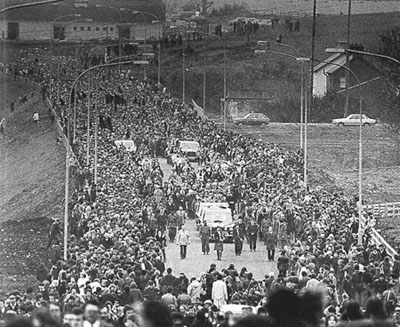
The film’s central paradox is that while it focuses on a very precise and well documented historical moment it gives no almost no context. The movement in support of the hunger strikers was a glimpse of what a real popular movement looks like. In parts of Belfast at the time about half the homes had posters of the strikers in their windows. In nationalist parts of the north innumerable hunger strike committees were organising vigils, meetings and demonstrations and this was a phenomenon the Republican leadership didn’t understand. Many Republicans at the time insisted that support for the prisoners had to be accompanied by political support for Republican strategy. In 1981 this did not include standing in elections until the IRSP and People’s Democracy each got two councillors elected on the basis of supporting the hunger strikers. (You can read the PD account of the period here – about two thirds of the way down) From that followed comrade Sands’ election to Westminster and arguably subsequent Sinn Fein electoralism. None of this ferment of tens of thousands of people getting involved in active anti-imperialist politics is hinted at. The photo above shows a section of the 100 000 mourners at the funeral. In British terms that would be the equivalent of around a million people. McQueen keeps the action to a few rooms in Long Kesh and maybe he was right to do so but it would be good to see how a more explicitly political director would have handled the same events.
Michael Fassbender’s performance as Bobby Sands is remarkable on three levels. The German actor catches the rhythms and intonation of the working class Belfast accent virtually perfectly and in the central scene with Liam Cunningham subtly portrays comrade Sands’ intensity and political will. Then there is the physical aspect. Joe McDonnell was the fifth prisoner to die after sixty one days and I saw him in his coffin. Fassbender replicated what that type of starvation does as near as must be possible without taking himself to the edge of death. His naked body in the final section of the film was almost impossible to look at as he imitated the spasms of a dying man.
McQueen did not set out to make a film about the hunger strikes and has given us a work looking at what the hunger strikes were for one man. Never easy viewing but it is one of the outstanding films of recent years and, in a way, the very fact that it was made is a posthumous moral victory for Bobby Sands and the other volunteers who died.




 Liam redux
Leave a reply to maeve66 Cancel reply