
Vocations officer for the Christian Brothers is one of the more challenging jobs in Europe at the moment. The reports of p rolonged and systemic abuse in institutions run by them on behalf of the Irish State are likely to finish the organisation off and the burgeoning industry of plays, memoirs and articles reliving the horror of an Irish Catholic education is probably one of the few things contributing positively to the 26 counties’ exchequer.
There was another side to the story and my experience was probably much more typical. Seven years of primary school were spent with the Christian Brothers. These were the farmers’ sons who were good at hurling but couldn’t quite manage the theology and Latin required for the priesthood. The big disciplinary tool was a thick leather strap and there were a couple of class thrashings. The thing was that this had a lot of parental consent – the view being that if you got slapped at school you got another slap at home for having been slapped at school. At the time even a whack with a cast iron frying pan was considered a useful, albeit extreme, means of chastising kids. In my street anyway. Physical violence was much more part of children’s lives and parenting at that time and the Brothers were just doing what they had learned at home.
Most of the songs that I still know by heart were taught to me by a Brother Lynch, a kindly old man who felt that a good day’s work involved getting thirty kids to memorise the words and tunes of songs like the Foggy Dew and the Bold Fenian Men. Jacqui Smith would probably lock him up for that. Lynch and his peers decided that the way they wanted to serve their god was through education and they brought to it a creativity and distinctive political slant that have gone out of fashion.
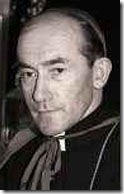
The priests at secondary school introduced us to existentialism, Marxism and Protestantism. Their presentations were accurate and well informed and they helpfully pointed out that although many well-intentioned people held these views they were a pathway to either damnation or a few million years in Purgatory. Like the Brothers they were mainly kindly men motivated by a sense of religious vocation. An exception to the rule is in the photo. Father Crossin visited me in hospital for no reason that I can fathom other than he felt that his belief required him to visit the sick. Never one in fourteen years did any member of a religious order do or say anything questionable and the harshness of their discipline was in keeping with the time.
Sometimes they were quite inspirational. At least once a year priests from a missionary order would come in and describe how they were bringing Christianity, education and health care to villages in Africa and Latin America. At the time I found them impressive enough to think it could be a career worth going into and I was by no means unique.
One result of the failure of the Irish bourgeoisie to establish a fully impendent state was that it left almost all its educational and health provision in the hands of the Catholic Church. In addition to the normal school system at any one time around 6000 children were in the care of religious orders. Boys were sent to “industrial schools” for begging, being orphans or in the care of “unfit” or abusive parents. Overwhelmingly these were the children of the very poor who came from large families in a state where the gave Catholic teaching on contraception the force of law. Once they were in these cruel institutions the state’s officials were so deferential to the hierarchy that they refused to enforce their own procedures. One circular from 1946 says “The boxing of children’s ears, the pulling of their hair or similar ill-treatment is absolutely forbidden and will be visited with severe penalties.”and 1933 guidance from the Department of Education said ““The manager must, however, remember that the more closely the school is modelled on a principle of judicious family government, the more salutary will be its discipline, and the fewer occasions will arise for resort to punishment.”
Even though the state was funding the institutions where the abuse was taking place it refused to exert its authority. Inspectors and police colluded with the hierarchy and the abusers in concealing what was happening. The Catholic Church still controls 92% of primary schools in the 26 counties and the State is adamant that this situation will not change. It was this relationship between the Church and the state that made the abuse possible, much more than the psychology of the abusers or the deference of parents and until the Irish state removes the Catholic Church from any role in providing health or education it cannot declare this story closed.


 Liam redux
Leave a reply to Jon Brownridge Cancel reply