

This seems like a campaign worth keeping an eye on. It’s called PinkStinks: the campaign for real role models and says of itself: “PinkStinks is a campaign and social enterprise that challenges the culture of pink which invades every aspect of girls’ lives.” While it should be the occasion for a piece reflecting on what capitalism does to childhood and the state of contemporary feminism I have to do some Christmas shopping.
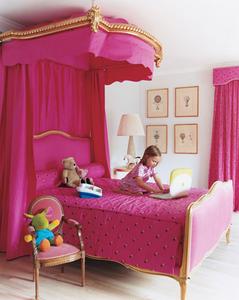
The Guardian carried this article which chronicles how pink used to be the colour for boys and touches on some of the big themes to which I would add that 95% of the stuff in the photos below will be landfill before Easter after being shipped halfway around the world.
Towards the end of the great war, in June 1918, America’s most authoritative women’s magazine, the Ladies’ Home Journal (it still exists), had a few wise words of advice for fretting mothers. "There has been a great diversity of debate on the subject," it wrote, "but the generally accepted rule is pink for the boys, and blue for the girls. The reason is that pink, being a more decided and stronger colour, is more suitable for the boy, while blue, which is more delicate and dainty, is prettier for the girl."
A few years earlier, the Sunday Sentinel had been of the same opinion: "use pink for the boy and blue for the girl," it said in March 1914, "if you are a follower of convention." So accepted, in fact, was this convention that as late as 1927 Time magazine was observing, on the obviously disappointing birth to Princess Astrid of Belgium of a daughter rather than the infinitely preferable son, that the cradle had been "optimistically decorated in pink, the colour for boys".
This is, as you may have noticed, no longer the case. For maybe the past decade or so, little girls have inhabited a universe that is, almost entirely, pink. It is made up not just of pink princesses and fairies and ballerinas and fluffy bunnies, but of books, bikes, lunchboxes, board games, toy cookers, cash registers, even games consoles, all in shades of pink.
This Christmas is no exception. There is a pink globe, specially for girls. Scrabble has been repackaged in pink (the tiles on the front of the box spell FASHION). Monopoly has gone pink, with the dog, thimble and shoe pieces replaced by flip-flops, a handbag and a hairdryer, houses and hotels becoming boutiques and malls, and utilities turned into beauty salons. In at least one major supermarket chain you can now buy slices of bright pink ham, cut into heart shapes and called Fairy Hearts.
 Something, plainly, has changed. "There’s been," says Abi Moore, a 38-year-old freelance television producer, "a wholesale pinkification of girls. It’s everywhere; you can’t escape it. And it needs to change. It sells children a lie – that there’s only one way to be a ‘proper girl’ – and it sets them on a journey, at a very, very early age. It’s a signpost, telling them that beauty is more valued than brains; it limits horizons, and it restricts ambitions."
The power of pink, however, is not to be trifled with. Eighteen months ago, Moore launched an anti-pink (or rather, pro-some-alternatives-to-pink) campaign with her twin sister Emma, a senior voluntary sector worker. For some time, the pair had been struck by how different their respective houses were beginning to look: Abi has two boys aged seven and three, Emma two girls born at almost exactly the same times. "I was coming back from filming an interview with Naomi Halas, this remarkable woman scientist who’s developing a new treatment for cancer," she says. "And I landed, and the media, all the media, was just completely obsessed with Paris Hilton’s release from prison. Nothing else. And I just cracked."
The campaign, PinkStinks, started out with the aim of offering girls positive alternative role models, says Emma, "women who do amazing things. Scientists and sportswomen and musicians and businesswomen and activists." Trying to reverse the seemingly unstoppable tide of pink was simply another way, they felt, of challenging what they saw as rampant and unacceptable gender stereotyping, from earliest childhood.
Then, two weeks ago, they devised a Christmas campaign denouncing the oceans of pink on show at the Early Learning Centre, which claims in its own publicity that its toys are designed to "help children explore the boundaries of their imaginations and creativity, make learning fun help children be all they can be". And all hell broke loose. PinkStinks has since featured in hundreds of television and newspaper reports, in 22 countries around the world, from Argentina to South Africa – and not always in a good way. In Britain, one paper derided the Moore sisters as "dour and humourless feminists". Another was considerably ruder. Sky News had presenter Nina Mishkoff dress entirely in pink to interview them and even the BBC World Service, says Abi, wanted to put them up against Zandra Rhodes.
They’ve been most shocked, though, by the emails. There’s been support: "I am nine years old," wrote one girl, "and I think PinkStinks is my voice. Girls like me shouldn’t be forced to like pink. Can you think of a good name for girls who don’t want to be girly girls but aren’t tomboys?" Please, said another, "carry on and make it easier for girls like me to try different things without feeling like an outsider." And where, a young mother asked, "are the toys I remember from my childhood – non-gendered, and educational? Well done for raising this issue and giving us parents a focus for change, to raise our daughters to aspire to dignity, goodness and equality rather than big boobs and tiny waists!"
 But there has also been vilification; hatred, even. "Do you sell campaign T-shirts in pink?" one respondent writes. "And do you have any with ‘I am a leftwing communist loony trying to brainwash girls’?" Another calls the sisters "lesbians" who "can’t leave normal young girls alone". A third "pities your children". Another: "So much go
ing on in the world and yet you start this crap. Amazing. Sorry, white coats needed for you."
The sisters are at something of a loss to understand why an innocuous, low-key campaign should spark such vitriol. "We’ve tapped into something that’s clearly very deep and very powerful," says Emma. "Some people plainly feel attacked."
Why should that be? Back in the 1800s, most children were dressed alike. Gender differences weren’t really apparent until they could walk, or later: boys and girls both wore dresses or skirts until they were six or so. By the end of the century, as the Ladies’ Home Journal noted, boys’ and girls’ clothing styles began to diverge. According to Professor Jo Paoletti of the University of Maryland, pink emerged as an appropriate colour for boys because it was "a close relative of red, seen as a fiery, manly colour". Blue was considered better suited for girls because of its associations, in art, with the Virgin Mary.
It wasn’t until after the second world war that the colour code was reversed. In 1948, as the author of an authoritative item in the Chicago Reader notes, "royal watchers reported that Princess Elizabeth was obviously expecting a boy, because a temporary nursery in Buckingham Palace was gaily decked out with blue satin bows".
Some claim the tide turned for innate biological reasons. Research into colour preferences in monkeys have apparently shown that females prefer warm colours such as pink or red, perhaps because the pink face of a baby primate brings out the mother’s maternal instincts. A widely reported study at the University of Newcastle in 2007 asked 200 men and women to choose their preferred colour from rectangles on a computer screen. It found that women showed a distinct preference for reddish colours. The researchers speculated that the gender d ifferences may be genetically determined: "Evolution may have driven females to prefer reddish colours – red, ripe fruits, healthy, reddish faces".
But the study failed to take full account of cultural factors: the enormous combined impact, for example, of parental preference, peer pressure and, above all, consumer marketing. The feminist writer and broadcaster Natasha Walter, whose book Living Dolls: the Return of Sexism is published next year, argues that the scientific case that such preferences may be biologically determined is "far from proven. I was very struck, when I had my daughter – she’s now nine – by the way girls seem to be expected from birth to live in this world of tutus. I was brought up in the late 60s and early 70s, with a mother interested in gender-neutral education, and I had just kind of assumed that things would have moved on from there. In fact, they’ve moved backwards."
A kind of fatalism, Walter says, seems to have crept in. "The view seems to be: ‘Oh well, people tried, in the 60s and 70s, they tried all that non-sexist, anti-stereotyping stuff, and it didn’t work. There’s obviously nothing we can do about it, it’s all laid down in our genes.’ Whereas in fact that’s not true: we never got the equality we set out to achieve. And now we all have to accede to the notion that little girls are naturally drawn to pink, and
you’re old-fashioned and over-serious and boring if you suggest otherwise."
Some are more explicit. "It’s as if the women’s movement had never existed," says Ed Mayo of Co-operatives UK, former head of the National Consumer Council and co-author of Consumer Kids: How Big Business Is Grooming Our Children for Profit. "It’s staggering, the extent to which parents are now having to trade off their own values against the commercial interest of companies. Today’s marketing assigns simple and very separate roles to boys and girls, and whips up peer pressure to police the difference."
All this happened, Mayo argues, "with the emergence of a children’s market, and the need to differentiate between boys and girls: the need to make more money, basically. This isn’t something that’s genetically hard-wired, it’s culturally created, and therefore it should be open to question." The children’s market has now reached the stage, he says, where "it’s no exaggeration to talk of a gender apartheid."
Why, though, does pointing this out, as Abi and Emma have done, strike such a raw nerve? "Guilt," says Sue Palmer, education writer and broadcaster and author of Toxic Childhood. "The obvious reaction is denial. When you don’t buy into the whole competitive consumerist status quo, you have to be dealt with – and that’s done by either bullying you or mocking you into submission: you’re either mad, or a lesbian."
Commercial marketing, Palmer insists, is behind pinkification. "When you’re two and a half or three,’ she says, "you have two key instincts. The first is towards inclusion: the overpowering need to be part of the group. And at the same age, children become aware of gender. So there’s this deep emotional need to be part of a group, and the group you want to be part of is your gender group – so that’s how you capture them. Quite simply, the medium for catching girls is pink. The marketers have been at it, driving gender stereotypes, for 20 years; it’s immensely insidious and it’s mostly gone on under parents’ radar."
But is it really so important? Do little girls really graduate from playing with pink princesses to wanting to be a WAG? There is, certainly, evidence to suggest "sexualisation" makes girls not just aspire to a particular kind of thing, but actually changes the way they think. A study by speech therapists in Durham found small children able to identify the colour blue, but saying "Barbie" when shown pink. A highly regarded US study indicated that anxiety about appearance can compromise brain function: young girls who had been asked to try on a swimsuit in a private dressing room before sitting a maths test performed notably worse than those who had been asked to try on a jumper.
"In the late 90s," says Angela McRobbie, cultural theorist and co-author of The Aftermath of Feminism, "feminism became repudiated and disparaged, as old hat, anti-fun. In this new era, girls and women are assumed to have gained equality, so feminism’s no longer needed. At the same time, consumer culture has penetrated deep into the childrens’ sector, and introduced a renewed, hard-and-fast form of gender difference. Consumer culture is exploiting the disappearance and devaluation of feminism – actually, it even claims to replace it, by being a ‘champion of girls’ in some respects, all the while creating new and younger markets."
So pinkification matters, McRobbie says, because it marks "a return to the past, but with the full force of contemporary marketing. It is so embedded in children’s culture that it penalises the non-feminine child. It turns small five-year olds into one-dimensional fashion queens, and it narrows their realms of interest, and imagination.
Shellshocked by their recent ordeal, the Moore sisters agree. "People say it’s all innate – they think we’re attacking something natural, within them, " says Abi. "But there are tremendously powerful forces out there. This is about money and marketing. That’s wor
th challenging, isn’t it?"





 Liam redux
Leave a reply to Liam Cancel reply