
The National Council of the Respect Party met on 22nd May to discuss the aftermath of the 2010 General Election – a serious and detailed discussion took place with all present expressing their determination for Respect to continue our work – seeking to organise and promote, where we are able, our values of peace, justice and equality. The following document is based upon those discussions.

Clive Searle, National Secretary
1) National Council: Progressive Politics after the General Election
The battle for our public services has begun. The new ConDem government has pledged to impose devastating cuts on public spending. The plans to reduce the deficit will be accelerated, with the burden falling on public spending rather than increased taxes for the better off.
Already, more than £6 billion of cuts have been announced with more to follow in the next four months as the coalition government builds its confidence. The economic crisis in the Eurozone and its effect on the British banking system is fuelling the increased pace of public service cutbacks.
The programme of the new government amounts to one of the most severe attacks in British history on public services, jobs and the living standards of working people and the poor. To minimise resistance and to strengthen itself, the government plans to rewrite the rules to force further coalition government in the event of failure rather than calling a new general election (the 55% rule). Cameron aims to reduce the number of MPs in a move that is widely believed will cost Labour up to 40 seats. The coalition has also pledged to ‘pursue a detailed agreement on limiting donations and reforming party funding in order to remove big money from politics’.
The last measure, from parties funded largely by super-rich individuals, aims to attack the right of trade unions to fund political parties – a direct attack on the Labour Party and the rights of working people in general to organise to secure political representation.
The outcome of the General Election is a weak, unstable government seeking to limit democracy to strengthen itself while embarking on protracted confrontation with all those who wish to defend jobs, wages, pensions and public services. This will be accompanied by a rise in racism – which the mainstream parties will either pander to or directly promote. This has already been signalled by the new measures attacking ‘economic migrants’.
The General Election
The General Election saw a 5% swing from Labour to the Tories; not enough for Cameron to form a majority government, but enough to force Labour from office. The hung parliament was a victory for none of the three major parties.
David Cameron, Etonian public schoolboy, is Prime Minister with the lowest share of the vote of any Tory party in history. He is only able to move into No.10 with the support of the Liberal Democrats, led by the ‘Orange Book’ group of right wing neo-liberals. Cameron describes the new alliance as socially liberal and economically conservative. Although the Liberal Democrats lost seats, their share of the vote increased since 2005 as many became desperate for an alternative to Labour and the Tories.
Many of these voters face the reality that they voted Lib Dem but got the Tories. The Liberal Democrats have already ditched key commitments such as the scrapping of Trident and the demand for a genuinely new voting system based on proportion representation (the alternative vote system we may be offered in a referendum is likely to entrench the dominance of the old order rather than challenge it.) Vince Cable, Lib Dem Business Secretary, will be instrumental in the plans to privatise the Royal Mail.
Millions of voters had already deserted Labour out of disgust at Blair’s alliance with Bush over the Iraq war. Under Gordon Brown, Labour lost a further section of its base as his economic and social policies unravelled.
But Labour’s vote did not collapse in this election. The justified fear of Tory plans brought large numbers of people to the polls to vote Labour, in what was perceived as the only practical way of stopping a Tory government. It was not necessarily a positive Labour vote but an anti-Tory vote mobilized by fear. Many that had deserted Labour in protest since 1997 came out to vote, so there was a higher turnout than 2005.
The 5% swing to the Tories was not uniform. In the urban centres, particularly where Labour was historically strong, the swings were much less – and in some cases reversed.
In 40 constituencies in London the average swing was to the Tories just 1.6%, and there were 13 constituencies which saw a swing to Labour of an average of 3.1%. These were in the north-east and east of the city with large black and Asian communities and high concentrations of poverty. In total, there were 27 seats in England where there was a swing to Labour. All of these were in poor urban areas; 13 in London, 4 in Birmingham, 2 in Liverpool and so on. In Scotland, 27 seats saw swings from the Tories to Labour – as many as in the whole of England and again concentrated in urban areas.
The General Election was, in the end, dominated by the stark choice between a Labour and a Tory government. The TV debates increased the sense that only votes for the three major parties mattered. With very few exceptions indeed, smaller parties and independents were squeezed out of the debate and overwhelmed by the surge of support for the main parties. Independents that had fought off Labour and the Tories in previous elections such as Dr Richard Taylor (Wyre Forest) or Dai Davies (Blaenau Gwent) were swamped on this occasion, both losing their seats.
The election of Caroline Lucas as Green Party MP in Brighton Pavilion was a rare and welcome exception. It was built on a platform of 17 local Green Party councillors and ward based campaigning over many years with a positive national profile for Caroline herself. But this was not a nationwide turn to the Greens as elsewhere the Green Party suffered a similar squeeze to other small parties.
The other positive aspect of the election was the weakening of the threat from the far right. The BNP was wiped out in Barking and Dagenham and failed to make the gains expected in Stoke and elsewhere. The combination of the main party squeeze and strong campaigning facilitated this but it should not obscure the reality that the BNP polled 564,000 votes nationally – up from 193,000 in 2005. Likewise, the vote for UKIP increased from 603,000 to 918,000. That is 1.5 million votes for parties based on racist and/or xenophobic appeal.
The Labour vote
When faced with the prospect of a Tory government, many voters were prepared to vote Labour. With Labour now in opposition and a ConDem government attacking living standards, it is very li
kely that support for Labour in its ‘heartlands’ will be sustained. This is a fact of electoral politics that Respect must take very seriously.
The Labour Party vote was historically appalling. It polled only 200,000 votes more than the 1983 vote. This was when Labour had suffered the split to for the SDP and Labour’s manifesto was compared to that of the Communist Party’s and described by Labour’s Gerald Kaufman as ‘ the longest suicide note in history’. (Though it must be said that Kaufman’s 22,469 votes in 1983 compares somewhat favourably with the 19,211 (50.1% he received on 6th May 2010). Labour’s share of the total potential vote was lower than at any point since the 1930s.
The leadership election illustrates the problem of Labour’s lack of a coherent progressive alternative to the ConDems. The three front-runners all claim that part of the problem for Labour was that it was not tough enough on immigration, while their policy differences with Blair and Brown remain marginal.
Even though the leadership election is highly likely to signal more of the New Labour mould, and with it a failure to resist the coalition government, it is also likely to be the beneficiary of attempts to remove the ConDem government – with many concluding that backing Labour will be the most effective anti-Tory vote. This is bound to squeeze the electoral possibilities of progressive parties like Respect.
Local Elections
In the local elections held on the same day as the General Election, Labour won back control of a number of local councils in urban areas. The first indications are that the ConDem government will push the burden of public service cuts onto local councils so posing an important question for Labour councils. Do they act as a shield for working class people and refuse to implement cuts or lead the way in slashing services and jobs? This dilemma has the potential to provoke deep splits in the Labour membership and electoral support.
Respect and the election
The Respect Party is historically unique in British politics. It is a party with localised but significant electoral support that has at its core the principles of anti-imperialism and anti-racism. It was born from the womb of the anti-war movement and resistance to Islamophobia since 11 September 2001. At this election, Respect sought to widen its position to embrace a critique of the public service cuts consensus and the bailing out of the bankers at the expense of society.
We had a genuine opportunity to create a small national platform for radical politics based on the values of peace, justice and equality. The election of even one Respect MP, to sit alongside Caroline Lucas in parliament, would have made a powerful impact on politics generally and helped the left to rally opposition to the public service cuts.
We fought positive and powerful campaigns but failed to win any of our three target seats. Respect lost 7 of its 8 councillors in Tower Hamlets and its only councillor in Newham. However well we performed in the election, and in some cases we performed very well indeed, the failure to win a parliamentary seat was deeply disappointing. There are no prizes for coming second in first-past-the-post elections.
Nonetheless, Respect’s achievements are worthy of note.
Birmingham
The vote for Salma Yaqoob in Birmingham Hall Green was unique. Her vote increased from a notional 7,500 in 2005 to 12,240 and her share of the vote went up from a notional 16.2% in 2005 to 25.1%. (The ‘notional’ figures take account of boundary changes). Salma’s campaign succeeded in gaining the support of the outgoing left-wing Labour MP and the endorsement of Caroline Lucas and the Green Party. It achieved a 11.7% swing from Labour to Respect (bigger than the 8.4% Lucas achieved in Brighton).
The swing runs counter to all the national trends and in the circumstances of this election was a remarkable achievement. Salma’s re-election as a local councillor was a vote of confidence and ensures Respect has a continued political platform with 3 councillors in Birmingham City Council. Respect polled 10,646 local council votes (21.8%) over four wards, an outstanding achievement.
East London
In other areas the Respect parliamentary vote was squeezed badly. Both Abjol Miah and George Galloway recorded strong votes but were ultimately unable to resist the surge of support for Labour. In the local elections in East London, our core vote held up very well but it was swamped by the general election turnout.
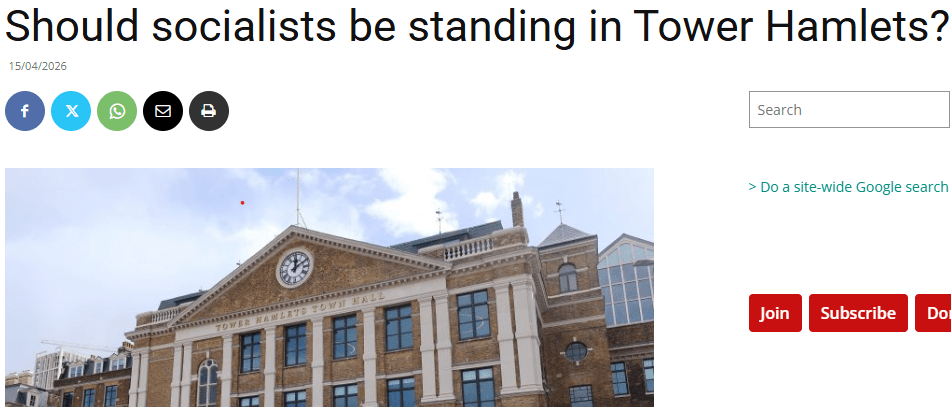
In Tower Hamlets, Respect polled 16,236 votes (15%) across 17 wards with 50 candidates, coming second with increased votes in 5 wards. In Newham, Respect polled 3,448 (12.1%) in 4 wards, coming second in two and third in two. These are historically high votes for a radical party.
We can be very proud of the campaigns we fought, and of the work of our candidates and campaign teams. Respect reached a very large new audience, engaged it with some success but ultimately, its loyalty remained with Labour and, to a lesser extent, the Liberal Democrats. There is no escaping the consequences of these results. We are unable to create the national platform that we had hoped for. And we have lost all but one of our councillors in East London.
A challenging situation
We now face a very challenging situation. The areas where we competed seriously with Labour proved to be those areas that stayed most loyal to it, especially when faced with a Tory government. The biggest swings to Labour were from exactly the kind of areas where Respect was standing.
Respect retains a strong base of support in Birmingham and East London with some effective though small electoral footholds in other cities such as Bradford, Rochdale and Manchester. But, in planning for the future, Respect will have to take full account of the fact that in most areas of the country, opposition to the ConDem government is likely to be expressed firstly by voting Labour.
The problem we face is how we develop a strategy around the positive contribution Respect can make to the struggle against the ConDem government, in terms of developing opposition to the public service cuts, alongside maintaining and ultimately expanding Respect’s electoral support in areas where we retain a significant base.
The future
Respect was formed because there was a need to oppose war, oppose racism and to stand up for public services and social justice. It has never been an exclusively electoral party. Respect is an electoral party and also a campaigning force between elections. It has a proud record from the Gaza solidarity movement, including initiating the remarkable Viva Palestina convoys, the Yes4mayor campaign in Tower Hamlets, in Manchester campaigns such as Free Public Transport or ‘School places for all’ and initiatives for new community facilities and funding for the local swimming pool.
Peace, justice and equality remain as necessary today as they were when Respect was formed in 2004. We will continue to speak fo
r these principles and find every possible way to connect with those who will feel the brunt of the attacks that are coming. They will hit every community and Respect will stand with every mobilisation of resistance. If the Labour councils or individuals councillors refuse to implement the Condem cuts, Respect will applaud and stand alongside them with the local community. But if those councillors chose not to defend those who voted them into office then Respect will campaign alongside everyone affected and help, to the best of our abilities, to mobilise the opposition.
The Respect 2010 Manifesto declared itself for ‘Jobs, Homes and Peace’ and carried a clear argument for investment rather than cuts. These ideas will be developed further to aid campaigning and help activists within and without the party. Respect intends to work with as many people as possible – from the Greens, Labour and other progressive parties as are willing to help, in giving an alternative vision of what can be done. We have a contribution to make both ideologically and practically.
There is no inevitability that ConDem cuts will lead to immediate large-scale public protest or strikes. Nonetheless, it is incumbent on those who oppose the cuts consensus to argue and explain the economic, social and environmental reasons why the neo-liberal orthodoxy is wrong – and outline our alternative. This must include the powerful arguments for the alternatives strategies needed for dealing with climate change – an issue that was woefully neglected by the major parties in the recent election.
As the cuts deepen they will produce a scramble for the little that is left on offer – and racism is likely to flourish. Respect will continue campaigning against racism and to undermine the myths about immigration which are used to divide the poorest communities where the cuts will bite.
Over the coming weeks and months Respect will be seeking to bring around us new networks of supporters. In some areas, the election campaigns have started this process. In others, Respect will need to articulate its argument against the cuts and demonstrate its campaigning ability to build such networks. It will take time and hard work, and is unlikely to be rewarded with high votes for some time.
Electoral Challenges ahead
Aware of the electoral challenges ahead, Respect will need to pick its targets carefully. In Birmingham, the priority will be to defend the council seat in Sparkbrook next May. In east London Respect locally will be assessing its tactics in relation to the autumn Mayoral election and across the city will be preparing for the Greater London Assembly elections in 2012 – held under a form of proportional voting. Elsewhere, Respect will need to adopt a much more localised electoral strategy of building support in individual wards.
In 20 of the 43 wards contested at the election, Respect polled more than 10%, while in 30 Respect polled more than 5%. In Rochdale’s Milkstone and Deeplish ward, Respect achieved 20.9%. In Manchester, Respect polled 1,830 votes (4.8%) in working class wards. Considering that Respect is contesting ground with a party that has been campaigning for more than a century, these results give grounds for hope. It will require long term campaigning over many years by every branch and group of supporters across the country to strengthen Respect into a party capable of becoming a genuinely national force. This is simply the reality of electoral politics – sudden breakthroughs such as George Galloway’s epic victory in 2005 are not the normal occurrence but are the exception. Most electoral success is developed with patient work over many years.
There were two examples of the changing character of political organisation in the election. The first was Labour’s use of technology, especially the Internet and phone banks, to mobilize support. The other was Hope Not Hate’s anti-fascist mobilisation using viral Internet campaigning methods. Respect will be seeking to adapt these methods to our own circumstances – to both strengthen own media message and reach a wider audience.
The communities from which Respect draws its support are among those most likely to be hit hardest by the ConDem government. The Liberal Democrats have been exposed as little more than bag carriers for the Tories, so its base of support in poorer urban areas is likely to come under pressure. People may vote Labour expecting it to defend them. But our experience is that New Labour will let them down badly.
While Respect is drawing many lessons from the election, its goal remains the same: wherever we have the opportunity to do so, we will seek to represent and defend our communities, and speak up for peace, justice and equality. The world is sick and needs to change in order to heal. Respect is determined to present the case for change and to work with those that seek the same.
This article is the product of debate and discussion over the last three weeks in Respect branches, which was further developed from a discussion document presented at the National Council meeting on 22 May 2010.



 Liam redux
Leave a reply to Rachel Cancel reply