
Having had my knuckles rapped for being a bit critical of loyalism and downright rude about Ulster Scots it seemed like a good idea to go away and think about them.
 Major revolutionary events have impacts on an international level. The ideas of the French Revolution enabled the United Irishmen to develop as a revolutionary movement demanding an independent republic with equal rights for the Catholic population. Much of their leadership and social base was to be found in Belfast, which in the late eighteenth century, was a rising commercial centre and among the prosperous Presbyterian farmers of North Down and South Antrim. This radical vanguard never won a majority of Ulster Protestants due in large part to land struggles with Catholic which ensured permanent conflict.
The defeat of the United Irishmen rebellion effectively ended the Protestant republican tradition in Ireland. Although some of the Belfast commercial bourgeoisie retained a liberal bent it was Orangeism which dominated among Protestant landlords and tenant farmers. As the city industrialised it became effectively a British industrial city forming one point on a triangle which also included Glasgow and Liverpool. In effect it was cut off from the rural southern economy with which it had very poor connections. Even today getting from Belfast to Galway is more challenging than getting to Paris and this economic separation made middle class liberalism in the north unresponsive or hostile to nationalist movements. As with transport infrastructure that cleavage still exists.
Protestants in the north were diverging politically and economically away from the rest of the island’s, overwhelmingly Catholic population. Northern Catholics were as a matter of policy kept out of the key industrial sectors and much of the rest of the country’s industry had been destroyed by the free trade which was a condition of the Act of Union.
Sectarianism in the north of Ireland is based on history and economics rather than theology and confronting it is one of the most important tasks for socialists in Ireland. It’s one they have not achieved.
There have been episodes of Republican sectarian violence against Protestant. However Republicanism’s roots lie in the emancipatory ideology of the French Revolution and it has never been a prominent feature of its practice. When it happens it is socialists’ responsibility to condemn it.
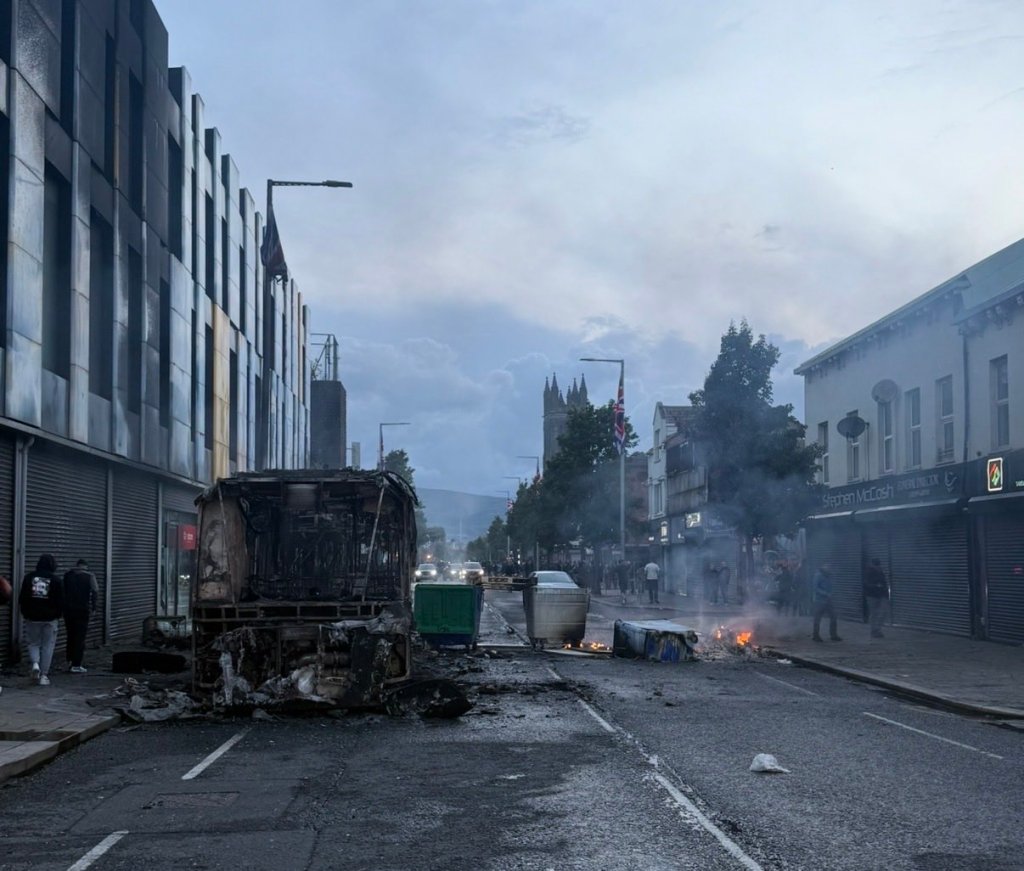
Loyalism, which we’ll define as that branch of unionism willing to use non-state physical violence, is an explicitly and self-consciously sectarian ideology. Identifying someone as a Catholic makes them eligible for physical attack, murder or having their house burned down. This applies to Protestants who live with or marry Catholics and in recent years has also been applied to immigrants.
The gullible can point to one or two statements by prominent loyalists in which they make weak criticisms of sectarian and racist attacks. Nonetheless the fact is that any campaign against sectarianism in the north of Ireland has to be clearly and unequivocally anti-loyalist. Loyalism is the ideology of sectarianism.
The typical response of socialists in the north or Ireland is to appeal for working class unity against sectarianism. This is a slightly more left wing version of religious leaders asking a community to stand united. It explains nothing and reduces offers no answers. The northern state’s own figures point to long term and continuing disadvantage among Catholics in the labour force.
- Protestants (76%) continue to have higher economic activity rates compared to Roman Catholics (67%). However, in terms of absolute numbers, the numbers of economically active Roman Catholics has increased by 51,000 between 1992 and 2005 compared to an increase of 7,000 for Protestants.
- The difference between the two communities’ respective economic activity rates is much more marked between Roman Catholic (58%) and Protestant (71%) females than between Roman Catholic (75%) and Protestant (81%) males.
- In 2005, Roman Catholics comprised approximately six out of every ten unemployed people in Northern Ireland with 19,000 Roman Catholics unemployed compared to 12,000 Protestants.Overall, a higher proportion of Protestants of working age (74%) than Roman Catholics (62%) were in employment in 2005, a relative picture which has persisted over time.
In a situation with long recognised and entrenched discrimination against a group socialists and trade unions should be calling for preferential recruitment of that group. By not raising the issue as a problem the unions and socialists are complicit in the discrimination. These marginal but real privileges for Protestant workers have led to the identifying with the sectarian state. Winning Protestant workers from supporting imperialism and thinking that the sectarian state is “theirs” is a necessary step in defeating sectarianism. This is not done by appeals to people’s better nature but by arguing a political case against sectarianism. This has happened before. A small number of Protestants were radicalised by the Civil Rights movement; the IRA had members on the Protestant Shankhill road in the 1930s and Communist Party members were driven out of the loyalist dominated shipyards for defending Catholic workers.
The struggle against sectarianism is both one against the northern state and British imperialism. Reformists who offer workers’ unity as an alternative to this struggle are doing nothing to challenge its political or material underpinnings. But that fight against sectarianism is itself inadequate. The Irish working class is not just divided between Catholics and Protestants. It is divided between two barely viable states. Only an anti-partitionist socialist programme offers a real alternative to loyalism, bourgeois nationalism and defeated Republicanism
Oh, and before I forget. Even when the Unionists had complete control of the northern state for fifty years not one person in government thought it was a good idea to erect street signs in Ulster Scots, set up a department to spread it or give grants for it. That is how much of a real cultural phenomenon it was until the British government wanted to give some money to ease the loyalist gangster groups into the political process.


 Liam redux
Leave a comment