
In the Name of the Most Holy Trinity, from Whom is all authority and to Whom, as our final end, all actions both of men and States must be referred,We, the people of Éire,
Humbly acknowledging all our obligations to our Divine Lord, Jesus Christ, Who sustained our fathers through centuries of trial,
Gratefully remembering their heroic and unremitting struggle to regain the rightful independence of our Nation,
And seeking to promote the common good, with due observance of Prudence, Justice and Charity, so that the dignity and freedom of the individual may be assured, true social order attained, the unity of our country restored, and concord established with other nations,
Do hereby adopt, enact, and give to ourselves this Constitution.
Preamble to the Irish Constitution
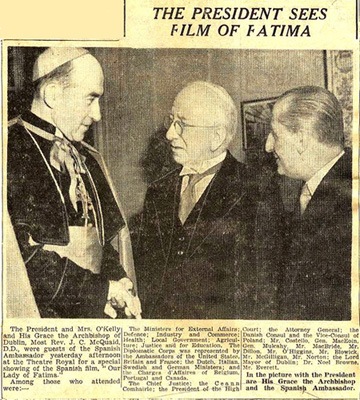 Rowan Williams isn’t the first mainstream religious figure who has tried to persuade the state to accommodate religious notions of legality. One of the dominant figures in twentieth century Ireland had a go at it too and there’s a strong possibility he’s a distant relative of mine. John Charles McQuaid was the Catholic Archbishop of Dublin from 1940 until he found out there isn’t a god in 1972.
John Cooney’s 1999 biography of the old bigot is a truly shocking book. Here’s his description of one day in Dublin in 1941:
In the afternoon the Lord Mayor, alderman and burgesses of Dublin Corporation filed into the library. After kneeling to kiss the Archbishop’s ring, Alderman Cormac Breathnach T.D. read out a handsomely framed address in Irish. He was followed in Latin by the City Manager P.J. Hernon, who pointed out how well qualified McQuaid was to lead the people, especially youth…
Replying in Latin, Irish and English McQuaid accepted the Corporation’s promise to build harmonious relations between the Catholic Church and the civic authorities.
Later that year the Labour Party leader William Norton grassed up a Mrs Cullen. She had written to him complaining about candle shrines in Catholic churches. The leader of Ireland’s workers sent her letter to McQuaid who would certainly have arranged for the local priest to put Mrs Cullen right.
By 1950 he was actively monitoring what was available in public libraries. One of the many branches of the Irish Taliban, the Knights of St. Columbanus, undertook the “wholesale clean-up of evil literature”. With the Archbishop’s support they set up “committees of readers” who went into the libraries looking for filth. Their big target was Dan Dare in the Eagle comic which they managed to get banned. Following that success they set up a Theatre Censorship Committee.
The lines between the state’s law and Catholic teaching were very blurred. When a mixed Protestant and Catholic couple separated and went to court for custody of their children the judge found in favour of the Catholic mother. Before their marriage they had signed an agreement in front of a bishop saying that the children would be raised as Catholics. At the time there was an article in the Irish constitution which said “The State recognises the special position of the Holy Catholic Apostolic and Roman Church as the guardian of the Faith professed, by the great majority of the citizens.” The judge found that the statement signed in front of the bishop, certainly under huge moral pressure, was cognizbale by the High Court.
Here’s one last example of gombeen sharia. Noel Browne was a health minister who wanted to introduce a limited version of a national health system to Ireland. Part of the hierarchy’s response was:
The state has no competence go give instruction in such matters (sex, chastity and marriage). We regard with the greatest apprehension the proposal to give to local medical officers the right to tell Catholic girls and women how they should behave in regard to this sphere of conduct.
Priests and bishops knew more about the subject than doctors and nurses was the skilfully hidden subtext. It’s a universal truth that there is nothing the religiously minded enjoy more than trying to control other people’s sexuality, usually in an inverse proportion to the opportunity they get to explore their own.
As Andy has pointed out at Socialist Unity there are some examples of religious law recognised in Britain such as the recognition of the Islamic Bank of Britain by the Financial Services Authority in 1994, and changes in stamp duty legislation to accommodate Islamic mortgages. The Islamic courts already give advisory judgements on other matters, but these are non-enforceable, and have similar status to any other arbitration service.”
Jewish law already operates the Beth Din courts (battei din), that can hear civil cases.
Accepting that people have the right to practise a religion and opposing any discrimination based on religion is all that is required of socialists. The clergies of all the major religions are self-selecting and self-appointed. In some communities their disapproval can cause deep shame and they nearly always err on the side of being socially conservative. If you haven’t lived in that sort of society you can only dimly understand the deference that there is to clergy. Arguing that they should be allowed to manage schools and hospitals or run a parallel legal system is a very retrograde step which can only strengthen the hand of the theological moralisers. A more coherent and consistent approach is to say that all the welfare and legal functions that should be provided by the state cannot be managed by religious bodies. For while it is true that the bourgeois state is an inherently repressive institution it still does allow room for a democratic leeway that can be influenced by political pressure and class struggle. The soi-disant interpreters of their god’s word don’t. That’s why we should conclude that Rowan Williams was wrong.


 Liam redux
Leave a reply to Liam Cancel reply