
Scoo bap a doo bap a scooby do de bap a bap a bap scoo
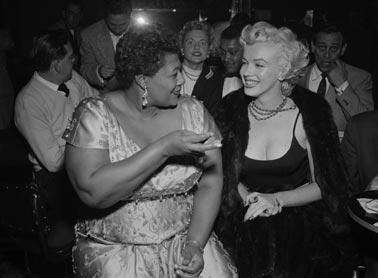 Permanent Revolution’s London social secretary is well connected in East London’s art scene and he managed to snag some tickets to see Bonnie Greer’s new play Marilyn and Ella at the Theatre Royal in Stratford. I was asked along to make up the numbers and had anticipated a demonstration of the appropriately revolutionary way to act in the theatre – try to unionise the ice cream sellers, boo when one of the characters talked about her manager, break down the barriers between actors and audience – but it didn’t happen. There’s a bit of Menshevism creeping in comrades.
A profound hatred of jazz makes me completely unqualified to comment on the subtleties of the performances by Nicola Hughes as Ella Fitzgerald and Wendy Morgan as Marilyn Monroe. Nicola in particular has an astoundingly good voice, the sort that makes you resentful of your own atonal croak. It’s a variation on the morris dancing conundrum. A lot of work has gone into it and the performances are technically superb but it just doesn’t turn you on. It’s worth pointing out that the members of the audience who had come because that was their musical cup of tea reacted very enthusiastically to the show so don’t put any weight on my opinion.
In 1955 Monroe (pictured right) pulled all her strings to get Fitzgerald a five night residency in a Los Angeles nightclub, the Mocambo. Hardly worth writing a play about. That’s moot. This was where the stars hung out but admission was denied to African Americans either as guests or performers so Monroe was firmly identifying herself as a liberal anti-racist. This was at a time when Fitzgerald and her band were a top selling act but still finding themselves refused hotel rooms in southern state and harassed by cops. Greer presents Monroe as a woman who had become intensely restricted by the persona that had been created by and for her and was now trying to evolve herself into a serious actor and film maker. Her obsession with Fitzgerald’s work drove her to work behind the scenes to get the gig.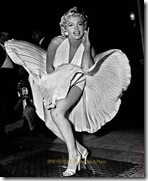
The play tended to take a “History Channel” view of the era, the event and the process. The Monroe character mentions the Civil Rights Movement which was just beginning at the time and how stars like Burt Lancaster and Tony Curtis wouldn’t want to be associated with the colour bar. That’s how the audience is reminded of the historical context but Greer gives the impression, unintentionally I think, that it was Monroe’s celebrity endorsement, even at a time when her own career was waning, which opened the doors for Fitzgerald’s talent. That is a bit of a paradox. From her TV performances Greer would seem to share the loathing of celebrity culture that is demanded of readers of this site.
Writing a musical about an historical event is one way of bringing a new audience to a subject. In fact as part of Socialist Resistance’s new media strategy we are working on an ecosocialist grime opera. The trouble is that public historical experience seems to be becoming increasingly restricted to around a dozen topics – World War Two, the Romans, Ancient Egypt… and at the same time nothing is quite validated unless celebrities are involved. Welcome to Marilyn Monroe, an anti-racist avant la lettre.




 Liam redux
Leave a comment