It’s sometimes hard to believe when socialists say that capitalism is not able to meet people’s basic needs. After all you can pick up a DVD player in Woolworths for £25. They used to be £300.

A few months ago I wrote a short piece remarking on the price of bread and butter. It’s got a lot worse since then.
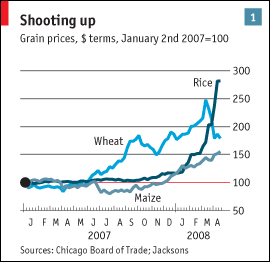
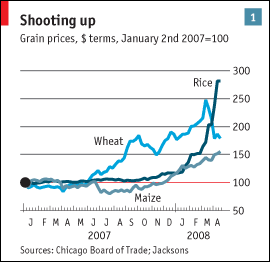
Graph Globally one in six, or it might be seven live on $1 a day. Another 1.5 billion bask in the relative affluence of up to $2 a day. Some make do on the equivalent of 50 US cents. If they were not so concerned with feeding themselves and their families these people would not argue with the socialists’ assertion. The Economist reports that last year year wheat prices rose 77% and rice 16% and since January, rice prices have gone up 141%; the price of one variety of wheat shot up 25% in a day. It may sound glib but this really struck me the other night in the pub when a pint of a beer I occasionally drink had gone up by 30p in one week. That sort or rise translated into bread and meat prices is a real erosion of working people’s standard of living. In the ultra low wage societies this becomes a threat to the physical survival of hundreds of millions of people and the prospect of long term malnutrition with its consequent impact on physical and intellectual development.

The war that the World Bank waged against the Global South in the last two decades is starting to claim its victims. The insistence on free trade gave access to cheap US and European foods to local markets. This acted as a retardant on investment in local agriculture. The twenty first century twist in the tale is that the major cosmopolitan supermarket chains and their local imitators are now emerging in the retail sector. As you will have noticed in Tesco they like their fruit and veg to be cosmetically appealing and standardised. This mitigates against the sort of smallholding common in the Global South and prevents farmers selling their produce to the chains.

The global rise in food prices is generally attributed to rising consumption of meat and grain in China and India, biofuels and drought in Australia. What’s is less often mentioned is the fact that there are cynical people out there making a profit out of starvation. They are an unloved sub branch of the capitalist class – commodity traders.

The Indian Express reports:

This is a perfect situation for hedge funds to jump in and make a killing by driving prices even higher… Another force behind the recent price rises has been an influx of more speculative investors – including hedge funds, institutional and even retail investors. They trade aggressively, increase price volatility and are bringing a whole new meaning to the phrase ‘bet the farm’ —commodity index funds are another set of investors hoping to profit from a commodity boom.

We’ll take it for granted that most of the readers of this site are familiar with the arguments around biofuels. They’ve been summed up in the aphorism “food is used to fill fuel tanks rather than stomachs.” If you want more detail Fidel Castro produced a very good article on the subject. What you probably didn’t know is just how wasteful biofuel production is of water. A factory producing 50m gallons of biofuels a year needs about 500 gallons of water a minute. That might not be a problem in Manchester but in the Global South where access to clean drinking water is a luxury it is a criminal use of the stuff.

For the sake of argument let’s be Anglocentric and date the beginning of the neo-liberal counter revolution to Thatcher’s election victory in 1979. Nearly thirty years on capitalism still keeps one third of the world’s population on under two dollars per day and is likely to condemn the world’s poor to a long period of hunger, food insecurity, malnutrition and starvation. That’s something to bear in mind the next time you hear a politician talk about the superiority of the market.

19 responses to “Capitalism's food war against the world's poor”

  1. on food prices:
    Labour party broadcsat 1974

    Like

  2. A sad commentary on the state of left-bloggery that this crucial topic gets barely a flicker of interest, while the “ISG statement on London…” rumbles on endlessly.

    Sect wars and sex scandals. That’s what keeps the left-bloggosphere going.

    Like

  3. Thanks for saying what I was thinking Prianikoff.

    The article to which I link below mentions food riots in Mexico, Indonesia, Yemen, the Philippines, Cambodia, Morocco, Senegal, Uzbekistan, Guinea, Mauritania, Egypt, Cameroon, Bangladesh, Burkina Faso, Ivory Coast, Peru, Bolivia and Haiti.

    For a group of people whose passion is the poor and oppressed of the world some of us could reflect on our polemical priorities.

    For example – other than “revolution now” would anyone like to start formulating some transitional demands to address this mass hunger?

    http://www.globalresearch.ca/index.php?context=va&aid=8754

    Like

  4. Bread, Peace and Land?

    Like

  5. It has an effect here, as Liam found with his beer: our weekly supermarket bill has risen by about 20% this year.

    One thing I do is buy luncheon vouchers and supermarket gift vouchers from someone who exchanges cash for these vouchers with asylum seekers. (Apparantly this is legal). In our area, the council gives mainly luncheon vouchers, conveniently packed to make up £35, which is what asylum seekers get.

    Obvioulsy, luncheon vouchers can only be used at certain places, and only for food. This means asylum seekers get nothing for bus fares (in order to get to somewhere that will accept LVs) or for household or sanitary goods. And now they have to cope with a 20% rise in food prices.

    Like

  6. Liam I’ve just posted a long reply to your poorly thought out point and it has’t come up!

    Like

  7. Tried three more times and won’t come up- though this time I’ve saved it.

    Like

  8. Final try – Although that did so I’ll try one more time.

    You claim that socialism is beyond th eken of most ordinary working class people

    “For example – other than “revolution now” would anyone like to start formulating some transitional demands to address this mass hunger?”

    Well is it so hard?

    Three examples:

    Today hundreds of thousands of public sector workers were out on strike.

    We showed that if we don’t turn into work in the morning the whole system grinds to a halt.

    If the bosses don’t turn in then everyone has a better day- we should get rid of the bosses and run the system ourselves.

    Teco profits
    Record profits 2004- http://www.foe.co.uk/resource/press_releases/tesco_profits_at_whose_exp_20042004.html
    Record profits 2005-http://news.bbc.co.uk/1/hi/business/4435339.stm
    Record profits 2006- http://news.bbc.co.uk/1/hi/business/4941236.stm
    Record profits 2007- http://news.sky.com/skynews/article/0,,30400-1260940,00.html
    Record profits 2008?
    Figures aren’t out yet but http://www.independent.co.uk/news/business/news/tesco-profits-rise-in-challenging-market-809084.html?r=RSS

    And we’re told times are hard- not for those at the top. But ordinary workers facing mortgage and rent hikes, food price hikes, pay cuts, poensions cuts whilst migrants are treated as slave labour.

    Is it beyond the wisdom of ordinary people to run the system?

    I spent several weeks living in rural Ethiopia amongst some of the poorest and most oppressed people in the world whom you claim as a socialist I don’t care about.

    They hadn’t heard of socialism but agreed with collectivisation and said that anything that meant more food was something they supported. It is that basic class instinct of material collective self-interest that we need to tap into.

    To claim socialists don’t care is an insult. I would give every spare minute and every ounce of my energy to fight for justice for the world’s poor and indeed the vast majority of humanity who have our labour and our lives stolen from us.

    There are millions like me but we need to get organised.

    Let’s start with demanding quality services under the democratic control of ordinary working class people.

    Or is that too advanced for people?

    The strikes today show that many ordinary people support workers’ struggles and can make the connections.

    Let’s start treating people with respect and admit we have got the intelligence to understand how to run our own lives.

    Like

  9. Liam it’s all very well but why aren’t my cmments coming up?

    I know this sounds bizarre to anyone reading this but seriously it isn’t coming up- I’ll email you the comment.

    Like

  10. In case people have seen this story here’s a quote and a link:

    “Nicaraguan President Daniel Ortega, Bolivian President Evo Morales, Cuban Vice President Carlos Lage, and Chávez signed a series of accords to promote mutual agricultural development, create a joint food distribution network, and create a $100 million ALBA food security fund.
    “The food crisis is the greatest demonstration of the historical failure of the capitalist model,” President Chávez declared.”

    http://www.venezuelanalysis.com/news/3380

    Like

  11. My point in summary (may be my earlier post that didn’t come up was too long or too many links?)
    is that I think socialists can and do fight against poverty and oppression.

    And I think it’s wrong to think that ordinary people can’t understand arguments in favour of socialsim.

    We are for taking action over the evreryday issues but linking this in to fight for working class control of services and industry.

    It isdisgusting that while the rich are having a boom time e.g. year on year record profits for Tescos- migrant workers are paid in food vouchers!

    Like

  12. And today’s strikes show that if workers don’t turn on for work the whole system grinds to a halt. But if the bosses don’t turn in everyone has a better day- so let’s get rid of the bosses and run the system oursleves.

    Like

  13. Jason,

    did your comment have a lot of links? greater or equal to 3?

    if so, it was probably caught by the automated WordPress filter

    it happens often on WordPress blog, it is not Liam’s fault

    Like

  14. Jason – it was the number of links rather than censorship. I’ve been out all day and this was my first chance to have a look at the site.

    Like

  15. No fair enough- must have been the number of links.

    We should be for basic commodities to be sold at a cheap controlled price.

    And of course trade unions and other community organisations should determine the actual rate of inflation in paritcular areas and for particular groups of workers- taking into accpount rises in fuel, rent or mortgages, transport, food etc. to organise militant campaigns for workers’ control of wages and conditions, and we should be for neighborhood price committees and so on.

    But none of this really begins to make much pracitical sense until we revive the working class movement- push for unionisation drives at work, including organising migrant workers etc., establish local workplace active union branches, local campaigns against cuts and services, local campaigns in defence of migrants.

    There are a series of steps linking th epractical demands with the demands for workers’ control of society through to socialism. So it’s wrong to say it’s just Revolution Now!

    But I don’t think it is difficult to use arguments in the workplace or community about why workers should have much more say in how our workplaces and communities are run- i.e. arguments for socialism- as long as it is linked in with the very necessary practical day-to-day work

    Like

  16. Meanwhile on the global warming front:

    “The average global land temperature last month was the warmest on record and ocean surface temperatures were the 13th warmest. Combining the land and the ocean temperatures, the overall global temperature ranked the second warmest for the month of March. Global temperature averages have been recorded since 1880.”

    “.. Temperatures more than 8°F above average covered much of the Asian continent. Two months after the greatest January snow cover extent on record on the Eurasian continent, the unusually warm temperatures led to rapid snow melt, and March snow cover extent on the Eurasian continent was the lowest on record.”

    Much of the US east of the Rockies is experiencing an April heatwave, low rainfall and forest fire warnings

    Only the current La Nina is keeping temperatures down. So what happens when it flips over to an El Nino? Seems like a good time to be cutting down on subisidies for maize used for beef and biofuel and expanding wheat production, even stockpiling it against future drought.

    Rock, hardplace?

    http://www.ncdc.noaa.gov/oa/climate/research/2008/mar/mar08.html

    Like

  17. Just had a pretty distrubing conversation with in-laws in Ethiopia where food prices have rocketed, rains have failed, life’s looking bleak.

    The government- utter shits though they are lending money to government workers to buy basic food essentials. However, only a small minority work for the government.

    The biggest problem is still the land. Despite the overthrow of semi-feudalism in the 70s it led to smaller and smaller plot sizes leaving farmers at the mercy of failed rain and other envoronmental blips. Deforestation and poor soli quality aggravate this. There ar eno tractors in the vast majority of farms it is Oxen ploughing, even less effficinet than horses- but horses need food from a surplus and are impractical in the hilly rocky conditions of many farms.

    What is needed of course is precisley a revolution. But of course you start from the immediate- demanding food subsidies from the government, organising demonstrations, strikes, protests- centred of course in th eurban centres but many urban dwellers and workers have famileis in the countryside, many being migrants themselves. All this needs to be linked in with the demands for democracy in the neighbourhoods and workplaces and against the stolen election of the Meles dictatorship.

    Sadly, if reports from my partner’s family are anything to go on we may be about to see a serious drought in Ethiopia, with very hard times ahead.

    It’s about time we started really putting ssues of global warming and the destruction of the planet centre stage in the working class and socialist movement.

    Like

  18. Without wishing to sound immodest Jason that is what we made a start on with the Ecosocialism book. Our new magazine (out now) is trying to deepen that and the next issue will have major articles on climate change’s impact on Africa and, touch wood, on the Alberta tar sands.

    Like

  19. Well I’ll certainly buy a copy. I think though we need to build a mass movement – easier said than done but if we could get up and running a public secotr allaince including the oil workers (as they should be in the publci secotr) that takes on basic wages and conditions AND wins AND raises more political points about climate catastrophe and capitalism and then also via migrant workers’ campaigns have a conduit to the workers in Africa that would be significant.

    Like

Leave a reply to Liam Cancel reply

Trending