
It’s sometimes hard to believe when socialists say that capitalism is not able to meet people’s basic needs. After all you can pick up a DVD player in Woolworths for £25. They used to be £300.
A few months ago I wrote a short piece remarking on the price of bread and butter. It’s got a lot worse since then.
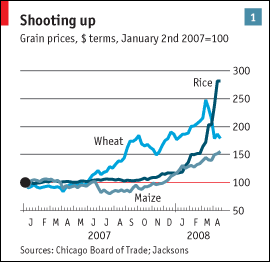
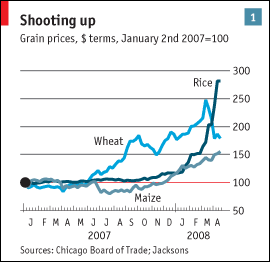 Globally one in six, or it might be seven live on $1 a day. Another 1.5 billion bask in the relative affluence of up to $2 a day. Some make do on the equivalent of 50 US cents. If they were not so concerned with feeding themselves and their families these people would not argue with the socialists’ assertion. The Economist reports that last year year wheat prices rose 77% and rice 16% and since January, rice prices have gone up 141%; the price of one variety of wheat shot up 25% in a day. It may sound glib but this really struck me the other night in the pub when a pint of a beer I occasionally drink had gone up by 30p in one week. That sort or rise translated into bread and meat prices is a real erosion of working people’s standard of living. In the ultra low wage societies this becomes a threat to the physical survival of hundreds of millions of people and the prospect of long term malnutrition with its consequent impact on physical and intellectual development.
The war that the World Bank waged against the Global South in the last two decades is starting to claim its victims. The insistence on free trade gave access to cheap US and European foods to local markets. This acted as a retardant on investment in local agriculture. The twenty first century twist in the tale is that the major cosmopolitan supermarket chains and their local imitators are now emerging in the retail sector. As you will have noticed in Tesco they like their fruit and veg to be cosmetically appealing and standardised. This mitigates against the sort of smallholding common in the Global South and prevents farmers selling their produce to the chains.
The global rise in food prices is generally attributed to rising consumption of meat and grain in China and India, biofuels and drought in Australia. What’s is less often mentioned is the fact that there are cynical people out there making a profit out of starvation. They are an unloved sub branch of the capitalist class – commodity traders.
The Indian Express reports:
This is a perfect situation for hedge funds to jump in and make a killing by driving prices even higher… Another force behind the recent price rises has been an influx of more speculative investors – including hedge funds, institutional and even retail investors. They trade aggressively, increase price volatility and are bringing a whole new meaning to the phrase ‘bet the farm’ —commodity index funds are another set of investors hoping to profit from a commodity boom.
We’ll take it for granted that most of the readers of this site are familiar with the arguments around biofuels. They’ve been summed up in the aphorism “food is used to fill fuel tanks rather than stomachs.” If you want more detail Fidel Castro produced a very good article on the subject. What you probably didn’t know is just how wasteful biofuel production is of water. A factory producing 50m gallons of biofuels a year needs about 500 gallons of water a minute. That might not be a problem in Manchester but in the Global South where access to clean drinking water is a luxury it is a criminal use of the stuff.
For the sake of argument let’s be Anglocentric and date the beginning of the neo-liberal counter revolution to Thatcher’s election victory in 1979. Nearly thirty years on capitalism still keeps one third of the world’s population on under two dollars per day and is likely to condemn the world’s poor to a long period of hunger, food insecurity, malnutrition and starvation. That’s something to bear in mind the next time you hear a politician talk about the superiority of the market.






 Liam redux
Leave a reply to Jason Cancel reply