
The document which John Rees has written for the upcoming SWP conference is an attempt to come to terms both with the split in Respect and the impact of the SWP’s involvement in systematic electoral work and the movement against the imperialist wars. It is a thought provoking document in terms of some of his descriptions of his own comrades’ behaviour, his account of the history and the conclusions he draws.
In setting the context of the debate John says that “the crisis in Respect is being handled in and personalised and destructive way”. Two paragraphs later he says that the central committee (CC) is “personalising the issue”. Further on he says that Lindsey German was “attacked so forcefully” at a CC meeting that the chair of the CC apologised for not stopping the attack. Note that it was not her ideas that were attacked. It was her. From the outside this looks like absolutely standard SWP procedure for dealing with dissenting voices. It is a technique that many former members of the SWP describe either receiving or witnessing and sends a clear signal to the rest of the organisation that an individual has fallen from grace. The alternative is to allow a thorough discussion of contentious issues and allow the membership to decide for itself. For an organisation which has the unofficial motto “bend the stick” the production of additional pre-conference discussion bulletins to allow the membership a chance to gauge the issues should not have presented a great challenge but John reports that this suggestion was voted down by the CC majority. Even at the best of times a leadership controlling and limiting discussion is an unwelcome constraint on internal democracy. At a moment when an organisation is looking to draw the experiences of a rich period of recent activity it creates an impression that there are very well defined limits to how free discussion can be.
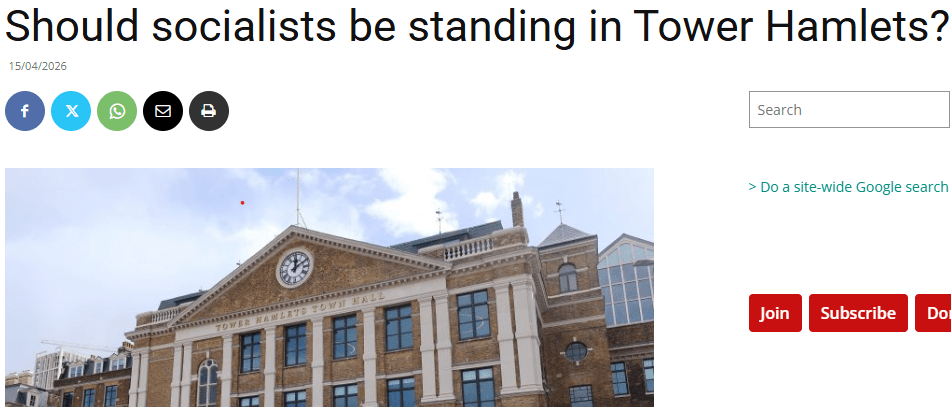
The interpretation of events in Respect is skewed and defensive. John writes “political differences in Tower Hamlets and Birmingham especially turned into acrimonious disputes over questions such as selection of candidates”. The sub committee which selected candidates in Tower Hamlets was numerically dominated by SWP members. They seemed to have a clear brief on who should get selected and why. A complication was that a new organisation had to find enough candidates to fight in every ward and many of the people who put themselves forward were almost totally unknown to the selection committee or the bulk of the membership. That was inevitable. What was avoidable was causing Bengali members to feel that they were being outmanoeuvred by socialist activists who had a much better grasp of procedure than they did. This was made worse by a perception that the serious political brain work had to be done by a small core group and that the function of the rest of Respect was to follow its orders. By trying to build and politically develop a cohesive and distinctive Respect political culture this could have been avoided. More usually, and perhaps to some extent understandably, the SWP’s way of working was simply grafted onto Respect.
Moving leftwards?
OFFU is given as an attempt to pull Respect “leftwards”. It was, and is, beyond question that Respect’s links with the unions are weak. OFFU looked like an attempt to kill them off completely. An event which had the ostensible purpose of engaging with rank and file trade union militants so completely resembled a SWP rally that it antagonised the very people in the audience it should have been pulling in. It painted a picture of an unappealing, stage managed, bureaucratically controlled front organisation. Its political impact was completely negative.
George Galloway’s letter was the catalyst which resulted in the split. John makes no mention of its contents and just asserts that George was reacting against a “left” turn. That’s not what the letter said. It was the work of a man who felt like many others that a summer election was a real possibility and was alarmed at how weak, small and disorganised Respect was. Articles saying pretty much the same thing had been carried in Socialist Resistance in the preceding months and the MP’s letter said nothing that anyone with eyes to see could deny. To borrow a phrase the SWP’s response was “handled in and personalised and destructive way”. By Christmas this had resulted in four of the SWP members most prominently sympathetic to Respect being expelled. The obverse of this was an attempt to “strengthen the Respect office politically” by asking two SWP CC members to work in it. Having a discussion through the structures of Respect of how to politically strengthen the office is not mentioned as an option.
Missing from the document is any discussion of why Respect was set up and, more importantly, if the period in which it is possible and necessary to build a broad class struggle party to the left of labour has ended. For John “the real question before the party is how we handle this reverse”. Yet that is a question which can only be answered properly by an organisation that has reached a conclusion about what is happening to New Labour and what sort of challenge the left can offer to it. The closest that the document comes to judging this is an assertion that “there will be no opening for a left of Labour electoral project until after the next election.” Even if we accept that this is true it offers only the hope of scrabbling around after the next election to create something new after a divisive and demoralising experience. It takes time to build up an organisation, recruit members, establish structures and a profile and this is not done in the weeks or months before an election. The Left List / Alternative is proof of that and its non-SWP members are left wondering why in the space of a few months the landscape of British politics has changed so dramatically that one week Lindsey German has a real chance of getting into the London Assembly and before Christmas the organisation is put in the deep freeze with Globalise Resistance and a bunch of other forgotten front organisations.
Leading role
Lack of recruitment is identified as a key problem and from what John says the SWP’s engagement in Respect was seen as the reason for this. What is conceptually interesting is that Respect was seen as one united front among many. So what could have been an important element in the realignment of the left of British politics was, for a number of SWP members, another bit of campaigning work which had to be kept under their organisation’s control and which should be used as a recruitment vehicle.
A similar approach informs relations with other forces on the left. The Public Sector Not Private Profit initiative involving Labour MP John McDonnell and the PCS was problematical because it was “controlled by forces hostile to the SWP, notably McDonnell’s office.” It was ditched in favour of a Charter which “allowed the SWP to play a leading role.” Having the “leading role” is more important than building a broad labour movement coalition with currents one may disagree with. This is a wrong political method which can only be motivated by a conception that one’s own organisation has the absolute right to be politically or numerically dominant in every field of activity and is actively detrimental to building effective working class resistance. This is explicitly stated when John writes “Had we not formed the Stop the War Coalition then others would have protested against the war with less adequate, less broad an
d less effective forms of organisation. It was always thus.” If this means anything it means that only without the SWP the anti-war movement would have been inadequate, narrow and ineffective. This is the world viewed through a very distorting prism.
Putting a premium on having the SWP in prime position in every initiative on the British left had an impact on the organisation’s internal functioning. Convincing the membership that the next big thing is even more important than the last big thing requires the leadership to “in a certain sense, exaggerate”. This is the origin of the “bend the stick” maxim. So instead of offering a long term strategic orientation the SWP’s leadership offered the members a sequence of important new campaigns. In the past year or so they were kept busy by Respect, defending themselves against a spurious witch hunt in Respect, the Left List, Love Music Hate Racism, the Left Alternative, PSNPP and the Charter. It’s worth noting that a couple of days after the London election results two leading SWP members called a demonstration in the name of two SWP front organisations through the Socialist Worker website. The intent was clearly to give the members something to do instead of reflecting on the elections. Just as suddenly the fascist danger evaporated. This is not a serious political perspective. It’s the work of a leadership trying to control an organisation by keeping the members busy. On occasion “bend the stick” can be a synonym for “mislead”.
Conclusions
Naturally as a longstanding leader of the SWP that organisation’s welfare is a major concern for John and this leads him to frame the perspective for the future in terms of its growth. Doing this requires “polemical and dynamic methods of leadership” and redoubling efforts to recruit. The model of the Scottish Socialist Party is dismissed out of hand with no reference to the SWP’s part in that split and no vision is offered of how to relate to radicalising working class militants who want nothing to do with New Labour but are not yet open to revolutionary politics. A document by one of the people best qualified to offer a clear balance sheet of the Respect experience says nothing about it and suggests that the only perspective for the coming years is to build revolutionary propaganda groups.
John’s document closes with a rebuttal of some points made by Neil Davidson in a document which raises the issue of internal democracy in the SWP. As an architect of the SWP’s structures John rejects Neil’s suggestions for a larger democratic space and less “top down” culture. While is essential point that the objective situation has been a severe limiting factor on the far left is correct that is not a persuasive argument for refusing to build a democratic functioning into the organisation’s daily life. Those of us who witnessed the direct transferral of the same methodology into Respect saw that it suffocated the organisation and the unspoken but widely understood rule was that ultimately real decision making authority inside Respect lay with the SWP. This was never going to be attractive to other forces looking for a political alternative to Labourism and that acknowledgement is something that has been absent from SWP accounts of what happened in Respect.
The value of John’s document is that it begins to explore the Respect experience and begins a discussion about what revolutionary currents need to do in the coming years. What it does not do is offer a convincing explanation of how the SWP managed to antagonise and burn its bridges with the forces which had collaborated to produce the first modestly successful working class electoral alternative. Instead of rejecting the SWP’s bullying and intimidatory internal culture and offering an organisation in which dissent is acceptable and valued it proposes a return to “polemical and dynamic leadership”. And finally instead of explaining how a relatively small propaganda group can help construct an alternative working class party it offers a return to building a slightly bigger propaganda group.
The document which John Rees has written for the upcoming SWP is an attempt to come to terms both with the split in Respect and the impact of the SWP’s involvement in systematic electoral work and the movement against the imperialist wars. It is a thought provoking document in terms of some of his descriptions of his own comrades’ behaviour, his account of the history and the conclusions he draws.
In setting the context of the debate John says that “the crisis in Respect is being handled in and personalised and destructive way”. Two paragraphs later he says that the central committee (CC) is “personalising the issue”. Further on he says that Lindsey German was “attacked so forcefully” at a CC meeting that the chair of the CC apologised for not stopping the attack. Note that it was not her ideas that were attacked. It was her. From the outside this looks like absolutely standard SWP procedure for dealing with dissenting voices. It is a technique that many former members of the SWP describe either receiving or witnessing and sends a clear signal to the rest of the organisation that an individual has fallen from grace. The alternative is to allow a thorough discussion of contentious issues and allow the membership to decide for itself. For an organisation which has the unofficial motto “bend the stick” the production of additional pre-conference discussion bulletins to allow the membership a chance to gauge the issues should not have presented a great challenge but John reports that this suggestion was voted down by the CC majority. Even at the best of times a leadership controlling and limiting discussion is an unwelcome constraint on internal democracy. At a moment when an organisation is looking to draw the experiences of a rich period of recent activity it creates an impression that there are very well defined limits to how free discussion can be.
The interpretation of events in Respect is skewed and defensive. John writes “political differences in Tower Hamlets and Birmingham especially turned into acrimonious disputes over questions such as selection of candidates”. The sub committee which selected candidates in Tower Hamlets was numerically dominated by SWP members. They seemed to have a clear brief on who should get selected and why. A complication was that a new organisation had to find enough candidates to fight in every ward and many of the people who put themselves forward were almost totally unknown to the selection committee or the bulk of the membership. That was inevitable. What was avoidable was causing Bengali members to feel that they were being outmanoeuvred by socialist activists who had a much better grasp of procedure than they did. This was made worse by a perception that the serious political brain work had to be done by a small core group and that the function of the rest of Respect was to follow its orders. By trying to build and politically develop a cohesive and distinctive Respect political culture this could have been avoided. More usually, and perhaps to some extent understandably, the SWP’s way of working was simply grafted onto Respect.
Moving leftwards?
OFFU is given as an attempt to pull Respect “leftwards”. It was, and is, beyond question that Respect’s links with the unions are weak. OFFU looked like an attempt to kill them off completely. An event which had the ostensible purpose of engaging with rank and file trade union militants so completely resembled a SWP rally that it antagonised the very people in
the audience it should have been pulling in. It painted a picture of an unappealing, stage managed, bureaucratically controlled front organisation. Its political impact was completely negative.
George Galloway’s letter was the catalyst which resulted in the split. John makes no mention of its contents and just asserts that George was reacting against a “left” turn. That’s not what the letter said. It was the work of a man who felt like many others that a summer election was a real possibility and was alarmed at how weak, small and disorganised Respect was. Articles saying pretty much the same thing had been carried in Socialist Resistance in the preceding months and the MP’s letter said nothing that anyone with eyes to see could deny. To borrow a phrase the SWP’s response was “handled in and personalised and destructive way”. By Christmas this had resulted in four of the SWP members most prominently sympathetic to Respect being expelled. The obverse of this was an attempt to “strengthen the Respect office politically” by asking two SWP CC members to work in it. Having a discussion through the structures of Respect of how to politically strengthen the office is not mentioned as an option.
Missing from the document is any discussion of why Respect was set up and, more importantly, if the period in which it is possible and necessary to build a broad class struggle party to the left of labour has ended. For John “the real question before the party is how we handle this reverse”. Yet that is a question which can only be answered properly by an organisation that has reached a conclusion about what is happening to New Labour and what sort of challenge the left can offer to it. The closest that the document comes to judging this is an assertion that “there will be no opening for a left of Labour electoral project until after the next election.” Even if we accept that this is true it offers only the hope of scrabbling around after the next election to create something new after a divisive and demoralising experience. It takes time to build up an organisation, recruit members, establish structures and a profile and this is not done in the weeks or months before an election. The Left List / Alternative is proof of that and its non-SWP members are left wondering why in the space of a few months the landscape of British politics has changed so dramatically that one week Lindsey German has a real chance of getting into the London Assembly and before Christmas the organisation is put in the deep freeze with Globalise Resistance and a bunch of other forgotten front organisations.
Leading role
Lack of recruitment is identified as a key problem and from what John says the SWP’s engagement in Respect was seen as the reason for this. What is conceptually interesting is that Respect was seen as one united front among many. So what could have been an important element in the realignment of the left of British politics was, for a number of SWP members, another bit of campaigning work which had to be kept under their organisation’s control and which should be used as a recruitment vehicle.
A similar approach informs relations with other forces on the left. The Public Sector Not Private Profit initiative involving Labour MP John McDonnell and the PCS was problematical because it was “controlled by forces hostile to the SWP, notably McDonnell’s office.” It was ditched in favour of a Charter which “allowed the SWP to play a leading role.” Having the “leading role” is more important than building a broad labour movement coalition with currents one may disagree with. This is a wrong political method which can only be motivated by a conception that one’s own organisation has the absolute right to be politically or numerically dominant in every field of activity and is actively detrimental to building effective working class resistance. This is explicitly stated when John writes “Had we not formed the Stop the War Coalition then others would have protested against the war with less adequate, less broad and less effective forms of organisation. It was always thus.” If this means anything it means that only without the SWP the anti-war movement would have been inadequate, narrow and ineffective. This is the world viewed through a very distorting prism.
Putting a premium on having the SWP in prime position in every initiative on the British left had an impact on the organisation’s internal functioning. Convincing the membership that the next big thing is even more important than the last big thing requires the leadership to “in a certain sense, exaggerate”. This is the origin of the “bend the stick” maxim. So instead of offering a long term strategic orientation the SWP’s leadership offered the members a sequence of important new campaigns. In the past year or so they were kept busy by Respect, defending themselves against a spurious witch hunt in Respect, the Left List, Love Music Hate Racism, the Left Alternative, PSNPP and the Charter. It’s worth noting that a couple of days after the London election results two leading SWP members called a demonstration in the name of two SWP front organisations through the Socialist Worker website. The intent was clearly to give the members something to do instead of reflecting on the elections. Just as suddenly the fascist danger evaporated. This is not a serious political perspective. It’s the work of a leadership trying to control an organisation by keeping the members busy. On occasion “bend the stick” can be a synonym for “mislead”.
Conclusions
Naturally as a longstanding leader of the SWP that organisation’s welfare is a major concern for John and this leads him to frame the perspective for the future in terms of its growth. Doing this requires “polemical and dynamic methods of leadership” and redoubling efforts to recruit. The model of the Scottish Socialist Party is dismissed out of hand with no reference to the SWP’s part in that split and no vision is offered of how to relate to radicalising working class militants who want nothing to do with New Labour but are not yet open to revolutionary politics. A document by one of the people best qualified to offer a clear balance sheet of the Respect experience says nothing about it and suggests that the only perspective for the coming years is to build revolutionary propaganda groups.
John’s document closes with a rebuttal of some points made by Neil Davidson in a document which raises the issue of internal democracy in the SWP. As an architect of the SWP’s structures John rejects Neil’s suggestions for a larger democratic space and less “top down” culture. While is essential point that the objective situation has been a severe limiting factor on the far left is correct that is not a persuasive argument for refusing to build a democratic functioning into the organisation’s daily life. Those of us who witnessed the direct transferral of the same methodology into Respect saw that it suffocated the organisation and the unspoken but widely understood rule was that ultimately real decision making authority inside Respect lay with the SWP. This was never going to be attractive to other forces looking for a political alternative to Labourism and that acknowledgement is something that has been absent from SWP accounts of what happened in Respect.
The value of John’s document is that it begins to explore the Respect experience and begins a discussion about what revolutionary currents need to do in the coming years. What it does not do is offer a convincing explanation of how the SWP mana
ged to antagonise and burn its bridges with the forces which had collaborated to produce the first modestly successful working class electoral alternative. Instead of rejecting the SWP’s bullying and intimidatory internal culture and offering an organisation in which dissent is acceptable and valued it proposes a return to “polemical and dynamic leadership”. And finally instead of explaining how a relatively small propaganda group can help construct an alternative working class party it offers a return to building a slightly bigger propaganda group.




 Liam redux
Leave a reply to The Digger Cancel reply