image I’m away for a bit to a place where there are lots of forest fires so to make up for very intermittent writing I’d thought I’d go for a bit of gratuitous controversy.
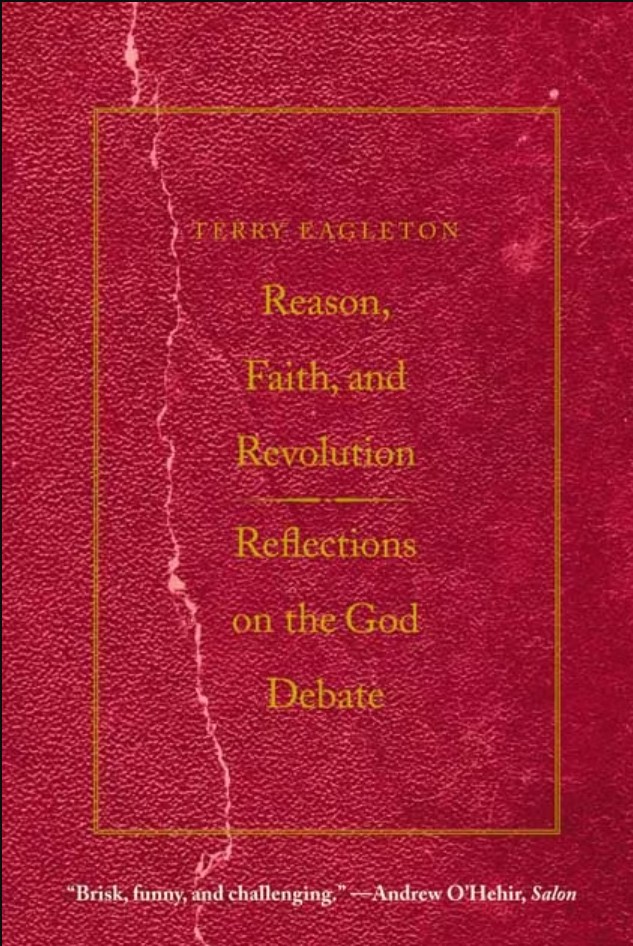
“Ditchkins” is Terry Eagleton’s coinage, an amalgam of the names of Richard Dawkins and Christopher Hitchens and he has great sport at their expense in his recent book Reason, Faith and Revolution: Reflections On The God Debate.

The God Delusion was a muscular and enjoyable statement of the case for godlessness at a time when unpleasant forms of religious belief were running the world.  Yet even as you were reading you could not help but think that Dawkins hadn’t really worked out why so many people have held onto religious faith despite all the reasonable evidence to the contrary. In particular he was very weak at understanding that religion can be a political phenomenon too and that it does genuinely offer people a sense of community and comfort that they fail to find anywhere else in the world.

Early on Eagleton, who remains a Marxist and an atheist,  offers an account of Christian faith that matches what lots of believers do. “It is a question of feeding the hungry, welcoming the immigrants,  visiting the sick and protecting the poor, orphaned and widowed from the violence of the rich. Astonishingly, we are saved not by a special apparatus known as religion, but by the quality of our relations with one another.”

You will find echoes of Karl Kautsky’s account of the revolutionary content of primitive Christianity which he described in Foundations Of Christianity (available from Socialist Resistance books). It was a religion of slaves, the lumpenproletariat and it was offering them justice and fellowship. And as if proof were needed that Eagleton still anchors himself in a brand of revolutionary Marxism he asserts that the two greatest betrayals ever suffered by an ideologies were the Stalinist corruption of Marxism and what the Church did to faith. Kautsky also explored this idea of how a movement of the power and the dispossessed can become hierarchical and bureaucratised and any union in the country is daily testament to the living process.

All through the work Eagleton draws parallels between what Marxists do – or should do- and Christian faith. Marxism for him was partly a response to a Christianity which betrayed its origins and then went on to repeat the mistake.

Some of the best fun in the book comes when Eagleton opens his broadsides against liberalism and, even worse, secular liberal imperialism. After all the it was the liberal democracies which spent good portions of the 19th, all the 20th and the 21st stealing people’s land, dropping nuclear bombs, starting war and changing the climate to the massive detriment of the world’s poor. Liberals have a habit of acquiescing to this, though to be fair so do social democrats.

Over and over again he takes Hitchens and Dawkins to task for their determined ignorance of the theology they set out to criticise reminding the reader that you would not take too much note of someone’s opinion on the finer points of mammalian biology if they’d not read much more than The British Book of Birds. What distinguishes Eagleton is that he did what Marxists are supposed to do and familiarised himself with the subject he was critiquing and while it is not likely to spur the casual reader to start reading a lot of theology it is a helpful set of signposts if you feel inclined to explore the subject further.

If you have ever been at one of the Strangers Into Citizens demonstrations a lot of what Eagleton has to say makes perfect sense. Of course it’s right to have an understanding of the materialist arguments against religion but it would also enrich our thinking of what religion is for lots of ordinary people if we take on board the ideas in this book.

111 responses to “Kerpow!! Take that Ditchkins!”

  1. I can’t say I agree with you Liam, I read Eagleton’s book and thought it was pretty terrible.
    Aside from the issue of style, terribly in-house, smug academic and stilted, it seems to me Eagleton just presents his one sided version of Christianity – its basically good based on “hope” and “love” – to Ditchens one sided version – its basically bad based “evil” and “hate” – so one account is just the inversion one of the other.
    The class struggle is mentioned not once, the working class doesn’t really appear at all and in its a step back from Ditchens in that at least they oppose religion, which is after all, the opium of the masses.
    That’s leaving aside Eagleton’s pronunciations on true Islam something which at the outset he concedes he knows nothing about.

    Like

  2. We’ll have to disagree on this Bill. All through Eagleton’s book it’s taken for granted that the world is split between the powerful and the exploited and he is giving a corrective to Dawkins’ one dimensional critique. He freely admits his ignorance of Islam and assumes that his readers are already acquainted with religious horror.

    Like

  3. strange to describe Eagleton as either a marxist or an atheist- he doesn’t seem to fulfill the necessary requirements for either label- Catholic Stalinist is probably closer.

    Leaving aside Hitchens and concentrating only on Dawkins- it’s unfair to criticise him for a lack of appreciation of theology- the “god delusion” doesn’t set out to demonstrate a reason or not in society for religion, only that God doesn’t exist. Moreover it’s akin to criticizing Charles Darwin for not paying sufficient notice to alchemists; my view is since go does not exist then theologists shouldn’t either.

    It takes a pretty idealistic view of christianity to find it a force for social good only diverted by the church as you sem to suggest (apart from obviously the early days of christianity where it was necessarily progressive compared to the religion it split from, otheriwse it had no purpose); christianity is the church and vice versa for all but a tiny minority of believers. The assorted arsehole vicars, priests, rabbis and preachers of the various religions who routinely appear on Thought for the Day are always socially conservative and illiberal compared to the majority of society and especially when compared with progressives.

    Eagleton’s failure is that he misses the points of Dawkins crusade: that mass believing in something that is clearly untrue is bad for society whether it leads to minor social improvement or not; and that anyway that mostly religion leads to an increase in badness in the world.

    Anyone wishing to claim to be a Marxist has to base their analysis on truth. The truth is hat there is no god and so any claims otherwise are delusions or lies. We have some duty not to let such a basic concept be eroded by ex-socialists having a mid-life crisis.

    Like

  4. Dawkins’ campaign to keep creationism and intelligent design out of the science classroom should be backed by every progressive thinking person. I don’t think anybody sends their children to school to be brainwashed but to learn. Dawkins is only defending enlightenment values and when he talks about `probability’ not as rigorously as I would like.

    Hitchens: who knows what motivates him? I don’t care what he says and though I have enjoyed Eagleton in the past this campaign against Dawkins is silly and seems to be motivated by nostalgia for his Catholic childhood.

    Like

  5. I find it fairly amusing to read the arrogance of Marxists – supporters of an ideological system with less than 200 hundred years behind it, with a seemingly endless series of schisms, a number of viciously repressive states that have claimed to follow its tenets, and less followers than any of the major and most of the minor religions. Yet so many Marxists claim to have ideological superiority to Christians on the basis of which any Christian could easily throw back in the face of Marxists. Ah, but the Soviet Union wasn’t really Marxist. Ah, but the Catholic hierarchy doesn’t really represent the spirit and teachings of Christianity. A little humility is frankly in order. It reminds me of Trotsky and Lenin’s admonitions against those supporters of proletcult and Lef in the USSR who disdained all art from before the revolution and felt that nothing was good in bourgeois art. Trotsky wrote that true revolutionaries sought to master the ideas of the past – which were always contradictory – to take from them what is useful for the liberation of humanity.
    As for Dawkins arguments about god – frankly any arguments about god beyond that “he” will intervene to save our asses – are utterly stupid scholasticism. We know not one thousandth of one percent about the universe. To make pronouncements on the ultimate nature of reality, teleology, the beginning or end of time, is not only irrelevant to political practice, it’s as scientifically foolish as claiming that humans would never fly prior to the Wright Brothers. As far as Marxists are concerned, the only point that matters is that humans are on their own when it comes to their liberation.

    As for religion, Kautsky had it about right in his Foundations of Christianity, locating the degeneration of the Christian church as much in the social conditions of the time as in the weakness of Christian ideology, which was itself a product of the defeat of the Jewish revolt against Rome, at least in the period of its rapid growth amongst non-Jews. Marxists, being materialists, always put social existence ahead of the ideas in people’s heads and Christianity (like Marxism) was always an evolving set of ideas, existing under the pressure of contradictory pressures over hundreds upon hundreds of years. People, like Dawkins and Hitchens who see religion as the source of problems in the world are liberals and idealists who see education as the solution and not the transformation of social relations. Just to be clear, religion as an organizing principle has just as often played a revolutionary and progressive role as it has a reactionary one – whether it was the radical Protestants of the Reformation, the liberation theologists in Latin America, the Islamic followers of people like Dr. Ali Shariati, or the Zealots, Essenes and Christians prior to and during the Jewish revolt against Rome. Here, in North America, the social gospel movement (which created Canada’s labour party), the Chautaqua movement, the Black Baptist Church, the Nation of Islam – all have been sources of revolutionary energy. Those who arrogantly strut about proclaiming the ultimate and singular truth of Marxism (an idea that the liberal Dawkins would never support) will find themselves exactly where they ought to be – in the wilderness.
    It’s also remarkably ahistorical: Marx and Engels fought against the tottering ancien regimes of Europe, whose ideological justifications were found in particular forms of the Christian religion. They needed to be exposed and struggled against. That battle was won, oh, 150 years ago. The biggest enemy now is secular, imperialist, liberalism.

    Like

  6. “The biggest enemy now is secular, imperialist, liberalism.”

    Imperialism is now the highest stage of liberalism?

    Like

  7. “I find it fairly amusing to read the arrogance of Marxists…”

    No kidding!

    Like

  8. redbedhead: what a load of meaningless, smarmy waffle.

    You have a clear choice in this issue. Stand against the Christian Zionist campaign for the insinuation of creationism and intelligent design into the science curriculum or capitulate to it. That will require a critique of idealism (and not theology as Eagleton unhelpfully obscures) whether you or anybody else likes it or not.

    As for how Marxists relate to the religious masses, that is always a tactical question usually founded on practical arrangements rather than political or programmatic adaptation or surrender but I wouldn’t expect SWPer to understand the united front tactic.

    Like

  9. prianikioff – liberalism is the ideology of capitalism. I’m talking about the ideological struggle, obviously, since the discussion here is about religion.

    David Ellis – “Christian Zionist campaign”? What? I have never heard of zionists pushing for creationism in the classroom. And if you think that the question of creationism vs evolution is the alpha and omega of questions on religion you have a pretty narrow conception of religion and you certainly know nothing about the North American political landscape, where the creation debate is primarily taking place.
    Christian belief is extremely complex and multi-faceted in North America, from the Quakers, who continue to play a quiet but important role in the anti-war movement, helping to spirit war resisters up to Canada, providing them with shelter, etc. to the very organized religious right. Theology in some abstract general sense isn’t the problem – the problem is the right wing, which is a political and not a theological question.
    And, as far as the religious right is concerned evolutionism vs creationism isn’t even the central struggle today. More so is the religious right’s justification for American imperialism, viz. manifest destiny, as they provide the central core of the neo-cons. Or their attempt to roll back women’s rights viz abortion or attack gays and lesbians. Creationism is a second string battle.

    As for your ridiculous dig about the SWP and united front tactics, it’s too schoolyard to deserve a reply.

    Like

  10. redbedhead – I see you don’t mention the murder of the mathematician Hypatia by a Christian mob.I think you are wrong to compare an ideology based on fallible humanity’s attempts to understand and change the world with a religion that is supposed to draw its inspiration from an omniscient God.

    Until recently it was still considered bad form even in one of the most secular countries in the world(UK) to attack religion, and so the idea that “there are no atheists in foxholes” has persisted, and many of those with atheist ideas have thought they were isolated and alone. In the US it is still impossible for a president to be elected without professing religious faith. So I don’t think that secular liberal imperialism quite covers the field.

    Like

  11. Skidmarx – Hypatia? Huh? You’re right, I don’t mention her, because it’s irrelevant. And I think you misunderstand that nature of religion and the history of Christianity. Religion springs from an attempt to understand the world and engage with it. It has moral, philosophical, scientific, legal, etc. aspects to it. To reduce it to “opium” is just silliness. There is some reason to believe that the early Christians were, in reality, part of the most radical wing of the urban insurgency in Jerusalem during the war against Rome in 66-73AD. That they later came to transform an ideology that was based upon struggle against the rich and the occupiers into one of a contradictory and incomplete accommodation to power was determined more by the total victory of Rome over its restive provinces than by flaws in the ideology of early Christianity. And it took place over hundreds and hundreds of years.
    And Christianity is not a closed system – precisely because it embodied the early revolt and the later accommodation. You can have the religious right in America, as well as Liberation Theology or the left liberals of the Unitarian Church, the United Church, etc. Even within evangelicalism there are fractures and fragments that are, ultimately, of a political nature – Jim and Tammy Faye Bakker’s son founded Revolution Church, based upon a rejection of dogmatism and intolerance.
    In any case, religion isn’t the source of problems in the world, the problems are rooted in class society in general and capitalism in particular. And, yes, the ideology of capitalism is liberalism. And the ideology of the USA is secular liberalism, regardless of whether the president needs to affirm that he is himself a believer. I follow the wikipedia on this question:

    “In one sense, secularism may assert the right to be free from religious rule and teachings, and freedom from the government imposition of religion upon the people, within a state that is neutral on matters of belief, and gives no state privileges or subsidies to religions. (See also Separation of church and state and Laïcité.) In another sense, it refers to the view that human activities and decisions, especially political ones, should be based on evidence and fact unbiased by religious influence.[1]”

    Of course the US is not thoroughly and completely secular – it was founded by Christians and that still marks the society (and is something about which there continues to be struggle). But it is predominantly secular.

    Like

  12. In what sense is Eagleton supposed to be a Stalinist?

    Given that its the AWL with their peculiar stages theory of history (viz. first we have secularism then we have socialism, therefore lets make alliances with everyone who is secular against everyone who is religious) who look pretty stalinist this seems an ironic accusation to say the least.

    Like

  13. oh and thanks for the review…it sounds a wonderful Marxist account of religion. Just what we need. Incidently a Marxist who really DID become a catholic has a lecture on-line about the development of his philosophy. If you scroll down the announcement you’ll find Alasdair MacIntyre speaking on ethics, religion, marxism and analytical philosophy…and much else. Its worth a listen if you are interested in that sort of thing.

    http://www.facebook.com/ext/share.php?sid=128966802564&h=4dQ6X&u=hNwBU&ref=mf

    http://www.facebook.com/ext/share.php?sid=128966802564&h=4dQ6X&u=hNwBU&ref=mf

    Like

  14. Yes, the followers of religious sects amongst the peasantry and oppressed nationalities can sometimes play a revolutionary role

    Engels made this point about Thomas Müntzer in his book “The Peasant War in Germany”
    Another more recent example is the Taiping rebellion in China. – They were heroic failures.

    Which is why Engels desribed “the theoretical expression of the proletarian movement” as Scientific Socialism and not “Religious Socialism”.

    Like

  15. Prianikoff – and that is why I’m a Marxist. But it is different to say that religiously-based methods of organizing have limitations on their ability to succeed (whether because they are defeated or because they win and are unable to implement their program) and, as David Ellis does (or Dawkins and Hitchens) to make the struggle against religion the central struggle. Our movement is secular, not because we demand its adherents be atheist. It is secular because we organize on a class, not confessional, basis. I repeat:
    1) religion is not the problem – the source of the greatest ills on the planet today are avowedly secular, liberal states.
    2) religion is a complex phenomenon that includes many traditions, sophisticated philosophical and ethical thinkers, insights into the natural and social world. Religion is the origin of most human thought – humans thought things in nature moved by way of spiritual forces (which is often not far from the truth when one thinks of, say, magnetism) and that certain types of behaviour (rituals, certain moral precepts) would influence those forces for good or bad. The refinement of that impulse becomes science, politics, art, etc.
    3) Under socialism there will still be some form of religious or spiritual belief, though it will be transformed in character. The awe of the universe, of death, birth, etc. will still inspire rituals of celebration or of repulsion and fear. We are beings of ritual as much as of language (in fact, most of our daily language is ritual “hello. goodbye. take care. how are you?”).

    Like

  16. “And I think you misunderstand that nature of religion and the history of Christianity. Religion springs from an attempt to understand the world and engage with it.”

    Quite the opposite, these days religion springs from an attempt not to understand the world and engage with it, at least on behalf of many of its followers, who, in case you hadn’t noticed, reject a scientific explanation of the world.
    If you’re a Marxist, then its a pretty poor show to claim that just because some of religions earliest believers may have had a different intention then that is the case for all religions throughout time. Ideas are after all a product of society, which as it happens, changes.

    Like

  17. BTW its stretching it to claim that the USA is a liberal or secular state, certainly not under Dubya. And Tony Blair was probably the most religious prime minister in recent history.

    Like

  18. Dubya, Obama, Clinton, whatever – the fundamental character of American society hasn’t changed under any of them, whether Dubya was a born-again Christian and Clinton a secular, adulterous, liberal intellectual. There are fights more or less around the fringes but the American state is still officially and primarily a secular state. This is not about individuals, it is about the social character of modern capitalist states.

    Like

  19. “these days religion springs from an attempt not to understand the world and engage with it, at least on behalf of many of its followers, who, in case you hadn’t noticed, reject a scientific explanation of the world.”

    That’s a pretty large generalization about the majority of the population on the planet. It’s also not the case that all belief in God is in contradiction with a scientific worldview. The Islamic viewpoint of God is that all of nature’s laws, all the matter in the universe is God – or at least one aspect of God, there’s a complex discussion of the relationship of God to divisibility and indivisibility within the Islamic tradition. Seeking to understand the rules, laws, forces, etc. of the universe is part of the struggle to know and understand God.
    The anti-science component within religion is primarily restricted to a very limited section of US-based Protestant fundamentalists. And even here it is only in relation to very specific disciplines or, rather, sub-disciplines, which most directly relate to moral, political and social knowledge. Evolution is a challenge because it implies the idea of change, of chance, etc. that takes place outside of the control of God. Abortion and stem-cell research is a challenge to the control of the human body for the purposes of reproduction.
    When you speak of religion you need to be specific and concrete.

    “If you’re a Marxist, then its a pretty poor show to claim that just because some of religions earliest believers may have had a different intention then that is the case for all religions throughout time.”

    I never claimed any such thing. I claimed that religion is a complex phenomenon whose roots are not solely or even primarily in the realm of ideological obfuscation or in the alleviation of mental suffering – the opiate aspect of which Marx wrote. As it happens I think Marx’ early writings on religion (and he himself didn’t say too much after that) were coloured by the struggle in Germany against the feudal regime and the reminiscences of the French Revolution (the past weighing like a nightmare on the brains of the living, and all that.)

    Like

  20. It’s also worth noting that an “anti-scientific progress” viewpoint isn’t necessarily socially regressive. The Luddites were a radical movement that Marxists would have supported, even though we would have had differences. In fact, Marxists regularly support workers’ struggles against technological job losses – surely this is an “opposition to science.” It’s not a surprise that some people, seeing technological unemployment, would see science as a thing that rises up in opposition to them, an alien thing, and would reject it. Better that, frankly, than if they were to shrug and say “Well, that’s science for you – one can’t argue against the scientific method.”

    Like

  21. redbehead: what are the chances of you fucking off and dieing? Surely someone in the otherworld would be interested in your brand of religio-marxism?

    Like

  22. “That’s a pretty large generalization about the majority of the population on the planet.”

    Certainly no larger than the generalisation that;

    “Religion springs from an attempt to understand the world and engage with it. It has moral, philosophical, scientific, legal, etc. aspects to it.”

    As for your claim that;

    “It’s also not the case that all belief in God is in contradiction with a scientific worldview.”

    That’s pretty as funny. More to the point its not easy to see how you can have a scientific view of say…society…if you think that it was all created by a super natural being. You claim to be a Marxist? I take it you have heard of materialism? You know, its that philosophical belief system that’s counter posed to… idealism?

    As for you claim that;

    “There are fights more or less around the fringes but the American state is still officially and primarily a secular state.”

    Do you believe everything that’s official?

    Like

  23. Cross posted with Dave Ellis. Is there no way of stopping this foul mouthed bore from posting?

    Like

  24. Is there no way of you fucking off for ever tosser?

    Like

  25. Bourgeois poseur.

    Like

  26. David Ellis – will you say something rude to me?

    Like

  27. Yes Will, you are a cunt. I’m very obliging.

    Like

  28. splinteredsunrise Avatar
    splinteredsunrise

    I don’t say this very often, but I agree with redbedhead. And since much of British Marxism functions on the level of a cargo cult, some thought about glass houses and stones should come into play before anyone denounces irrationalism.

    Like

  29. splinteredsunrise – I like you more just because you used the term cargo cult in relation to British Marxism. I think I’ll be giggling all night at the mental images you’ve generated.

    Like

  30. billj – In response to your argument that I’m generalizations about specific things viz:
    1) “Religion springs from an attempt to understand the world and engage with it. It has moral, philosophical, scientific, legal, etc. aspects to it.”

    I have to say that I find it surprising that this would even be controversial. Religion is a form of knowledge that has many facets to it, whether you think they are false or not is another question. It obviously and self-consciously engages with the broader world as an attempt to explain, even if that explanation is, for instance that such and such occur because of original sin.
    And obviously religion is more than just “God exists in heaven”. There are certain truth claims about the world, how it came to be, what constitutes appropriate behaviour (the ten commandments), proper forms of political organization (the caliphate, the levels of angels, bishops, etc.), attitudes to the study of nature, law (sharia, et al), etc.

    2) “It’s also not the case that all belief in God is in contradiction with a scientific worldview.”

    You seem to be under the impression that religion stops at the claim that there is a God in heaven, now do as he says. But it doesn’t. Religion is partly, sometimes mostly, idealist – but it isn’t fully idealist. When the early Christians – along with most popular Jewish religion – talked about the Kingdom of Heaven on Earth, and the coming of the Messiah – they were talking about killing Romans and rich people, destroying the debt ledgers (as they did in 66AD), under the leadership of a warrior-general-prince. Pretty material stuff. That they imagined the Messiah would be sent by God was in no small part a reflection of the fact that about the only way they could hope to defeat the Romans was to have a general who was sent by God. Materially, it wasn’t going to happen.
    But in the context of the present, nobody can read the writings of Dr. Ali Shariati, who died before the Iranian Revolution but inspired the more radical, leftist Islamists, and not see an analysis of society. I don’t agree with all of it – I’m not a left Islamist – but I respect its engagement with the real issues faced by a colonial people, its subtlety, etc. – just as much as Frantz Fanon’s.
    In relation to the natural sciences, engineering, etc. – you know, you can believe that the universe was the creation of a “supernatural being” and still believe that you need a scientific method – experimentation, certain forms of logical argument and examination, repeatable results, etc. Why are these things counterposed?

    3) “There are fights more or less around the fringes but the American state is still officially and primarily a secular state.”
    billj: “Do you believe everything that’s official?”

    Huh? There are some pretty clear measures, I’d say. The legal system is not, as in Iran, for instance, explicitly structured around the Ten Commandments. The testimony of a Muslim is not officially/formally worth less than that of a Christian. There are not laws, regulations and so forth that are structured around Christianity.
    Is there discrimination? Is America Islamophobic? Are there contradictions and tensions rooted in both America’s history as a Protestant nation (Manifest Destiny) and in present struggles within the ruling class and beyond. Of course. But it isn’t even remotely comparable to, say, feudalism in which the Church and state were merged.

    Like

  31. Flannel.

    Like

  32. David Ellis – here’s a quote from your favourite “bourgeois poseurs”. Enjoy!

    “Our Bolivarian revolution is very Christian and I have a friend who isn’t Christian, but lately has said he is a Christian in the social aspect: his name is Fidel Castro,” Chávez announced. “I talk to [Castro] a lot about Christ each time we see each other, and he told me recently, ‘Chávez, I’m Christian in the social sense.’”

    http://www.discoverthenetworks.org/Articles/Saint%20Hugo.html

    Like

  33. billj – oops, my first sentence has some bad grammar. Teach me to talk while writing…

    Like

  34. redbedhead: I bow to your christ-like personna.

    Like

  35. no doubt billj will play john the babtist next.

    Like

  36. I’d prefer if you would just take collections amongst my faithful and deposit the money in a tax-free account in the Cayman’s, thank you very much. We could start with you – a cheque for a thousand dollars would be a nice start.

    Like

  37. Thanks Liam for the heads up. Many of the ideas are probably in his LRB review of Dawkins at http://www.lrb.co.uk/v28/n20/eagl01_.html but the book looks well worth it. My own stab at a summary of the orthodox Marxist position is at http://www.greenleft.org.au/2006/677/8205

    Eagleton is a witty and clear, if somewhat heterodox, Marxist critic. His /Ideology: An Introduction/ is essential. Anyone calling him Catholic, Stalinist or smug is, I’m sorry, an ignorant philistine.

    Some of the ferocious crusaders against religion making points above should be introduced to the concept of dialectics. The social and political effects of religion can be good or bad, even partly both at the same time. Read some Marx, Engels, Lenin, Trotsky, Kautsky and Castro on this FFS. And maybe ask themselves who’d they’d prefer next to them on a barricade: Richard Dawkins or a Latin American Catholic Marxist.

    “Intelligent design” is a complete joke here in Australia and I would think in Europe too. Islamophobia is a far bigger threat. Last week the pathetic cowards of the state Labor government denied permission for a new Islamic school in outer Sydney after a revolting campaign including pigs’ heads on sticks. No doubt the fascists of the Australia First Party were happily inflaming matters and recruited out of it. Heroic victory for secularism though.

    Like

  38. Or maybe Pontius Pilate?

    “…whether you think they are false or not is another question.”

    So now that’s a matter of opinion?

    “you can believe that the universe was the creation of a “supernatural being” and still believe that you need a scientific method”

    Err…no you can’t. That’s not to say some scientists for example obviously do believe in God. But in their area of study, they have to rely on materialism if they are to be scientific.

    And your assertion that the main threat is secular liberalism simply ignores the facts. The Neo-Cons who launched the war on terror, were religious and extremely right wing.

    Like

  39. Redbedhead, you’re infected by the new meme going around the IST, exemplified by Roland Boer’s article in the last International Socialism Journal.
    The punchline being:-
    “..the sheer diversity of the left is one of its great achievements. Within this diversity, a religious left has a legitimate and crucial role to play.”
    There we have it.
    Not a UNITED FRONT between socialists and left religious sects.
    Not acceptance of religious believers in a Socialist organisation if they promote its programme.
    But a RELIGIOUS LEFT.
    All couched in terms of Pauline “celebration of diversity”, the slogan of real, practical Christianity’s historic mission of imperial integrationism.
    Amazing stuff!
    This represents not just yet another turn away from the working class,but its ideological codification.
    Accept this and it will be from a scratch to a gangrene.
    I can only assume that the remaining members of the IST are a bunch of whipped curs no longer capable of any critical thought.

    Now I understand why Jonathan Neale reminded me of a Baptist Preacher the other night.
    – Part acocalyptic revolutionary, part snake-oil salesman.
    Why he envisioned all the Church Bells on the Isle of Wight ringing the alarm and why he was so uncritical of the Liberals.

    This is the line being pushed to a workers occupation? Jesus wept.

    Like

  40. external bulletin Avatar
    external bulletin

    I also don’t agree with redbedhead very often (or “ever”, to use common left-wing parlance), but his posts in this thread are an excellent – and properly Marxist – way of looking at things.

    Like

  41. I suspect that Nick Fredman is correct when he suggests that many of the arguments in Eagleton’s book originate in his attack on Dawkins in the LRB review. I have to say that I found that review poor and unconvincing at the time, and I won’t be rushing out to buy the book.

    I’m disappointed too with what I’ve read in Liam’s post and in some of the responses on here. Both Dawkins and Hitchens have written powerful polemical attacks on religion and idealism. Dawkins however is weak and naive on political issues; Hitchens (as we all know) is positively poisonous. But that doesn’t mean that everything they’ve written needs to be confined to the dustbin. Someone on here mentioned the need to look at these issues dialectically; well quite, and that cuts both ways…

    Like

  42. The old enlightenment view of religion: that it is a wicked conspiracy cooked up by elites to keep the masses in thrall to the feudal order is, shocking though this might seem to some, the view that Marx combatted when he was developing his ideas about not just religion but historical materialism. Everywhere he wrote of its contradictory charecter. This was part of larger scientific progress in understanding ideology (its why he argued that the ‘beginning of all criticism is the criticism of religion: it was the field in which more sophisticated ideas about how ideology worked began to be discussed). As more modern critics of ideology have put it: don’t look to the function of ideas in society: look to the contradictions they express.

    One classic instance of the result of not moving beyond the radical enlightenment in the critique of religion was revealed in a pretty ubiquitous critique of molyneux’s article on religion from the right. When he stated that Marxists regard as more radical a peasent influenced by Hamas then the most secular of critics in the west he was accused of many things idiotically. But the point is that the attitude to be taken to Hamas is not a religious but a political question. In other words its a debate about the Palestinian national question not about ‘religion’. Which was of course the whole point of his statement.

    Like

  43. I’m also puzzled incidently about why anyone would think the idea of a ‘religious left’ an oxymoron. Its pretty common to have had a religious left.

    Like

  44. ext.bull: “an excellent – and properly Marxist – way of looking at things.”

    Here’s how some Marxists looked at the same issues:-

    “One Sunday I went with Lenin and Krupskaya to a Social Democratic meeing in a church, where speeches alternated with singing hymns.

    The principal speaker was a compositor who had just returned from Australia. He spoke of the Social Revolution. Then everybody rose and sang “Lord Almighty, let there be no more kings or rich men!”
    I could scarcely believe my ears.

    When we came out of the church, Lenin said:-

    ‘There are many revolutionary and socialist elements among the English proletariat, but they are mixed up with conservatism, religion and prejudices and can’t somehow break to the surface and unite’ ”

    – Trotsky “My Life” Chapter 11

    Like

  45. I would dispute the suggestion from redbedhead and johng that because people with religious ideas are sometimes also radical, that those religious ideas don’t represent a fetter on the development of an accurate world-view. Just because Marx thought that religion provided a salve for people, didn’t mean he proposed that they smoke the opium of the people until oblivion comes.

    Like

  46. Except no-one is suggesting that skidmarx. We are just putting foward the very conventional Marxist view of religion. ie that religion is not simply ignorence and nor is it a conspiracy to keep the masses deluded, but instead expresses the contradictions present in any given society (just like other ideologies). At each stage it is the job of a Marxist analyses to ask what are the nature of these contradictions in any given society and which ones are being expressed. Religion is thus bought down to earth from heaven. Its why its so absurd to take the judgement of a Marxist on one particular expression of such contradictions and conclude that that judgement fits all examples. That is to learn a lesson from a Lenin or a Marx that they never intended to teach.

    Like

  47. Well, lots of non-religious radicals have ideas which represent a fetter on the development of an accurate world-view (reformism, nationalism, feminism, anarchism, etc). That’s just another way of saying that they’re not Marxists.

    Marxists can either relate to them by saying “We agree on this – let’s act on this and then discuss what we disagree on”, or we can behave like David Ellis.

    Like

  48. skidmarx – you ought to read what I wrote and what johng wrote. But I will say that, frankly, I would take an active, anti-imperialist, Islamist over an academic Marxist any day of the week.
    Secondly, if you think religion is just a salve, then you know very little about religion. Religion is contradictory and is shaped by the political circumstances of its birth, development and present condition.
    I think Marxists believe that being religious or a religious scholar means simply sitting around, praying, waiting for God to save you. Religious scholars have dealt with some very sophisticated and subtle philosophical problems. Marxists who think that critical thinking began with capitalism and with atheists are philistines. The point about capitalism is not that it was the origin of all things good but just not enough of them and one needed to merely add to the bonanza of capitalism. The capitalist mode of organizing production, leading to rapid technological advance, made a leap to the realm of freedom possible. But it also was retrograde in all sorts of ways, destroying social bonds, destroying the planet, undermining traditions that were actually a good thing.
    For instance, monoculture agriculture is an efficient way to create cash crops, particularly those vast monoculture crops, like corn and soy, that are needed for the processed food industry as filler, for the bio-fuel industry, etc. But the older forms of agriculture, based upon mixed crops in the same physical space is much better for the soil. Monoculture necessitates vast quantities of petrochemical fertilizers, insecticides, etc. Monoculture is also killing us, contributing in a big way to obesity and heart disease. Under socialism, my guess is that agriculture will look as much like older forms of growing food as modern forms.
    Dialectics is another example. It’s origin is not with capitalist modes of thinking. It comes from the ancient world, philosophers like Heraclitus in Greece or a lot of Hindu cosmology. Capitalism has no use for dialectics, which is based upon ideas of conflict. Liberal secular thinking is built upon positivism, empiricism, etc. Certainly dialectics, materialist dialectics, is an advance upon both of these. And yet it requires using modes of philosophical thinking whose origin lies in pre-modern religious thinking.

    Like

  49. chjh – here, here!

    prianikoff – excellent, you can quote Trotsky quoting Lenin. That’ll show those religious people with all their Bible quotes!
    “And thus did Lenin enter the temple and within dids’t he not see the English Proletariat enraptured with hymns? Yea, verily he turned to his favourite, the apostle Trotsky, and sayeth unto him, “behold the blindness of them that followeth not me. Knoweth that none shall enter the Kingdom of Socialism except through me…”

    Prianikoff, you really ought to learn to argue more effectively. So far your argument amounts to a series of personal insults about the decay of the IST, “a bunch of whipped curs no longer capable of critical thought”. Ha ha. Interesting, and yet, here we are disagreeing with the argument put forward by Molyneux, a long-standing and leading member, expressing what is probably the mainstream viewpoint in the SWP and the IST more generally (I haven’t done a survey, to be honest). In other words, engaging critically with arguments about a complicated topic. What “whipped curs” indeed!
    Your other argument is an out of context quote from Trotsky. It may surprise you to note that England then and now is not the same as semi-feudal Russia under the Tsar, where the church was a direct prop of the state – and not just ideologically, institutionally. They were interwoven at all levels. Secondly, he was in England at a time when Protestantism was used as an ideological hammer against Catholics, particularly Irish. For all we know, from your quote, Lenin was referring to the fact that the English Anglican workers needed to break from their state religion in order to embrace the oppressed Irish Catholics, from whom they were divided. This is rather a different point, utterly unrelated, in fact, from anything I am saying.
    Material context is important to understanding the significance of any quote. But I will be sure to refer you to any research assistant jobs that come up as you clearly have an ability to quickly find quotes buried in books.

    Like

  50. “Well, lots of non-religious radicals have ideas which represent a fetter on the development of an accurate world-view (reformism, nationalism, feminism, anarchism, etc). That’s just another way of saying that they’re not Marxists.”

    What a one sided assertion. Its a shame you don’t demonstrate the same hostility to religion. Feminism as a means for women to fight sexism is a positive force. Anarchism in as much as it expresses hatred for bureaucracy and reformism is entirely progressive. Nationalism in the shape of oppressed peoples fighting imperialism is just and right, reformism as a nascent expression of class conciousness is the beginning of wisdom.
    To dismiss them all, while defending the notion that religion is compatible with science, is far from being Marxism.

    Like

  51. rdbdhd: “… he was in England at a time when Protestantism was used as an ideological hammer against Catholics, particularly Irish. For all we know, from your quote, Lenin was referring to the fact that the English Anglican workers needed to break from their state religion in order to embrace the oppressed Irish Catholics.”

    Uh, what??? This was a socialist meeting what they sung hymns at. So it would have been some kind of non-conformist Methodist, or Baptist dude. i.e. a Christian Socialist. i.e. Just the sort who Tezza Eagleton, yourself and johng think of as the “religious left”.
    But we have comrade Lenin saying this is an example of mixed up politics, not build the friggin’ religious left.

    Your stuff about the Protestant Church of England being down on the Catholics is actually what’s out of context for the early 1900’s. Go and find out about Cardinal Newman sometime.

    I reserve the right to quote from Trotsky if I think it’s appropriate to the argument about what Marxists think about religion, since I don’t belive it’s what you claim.
    I could also engage quite happily with your views on religion using biblical quotes if you want, but I don’t think it’s particularly appropriate here and prefer to look at real history.

    Like

  52. …for example during the Dockers Strike of 1889, the Catholic Cardinal Manning acted as a mediator between the employers and dockers.
    He later helped influence a Papal Encyclical which supported the right to form unions, but rejected socialism.

    Tom Mann who helped lead the strike was elected President of the Dockers Union and was a founder member of the ILP.
    Mann was a practising Anglican, who organised support for the strikers from the Salvation Army.
    After 1917, he supported the Russian Revolution, joined the CPGB and became chairman of the National Minority Movement.

    I’d suggest that what decided their respective politics was not the Anglican-Catholic question, but their class interests.

    Like

  53. splinteredsunrise Avatar
    splinteredsunrise

    To bring it up to date, Senator Heloisa Helena, Brazil’s most prominent Trotskyist and a brilliant class fighter, is also a practising Catholic. What’s decisive in her politics is her clear class stance, but it would be philistine to assume that her religion didn’t inform her view of social justice.

    Like

  54. johng: `The old enlightenment view of religion: that it is a wicked conspiracy cooked up by elites to keep the masses in thrall to the feudal order’

    The englightenment’s greatest gift was to overthrow theological obscurantism and replace it with the ultra-democratic rule of reason. Marx’s greatest gift to the working class was to bring reason to the study of society and to for ever tip the balance of the class struggle in favour of the working class despite its material disadvantages.

    Theology has always been and will always be used to pacify the masses, from the Egyptian priests who with their exclusive commune with the gods could predict flooding and drought forgetting to mention their incredibly sophisticated charts of the movement of the moon and stars which actually caused them all the way up to today’s god botherers.

    The class system, not their religion, will bring the religious masses into struggle often against their instincts and we must be able to make practical agreement with them but that does not include political, programmatic or doctrinal adaptation. Keep creationism and intelligent design out of our classrooms!

    Like

  55. Prianikoff – I don’t understand your point then. First you’re celebrating Lenin’s complaint that English workers were religious, then you’re celebrating Tom Mann, the Christian Communist? All to make a point that class plays an important role in determining consciousness?
    I don’t recall this being in dispute at any point in this discussion. Nor does it prove there was no anti-Catholic bigotry in England to tell me that an Anglican communist had better politics than a Catholic Bishop. If anything, you’ve proved Lenin wrong.

    Like

  56. billj – you mention the progressive side of the nationalism of the oppressed but conveniently neglect the nationalism of the oppressor. In other words, like religion, nationalism can have a contradictory character.
    I realize, now that you’ve pronounced what falls outside of Marxism, that you are the omniscient and objective arbiter of such things but i suggest that you do some reading about theories of God and maybe look up a definition of “scientific method”, since you seem to be ignorant of these things. Then perhaps you’d understand how it is possible that Iran could produce probably more scientists and engineers per capita than Britain.

    Like

  57. rbdhd: “Prianikoff – I don’t understand your point then. First you’re celebrating Lenin’s complaint that English workers were religious, then you’re celebrating Tom Mann, the Christian Communist?”

    My point is way back up the thread, where I stated that the Marxist position has always been to defend scientific materialism. Hence Lenin’s factional struggle with the “God Builders” within the Bolshevik Party.

    At the same time, to be prepared to form a united front with religious sects when they were being oppressed by the state and to accept religious believers in a Socialist organisation if they promote its programme. It’s not however, to build or promote a RELIGIOUS LEFT.

    What Trotsky describes in his autobiography was precisely that; an example of an attempted syncretism between religion and socialist politics.
    Describing Tom Mann as a “Christian Communist” makes a big concession to that point of view. As far as I’m concerned, he was won over to an organisation , the CPGB, that had the policies I’ve defined above.

    Like

  58. “I realize, now that you’ve pronounced what falls outside of Marxism, that you are the omniscient and objective arbiter of such things …”

    Look who’s talking.
    But yes I do have an opinion and yes its different from yours. Tough.

    Like

  59. billj – it’s not a question of an opinion it’s the pronouncement of who and what gets to be Marxist. That’s simply an attempt
    to shut down debate using bull tactics.

    Prianikoff – the Trotsky quote is a specific point about religion preventing the workers from uniting. You are imputing something greater to it than is there. And it is, in any case, a quote, not an argument. As for Tom Mann, I haven’t read much about to know if he continued to attend church, to use religion as moral/ethical touchstone for his politics, drew upon the Bible in his speeches, etc. If he did then, yes, he was a Christian Communist. So what if he did?
    And who in this argument is talking about building a “RELIGIOUS LEFT”? Any socialist organization obviously has to organize on class lines and across confessional lines. But that doesn’t mean demanding members don’t attend church or mosque or synagogue, etc

    Like

  60. chjh – God forbid we should act like David Ellis. Where Marxists disagree with non-Marxists is it not OK to point out these differences, and perhaps to back up the arguments of atheists putting the same point of view?

    redbedhead – I think that God being in Heaven informs more of religious faith and thinking than you do, but I don’t have time to expand on it right now.

    Like

  61. Eagleton is ex-International Socialists and then did some time in Alan Thornett’s organisation, he has never had any truck with Stalinism. He is possibly a bit soft on catholicism (as many ex-catholics, probably myself included are, who in our childhood read the dogma through the prisme of our social consciousness and thirst for justice), but his (and others) recent attempts to join thomist and aristotelianism ethics to marxism seem a fruitful line of enquiry.

    VI Lenin could see essentials
    ‘Unity in this really revolutionary struggle of the oppressed class for the creation of a paradise on earth is more important to us than unity of proletarian opinion on paradise in heaven’

    Just on an aside, I was reading Eric Hobsbawm’s memoir (and disappointed with how reactionary the guy is, despite having a love for his books ‘Primitive Rebels’, ‘Bandits’ and ‘Captain Swing’) and he mentioned that Gramsci wrote a lot on religion including obviously catholicism, but also the strange phenomena whereby a lot of Communist branch secretary’s in the rural south of Italy were members of the Seventh Day Adventists.

    I don’t think that we should be uncritical towards religion etc. but any mass workers party will contain all sorts.

    Now I’m off to read Ernst Bloch.

    Like

  62. Well said. Blessed are the meek, for they shall inherit the Earth (when everyone else is finished with it).

    Like

  63. “I don’t think that we should be uncritical towards religion etc. but any mass workers party will contain all sorts.”

    Exactly and succinctly put. In the American South there were also many Black Baptist Ministers who were leaders of Communist cells. I remember reading about one who kept a copy of the Bible and Stalin’s book on the national question on his bedside table so that he could read from each before he went to sleep. (Yes, yes, I know it’s Stalin – but you get the point). The attitude of the CPUSA in the Deep South during the early 30s (before the Pop Front destroyed their base) was to fight against the conservative church leaders, while claiming to stand in the democratic and militant traditions of the early black church and the often religiously coloured slave revolts. They built up a very impressive sharecroppers organization and recruited thousands of blacks under conditions of Jim Crow terror.

    Like

  64. “I think that God being in Heaven informs more of religious faith and thinking than you do”

    I am no expert but there are numerous theories of the role of God within and between religions. There is the personal God of Christian fundamentalism and charismatic Christian religions, with faith healing and the like. But there are also theories of God as the prime mover who, once having set the universe in motion, now leaves it to humans to work things out, with a judgement coming in the end times. One of the Islamic views of God, as I understand it, is that God is the totality of everything in the universe. In a sense It is sort of a quantity into quality relationship, where the totality of all things by virtue of its complexity becomes a consciousness. Thus to study and learn the laws of nature, physics, etc. is to study God.

    This, of course, barely scratches the surface of a complex subject with a long history. Now, we can be like billj and David Ellis and throw contempt upon something that is central to the lives of many workers or we can have sensitivity and respect for the long traditions in which people locate themselves. It doesn’t mean you have to go to church or become a Muslim but it means having more to say to religiously inclined people than “off with your blinkers!” or that “all belief in God is delusion”, which is just philistine. Nor would we tell people to stop going to church or to not organize within their church. We leaflet mosques and churches not infrequently. We have members who try to use their churches, mosques, etc. as opportunities to organize people – for buses to protests, for solidarity collections, etc. But also to intervene in theological debates if that is their community (just as, as an artist, I intervene in artistic debates) – because people’s ideas matter in all kinds of ways, not just “for or against proletarian dictatorship”. Politics finds expression in all sorts of venues and we shouldn’t dismiss any opportunity to radicalize our class.

    Like

  65. skidmarx – i think you’ve hit on a crucial point when you talk of atheists putting the same point of view. I don’t think of myself as belonging to a political category of ‘atheists’ , opposed to the political category of ‘believers’. Politically, believers will often be closer to Marxists than non-believers. People who derive their politics from their religious beliefs – think Martin Luther King or Tony Benn – can be far better fighters against oppression and exploitation than people who derive their politics from their non-belief.

    Like

  66. Hi David Ellis, I understand you’re a super-revolutionary at the forefront of building a super-revolutionary front against capitalism, bourgeois poseurs, people who like Jesus and the intelligent articulation of considered opinions.

    I only ask because, after years as an activist in the same city and playing a role in all the major campaigns that have taken place there, you’ve never popped up. Indeed, all I know of you is your super-revolutionary comments on blogs. Oh, and the odd silly letter in the local paper.

    So what are you playing at? For all your super-atheist pronouncements, your political practice can’t involve a lot more than sitting at home praying.

    Like

  67. Hi `The Bunk’ , I’m guessing you are fash trying to add to your little list, otherwise you would quote from my `silly letters’. What am I playing at? Please tell me.

    Like

  68. I too have been aroudn the block `The Bunk’ but I’ve never come across you.

    Like

  69. Rdbdhd “…who in this argument is talking about building a “RELIGIOUS LEFT”? ”

    You are, following the kite flown by Roland Boer’s article in ISJ.
    Here’s a reminder of what he said again:-
    “..the sheer diversity of the left is one of its great achievements.
    Within this diversity, a religious left has a legitimate and crucial role to play.”

    i.e. it’s not just a question of legitimising a “religious left”, but making it central within an ideologically diffuse broad left.
    This is an argument for political liquidationism.
    Tariq Ali’s “Redemption” was obviously not a satire, but a prophecy!
    Whereas I specifically DON’T argue that “members don’t attend church or mosque or synagogue, etc”, or that the debate over atheism vs religion is central to class politics.
    Just that Marxists in the Leninist tradition defend scientific materialism and should promote it in their mass propaganda.
    I can’t see a lot of difference between your views and those of Lunarcharsky, Gorky and the God Builders.
    As to your point about Tom Mann.
    As far as I know he continued to attend church and certainly did use biblical quotes in his speeches.
    So what? I wasn’t arguing against that.
    He was even approached by the church with a view to making him a Minister of Religion and was seriously considering it.
    But he decided against. Quite rightly too, because he would have been compromised politically.
    The Church leaders were trying to moderate his politics but showing much better class instinct, he joined the CPGB.
    There’s no evidence that he was promoting any sort of “religious tendency” within it.
    In fact it’s noteable that the “Labour Church” movement, which became popular in England in the late 1890’s, died away as the LP and CPGB grew.

    Like

  70. decent interval Avatar
    decent interval

    1/ “The Neo-Cons who launched the war on terror, were religious and extremely right wing.”
    I can’t think of any neocon theorists who are particularly religious. Can you tell us who you have in mind, Bill J?
    2/ One shouldn’t read too much into the singing of religious songs at socialist meetings – I was told by somebody who attended the founding congress of the Workers Revolutionary Party of Namibia that after singing the Internationale, they wanted to sing something else, and settled on The Church’s One Foundation as it was the only song everybody knew.
    3/ Without knowing too much about science, I would just ask why, if Marxism is the one true scientific method, nobody prominent in science seems to use it?

    Like

  71. chjh – yes I think there is a difference there. I tend to come to this from the same place as evolutionary biologists – the attempt to deny children the ability to learn scientific explanations rather than religious ones in schools.I don’t think that atheism is a necessary component of a socialist world-view (though I might want to dispute whether Benn and MLK’s politics are utterly derived from their religion rather than the world), but I think it helps to maintain coherence to look at all aspects of reality through a doubt-based paradigm, and there I think we have Dawkins and possibly even the politcially obnoxious Hitchins to thank(I haven’t done more than flick through HIS book). Perhaps look at it the other way round: why of significant Marxist thinkers is James Connolly the only one I can think of with firm religious beliefs? Maybe atheism per se is good for you.

    OT I was having a discussion with billj about state capitalism at http://www.permanentrevolution.net/entry/2760
    Maybe you might have some more insightful things to say. At the same time I’ve been reading Capital and wondering if Cliff’s arguments against regarding labour power as a commodity under state capitalism stand up – heresy I know.

    decent interval – on point 3, decent Marxism isn’t prescriptive about scientific research, Lysenkoism has given it a bad name, scientists may not be so prominent if they have wacky left wing ideas, there are a number of scientists in different fields that do acknowledge the influence of Marxism (off-hand I can only think of Stephen Jay Gould who’s now dead, ask around if you want to hear more).

    redbedhead – don’t go along to churches and mosques(or synagogues and temples) to prosyletise for atheism, but don’t hide your light under a bushel when the subject comes up. Does that sound reasonable?

    Like

  72. If there is any repeat of the vile name calling that I have deleted I will ban those responsible permanently.

    Like

  73. decent interval Avatar
    decent interval

    Skidmarx – I know a little of Gould, that he came from a Bundist background and was an opponent of more reactionary world views in his field, but am not aware of to what extent the vaunted materialist method aided his work. And it is a pretty poor showing for a method which is allegedly so superior, isn’t it? I could name lots of great scientists who believed in this silly religion thing, and many of the greatest, such as Newton, were highly motivated theologically.

    Like

  74. prianikoff – You wrote: “You are, following the kite flown by Roland Boer’s article in ISJ.
    Here’s a reminder of what he said again:-
    “..the sheer diversity of the left is one of its great achievements.
    Within this diversity, a religious left has a legitimate and crucial role to play.”

    No offense, but you’re quoting Roland Boer’s point of view to argue against me. But I’m not Roland Boer. However, I don’t disagree that a religious left – since we’re talking about something that exists and not something that I organized – has a legitimate and crucial role to play. Would you want to exclude left Islamists, Liberation Theologists, etc. or deny that they have a legitimate role to play? Certainly, based upon your views about Tom Mann, it wouldn’t seem so. So, where’s the issue?
    What’s more, any mass radicalization will radicalize people in the churches and mosques, Hindu temples and synagogues, etc. Religious opposition movements and radical currents will form. Do we dismiss them as irrelevant until such time as they come to the conclusion that atheism is the answer?
    Or do we attempt to draw them into struggle alongside the broad, multi-denominational, multi-ethnic working class? Not only so that they can learn but also so that they can teach. The class and Marxists learns from the struggle and the includes, potentially, from religious sectors of the class. Certainly the student movement in the US in the 60s wouldn’t have been possible without the Civil Rights Movement, which was largely organized through the Black Baptist Churches.

    But I see you make another point: “i.e. it’s not just a question of legitimising a “religious left”, but making it central within an ideologically diffuse broad left.”

    But nobody argued this, not even Boer – at least not in the quote you supply. He never uses the word “central” or “legitimize” – Marxists are not in a position to determine the shape or content of the left. The Left is a big, mostly amorphous body of people with a broad set of politics from relatively mild reformism to revolutionaries (who are the smallest minority). It is riven with contradictions and complications – Catholics who are pro-choice, Marxists who support Ahmadinejad against pro-democracy protestors, Marxists who don’t, Muslims in the Labour Party, etc. We have to deal with that in a way that is productive by finding common ground to move forward the struggle. Now, there are some big discussions about how to deal with that going on in Britain right now – left electoral unity, fighting the fascists, how to resist the recession, etc. Certainly any left unity project will have to be “broad left” if it is to be mass. Perhaps you disagree with organizing a party or a coalition broader than revolutionaries? I don’t know. But, in any case, that’s a bigger, different argument than the one begun above regarding religion.

    Also, I don’t happen to agree with Boer that we should “celebrate diversity” for diversity’s sake. But I also don’t believe in unity of common politics in some abstract idealist way. One of the reasons there are so many disagreements on the left is that the class has not moved in a big way. When big struggles erupt they tend to focus the mind – on the one hand sharpening arguments, on the other hand making those arguments concrete, real and testable. People can quickly come to common conclusions based upon a rapidly evolving set of common experiences. Unity of purpose will be forged through common struggle.
    But winning broader layers of the working class to a common set of radical tactics and strategy isn’t counter-posed to people continuing to live as Muslims, Christians, etc. In fact, people will do that, whether you want them to or not. The job of revolutionaries is to help people be effective in the communities where they live and are rooted.
    And I don’t think I ever argued against science or for creationism. So, this is just another straw man to suggest I did by asserting the need for “mass propaganda” in favour of scientific materialism. Whenever questions have come up concretely, as far as I can tell, the SWP has done so – whether it was around chaos theory and claims that it meant the end of materialism or the evolution debate. So, I don’t see what the issue is.
    So, Tom Mann used religion as part of his worldview and as a reference point in his speeches and he went to church. In other words he was a Christian Communist, or a Communist who was a Christian, if you will. And, you brought him up but for what purpose I’m no longer clear, since you quoted Lenin as being disturbed that religious workers were singing socialist songs in church (frankly, I think Lenin was wrong – and the quote from Adamski suggests that Lenin had a different view at a different point on this question as well). Jeez, I wish there were churches singing socialist songs in Canada!
    In any case, I don’t think Mann would necessarily have been compromised had he become a minister. The social democratic movement in Canada was founded in large part by social gospel radicals, including Rev. Tommy Douglas, who organized strike support for miners in the early days.

    Like

  75. skidmarx – “don’t hide your light under a bushel when the subject comes up. Does that sound reasonable?”

    I don’t even own a bushel! But I’ll also say that when the subject of religion comes up, as it did not so long ago in my workplace with a Bengali co-worker who was Muslim, I was more interested in just talking to him about his religion, his beliefs, etc. than trying to find a way to poke holes in it. He was very excited that a white guy was actually interested in what he thought. And I found the conversation really informative and a nice way to bond with someone who has a totally different life experience than me but who is, you know, a brother and a comrade in the workplace.
    And I don’t generally say I’m an atheist – partly because most of the people who do these days are obnoxious liberals. And partly because it’s irrelevant politically. If someone is anti-choice on abortion because they’re religious – I take on the argument about why it’s a woman’s right to choose. I don’t proselytize about the non-existence of God.

    Like

  76. Oh David, Bunk’s not my real namee Aabusee deleted and if you two want to carry on with this squabble do it somewhere else. liam

    Like

  77. rdbdhd: “Would you want to exclude left Islamists, Liberation Theologists, etc. or deny that they have a legitimate role to play?”
    The question is, exclude from what?
    Fudging the differences between a united front and a political party has got the IST and other “new mass party” tendencies is a horrible mess.
    I’m not defending the political views of atheist secularists here.
    I’m more concerned with the publically expressed views of IST supporters.
    Although your views differ from Boer’s, you have to take some responsibility for them too!

    I would certainly be prepared to operate in a united front with left Islamists, Liberation Theologists etc..
    In that sense they have a “legitimate role to play” within the “left”
    But in the unlikely event of finding myself in a common political party with them, I certainly would NOT want them to win a majority position!
    So I obviously wouldn’t view their role as “crucial”

    Like

  78. redbedhead -the bushel becomes a bowl or vessel in the gospels of Luke and Mark. Own either of those?

    “No man, when he hath lighted a candle, covereth it with a vessel, or putteth it under a bed; but setteth it on a candlestick, that they which enter in may see the light.”

    Is the difference between philosophical idealism and materialism irrelevant politically? I know it’s a long time ago, but I recall that Lenin in Material and Empirio-Criticism tends to rail against ideas that lead to idealism and thence to God.

    Like

  79. redbedhead: you kinda sum up the whole SWP way with that last comment of yours. Reaching out to other forces is always an excuse to adapt and hide your principles which is exactly what makes you centrist. Nobody would argue against engagement and respect but to dishonestly create a bond by hiding your true opinions can only end in tears and I’m sure your Bengali co-worker will end up disappointed in you if you ever reveal your true beliefs after hiding them so judiciously to earn his favour.

    Like

  80. “I’m more concerned with the publically expressed views of IST supporters.
    Although your views differ from Boer’s, you have to take some responsibility for them too!”

    I’ve never heard anyone argue against the IST having an open debate about something before. Why pick on that one? There was also a debate between Callinicos and Panos Garganos from the IST’s Greek group about perspectives on left unity. Is this also a bad thing? Should we expel Boer’s? I’m not sure what your problem is here.

    “But in the unlikely event of finding myself in a common political party with them, I certainly would NOT want them to win a majority position!
    So I obviously wouldn’t view their role as “crucial””

    The specific form of political relationship with anyone outside of the ranks of a revolutionary organization is always a tactical question that fits within the general strategic perspective of building the maximum fighting unity of the class. If Islamism is an ideology that influences the leading edge of Muslim workers – then, yes, their role is crucial. If Muslims are mobilizing against their own oppression (by opposing the war on terror, etc.) and that puts them at the leading edge of the struggle – then the role of Muslims is crucial. If Muslims are being targeted and oppressed as Muslims, as they are, then, yes, their role is crucial.
    Whether you end up in a party with them or not is a question to be assessed at a given moment. If the point you are making is that the SWP shouldn’t have formed Respect, along with Galloway and leaders from the Muslim community, like Salma Yaqoob – well, we disagree.

    Like

  81. “Is the difference between philosophical idealism and materialism irrelevant politically?”

    The difference isn’t always so clear as you seem to indicate, certainly not in the moment. The balance between that which is material, say struggle over economic issues, and that which is ideological – debates in the media, for instance – is always shifting. Dialectical materialism recognizes the power of ideas to alter material reality, it simply maintains an awareness that material reality is ultimately the determinant.
    In general most ideologies are not exclusively one or the other. Religion, except for the more esoteric forms, is a mixture of many elements. It includes economic proscriptions, legal aspects, etc. For instance, Jewish kosher practices seem strange to non-Jews today. But in the cities of the Roman Empire, such practices meant lower rates of death from food borne infections. They were very practical and material, it’s only afterwards that they are codified in ideology.
    Of course socialists, in politics, are always trying to keep people’s eyes on the need for human agency, class unity, etc. But, there is much greater room for movement and debate outside of the realm of politics – because what is material, what is ideological, etc. isn’t always so clear.
    Look at physics – what is material? Is light a wave or a particle? What is magnetism – it seems to defy the laws of thermodynamics. What about Bell’s theorem in which a binary particle is broken into two and sent into opposite directions. Yet, when they change the spin of one particle, the other one, in no connection with its former twin, also changes its spin. The universe is a complicated place and Newton’s physics have limited use beyond billiards and artillery.
    Even in biology. Everybody’s up in arms about evolution. Which kind of evolution? Darwinian? Do people even know Darwinian theory from, say, Lamarkian theory of inherited characteristics? Darwin has been dominant – with good reason – but there’s still holes in it. It’s not a finished thing. The mechanisms are not really understood. And, in a hundred years, there could be a discover that radically alters our view of how species alter, etc.
    So, sure, materialism, but people need to be a bit humble about what exactly this means and how difficult it is to actually pin down “materialism” in science and separate it from ideological assumptions (think of social Darwinism, for instance or metaphors of how the brain that always change with each new technology).

    Like

  82. “Reaching out to other forces is always an excuse to adapt and hide your principles which is exactly what makes you centrist. Nobody would argue against engagement and respect but to dishonestly create a bond by hiding your true opinions can only end in tears and I’m sure your Bengali co-worker will end up disappointed in you if you ever reveal your true beliefs after hiding them so judiciously to earn his favour.”

    What are you talking about? Who’s hiding anything? I was having a conversation at work while we were fucking the dog. I was getting to know him and learning something about him, his country and what is important to him. Developing relationships with people is – besides being a nice human thing to do – important to being rooted in a workplace and a community. Using every moment to “have the argument” is a sure way to make people think you’re a jerk.

    Like

  83. Redbedhead please reassure us that the dog reference is not to be taken literally.

    Like

  84. Dog fucking is a key ritual in my personal religion. Perhaps you’ve hears of it, it’s called the Church of Lazy.

    Like

  85. “Using every moment to “have the argument” is a sure way to make people think you’re a jerk.”

    Actually, I think that’s precisely why most lefties are jerks. They don’t know how to turn off the flood of political complaints. Listening to and learning about other people is critically important.

    There will be moments that will force socialists to make the arguments, but in the meantime, ie: the monotony of every day life, why not “map” people’s fears, hopes, history and personality just like a salt maps a workplace? The latter doesn’t require open political debates, but lays the groundwork for actually winning the debates when they have to be made – and won.

    Or you can just be another lefty prick who can’t relate to the vast majority of people who “don’t get it” like you think you do.

    Like

  86. Oh, I guess you might not have that particular saying across the pond, though it does have a kind of cockney feel about it.

    http://www.urbandictionary.com/define.php?term=Fucking%20the%20dog

    Like

  87. Cheers, on an aside- I met a guy once who was into bestiality, necrophillia and sado-masochism. To be honest, I thought he was just flogging a dead horse.

    Like

  88. Adamski – religious people are OK in a revolutionary party. Punsters will be expelled.

    Like

  89. The 1960s American Maoist organisation Progressive Labor really did throw people out for punning. Members got a warning for the first offence, but if they persisted they were ex-PL-ed.

    Like

  90. Light is both a wave and a particle, depending on the context in which you view it. Either way it is part of a material reality.
    I’m not sure that magnetism does appear to violate the laws of thermodynamics.Which one?
    Bell’s theorem -that’s why we have quantum mechanics.my favourite explanation for action at a distance is that there are dimensions connecting the particles that we can’t directly perceive, but I’m open to ideas.
    Darwinism- I think you’re giving too much ground to creationists. Yes it is Darwinian rather than Lamarckian development that’s a runner.The basic principle of descent with modification has held good since Darwin,there are fewer gaps in the fossil record than ever, the mechanism was explicated by Mendel’s experiments and the discovery of DNA.

    Religion may have many elements, but philosophically tends to start from an idealist position:Bishop Berkeley’s belief that we exist in the mind of God,”In the beginning was the word,and the word was God”.Other religions may be different in specifics, but I think tend to see the non-material as the more fundamental reality. While Heaven may be on another plane rather than above the clouds for anyone whose moved on from flat-earthism, doesn’t mean that most Christians don’t still think it’s somewhere.

    I don’t see the relevance of the changing reasons for Jewish kosher practices. Some vegetarians are such for religious reasons (like Jains), others for a variety of secular reasons. I’m not planning on having a political argument with anyone about their consumption or non-consumption of meat unless there’s a political reason to do so.

    Like

  91. re: Light – understanding light requires stretching the concept of “material reality”. It is not material in the sense of capital or an apple. What, after all, is a wave? A wave of what?
    And magnetism, as far as I understand it, is theorized to be based upon virtual particles – new matter that comes into existence and then departs existence, thus bending but not breaking the 2nd law of thermodynamics (energy cannot be created or destroyed, only changed).
    As Darwin, I’m not giving anything to the creationists. The idea of “intelligent design” is ridiculous. All I’m saying is that Darwin’s theory – like all scientific theories – are only ever provisional and incomplete. Natural processes are extremely complex and theory can only take a two dimensional snapshot of a four dimensional process. What’s more every theory is rooted in the historical context of its creation. Descartes idea that animals were complicated machines was a comprehensible metaphor for his age. The computer is the metaphor of our time.
    We need to see knowledge as a process existing within a context. It is never fixed for eternity.

    “Religion may have many elements, but philosophically tends to start from an idealist position:Bishop Berkeley’s belief that we exist in the mind of God,”In the beginning was the word,and the word was God”.Other religions may be different in specifics, but I think tend to see the non-material as the more fundamental reality.”

    Religion is a mixed bag and which element predominates at any given moment tends to be the product of the historical context, tradition and the balance of struggle. You can have a simplistic, grandfatherly king perspective on God – watching over us, ensuring our obedience. Or you can have a notion of God as being embodied in the natural processes of the universe, which is much more material.
    If someone were to say to me, for instance, that all of the elements, forces, laws, particles, etc. in the universe or cluster of galaxies create such a complex interactive system that it acts as an intelligent totality – well, is that idealist? Is that a theory of God? Could we ever know since we might never be able to achieve the observational distance and perspective to measure the truth or falseness of the claim. Certainly it’s not relevant as far as whether or not to support the Vestas occupation or oppose the war in Afghanistan (at least not in any way I can immediately see; though perhaps certain ethical positions are implied). Does it have scientific relevance and usefulness as a thought experiment? I don’t know but it’s an interesting idea – perhaps one I’ll steal for a sci-fi script (though there was already a trilogy by writer John Varley called Gaea. And there are “deep ecologists” who hold to a version of this in relation to the planet earth.)

    Belief in heaven doesn’t so much worry me. If humans were oppressed and DIDN’T believe in a better world, like heaven – then I’d be worried.

    I mentioned Jewish kosher practices simply to demonstrate that religion encompasses both materialist and idealist practices/philosophy and they often change back and forth and are not fixed.

    Like

  92. `re: Light – understanding light requires stretching the concept of “material reality”. It is not material in the sense of capital or an apple. What, after all, is a wave? A wave of what?’

    I think your Bengali friend and his mysticism have had more affect on you than any of your beliefs have had on him. I had a tete-a-tete with you over at the Tomb not so long ago during which you denided the class basis of society as well. I think you should stop deluding yourself and others that you are in any way a marxist. Do you consider yourself a Marxist out of interest?

    Like

  93. `3/ Without knowing too much about science, I would just ask why, if Marxism is the one true scientific method, nobody prominent in science seems to use it?’

    All major scientific breakthroughs have come as a result of dialectical materialist thinking by the scientist in question. And that thinking comes in opposition to the prejudices he/she is taught in school, universiity etc. Obviously it is not systematically or consciously applied dialectical materialism but if you want to understand any process in nature then there is no getting round its dialectical nature. Dialectical materialism is the logic of the changing world which if that change is any more than a simple change of place is a contradictory process.

    Science would be freed up to make tremendous steps forward if it was to systematically and consciously adopt dialectical logic. But this is class society and it would be very strange indeed if just identifying the logic of history and class society was enough to abolish it.

    Like

  94. “I had a tete-a-tete with you over at the Tomb not so long ago during which you denided the class basis of society as well.”

    keep smokin’ that rock, buddy…

    Like

  95. http://leninology.blogspot.com/2009/07/present-crisis.html

    I think you are the one with the memory issues and the drug problem.

    Like

  96. But I notice you avoid the question as usual with an unconnected personal attack. What is your opinion of Marxism? Is it the science of working class emancipation and socialist revolution or was Marx just another philosopher with often brilliant insite that we can make use of as required? Is he just one of the `philosophers’ you dip into? Judging by the reams of post-modern tripe you’ve posted above I’d say it was the latter.

    Like

  97. splinteredsunrise Avatar
    splinteredsunrise

    I think redbedhead is basically along the right track. If you’re going to have a left – or call it a workers party if you like – that has a mass character, it’s inevitably going to be broad, and contain all sorts of deviations that David is uncomfortable with.

    And I think we need to get past this conceit of scientific socialism. This bizarre idea that Marxists are the equivalent of hard scientists, making rigorous deductions from concrete evidence with no value judgements involved… bollocks. Even Professor Dawkins admits to making value judgements. It’s usually just a rhetorical device to make schematic shibbolethim look more respectable.

    Like

  98. David – fine, you link to a discussion about base and superstructure. Nowhere did I deny the class nature of society. And, no offense, but I feel no need to pass your “Are you a Marxist?” test. It’s just silly.

    “schematic shibbolethim”? Now THAT is a mouthful!

    Like

  99. Splinty, you know i love you. You are a proper dialectical thinker in the socratic vein.

    Redbehead: you are a conscious anti-dialectician and a conscious anti materialist. Anybody who reads the thread i posted will see how you denied the base supercstucture thing.

    Like

  100. splinteredsunrise Avatar
    splinteredsunrise

    There was no better dialectician than Thomas Aquinas.

    Like

  101. splinty – you’re forgetting Heraclitus he was a good old dialectician. Though Ellis will accuse me of being a Greek slaveholder and Aristotelian now.

    Like

  102. […] of religion are all over the left blogs at the moment, see Splintered Sunrise and Liam Mac Uaid, the discussion in both threads of comments is quite […]

    Like

  103. The root of Eagleton’s approach is pretty complex. But one thread is that of the Two Churches, Kautsky was not the only one with this idea. Labriola developed it as well.

    Historically it is not true. early Christianity was an urban and often educated phenomenon. It spread across Europe as an aristocratic belief – see Anglo-Saxon poetry.

    I doubt if you’d like what I’ve written on the themes your interesting post touches on but I’ve written on this – and Eagleton – at great length. In a work-in-progress.

    http://tendancecoatesy.wordpress.com/2009/04/23/the-spirit-of-factions-and-sects-2/

    Like

  104. Thomas Aquinas was a good though idealist dialectician but it was Hegel who finally systematically developed and deployed dialectical logic. Marx, however, was the genius who recognised it as the logic of nature, society and thought as opposed to the absolute ideal and who thereby provided the working class with its most powerful weapon in its struggle with its enslavers.

    Like

  105. What, after all, is a wave?
    It’s where you find Jonathan Woss dancing to wepetitive beats at thwee in the morning.

    Just because you can’t see something doesn’t mean it’s immaterial, or that it is equivalent to supernatural phenomena there is no evidence for.

    If you want to see how well Dawinism is standing up, I’d recommend The Ancestor’s Tale by,oh what’s his name,it’s fairly common, oh I know it’s Richard Dawkins.

    Could we ever know since we might never be able to achieve the observational distance and perspective to measure the truth or falseness of the claim.
    If there’s no way to measure there’s no reson to beieve it’s the case in the first place. I think it might be Fredric Brown who wrote a short story that ends “Yes, now there is a God!”

    splinteredsunrise – I don’t agree that scientific socialism is a conceit, that’s often the position of those who don’t understand or don’t agree with it. I’d tend to agree with your previous paragraph though.

    Like

  106. Engels on matter:

    NB: Matter as such is a pure creation of thought and an abstraction. We leave out of account the qualitative differences of things in lumping them together as corporeally existing things under the concept of matter. Hence matter as such, as distinct from definite existing pieces of matter is not anything sensuously existing. When natural science directs its efforts to seeking out uniform matter as such, to reducing qualitative differences to mere quantative differences in combining identical smallest particles, it is dong the same thing as demanding to see fruit as such instead of cherries, pears, apples . . . As Hegel has already shown, this view, this `one-sided mathematical view’, according to which matter must be looked upon as having only quantitative determination, but, qualitatively, as identical originally, is `no other standpoint than that’ of the French materialism of the eighteenth century. It is even a retreat to Pythagoras, who regarded number, quantitative determination as the essence of things.’

    Dialectics Of Nature

    So redbedhead I would be more likely to call you a Pythagorean than an Aristotellian but your observation about light, that understanding it requires stretching the concept of `material reality’ and there by implication brings into question the basis for philosophical materialism, makes you an idealist.

    Like

  107. skidmarx: why of significant Marxist thinkers is James Connolly the only one I can think of with firm religious beliefs? Maybe atheism per se is good for you.

    Connolly’s own beliefs are still a matter of some debate, but nonetheless he did argue fervently that it was possible to be both a socialist and religious, and debated with both socialists and clergy who claimed the two were mutually exclusive. The Connolly-DeLeon Controversy and Labour, Nationality and Religion are good examples of each, which I believe are still relevant today.

    Like

  108. Ciaran – I did read my way through his collected works some years ago and was impressed, though I do find that rendering unto God what is God’s and to Caeser what is Caeser’s results in a somewhat limited world view.
    Certainly he’s more ecumenical than the Rastafarian I heard on the train several years ago:” There’s one true religion. From Ethiopia, All these Christians and Muslims, they can fuck off.”

    splinty – I realise my previous comment was a bit of a truism: if you disagree with what I think is correct I’m likely to think you don’t understand it. Having studied bourgeios economics I think Marx’s version is a lot more like science, and the method he uses does create an adequate social theory of everything.No it doesn’t provide the same sort of experimental prediction as hard science, but does provide the explanatory insight of the best of soft science.

    redbedhead – you can have a notion of God as being embodied in the natural processes of the universe, which is much more material.
    No it’s just an unnecessary ghost in the machine.

    If humans were oppressed and DIDN’T believe in a better world, like heaven – then I’d be worried.
    One of the revolutionaries in Ursula Le Guin’s The Dispossessed says “This time we’ll have justice here or nowhere.”
    As an aside Marx says somewhere that previous revolutionary movement have cloaked themselves in the clothes of their predecessors, something socialism as the ultimate in human emacipation has no need of.

    Magnetism – doesn’t seem like much of a problem, especially if the bearer particles are massless. To reiterate on light, just because modern physics posits particles that we can’t see, and post-1900 physics particles that don’t operate according to Newtonain laws, doesn’t make them outside of a material reality.

    Like

  109. A much fuller review of the book can be found here http://socialistresistance.org/?p=648

    Like

Leave a reply to Andrew Coates Cancel reply

Trending