
The second section of Christopher Hill’s Puritanism and Revolution is divided into chapters focussing on intellectually significant figures linked to the English Revolution. Thomas Hobbes is in there along with Lord Clarendon and Andrew Marvell whose poetry is utterly unreadable. A more surprising inclusion was a former Leveller and a man with a strong claim to be England’s first documented vegan, Roger Crab. For the last twenty years of his life he lived in Bethnal Green, which was a semi-rural hamlet on the edge of London in the 1650s and is buried in Stepney.
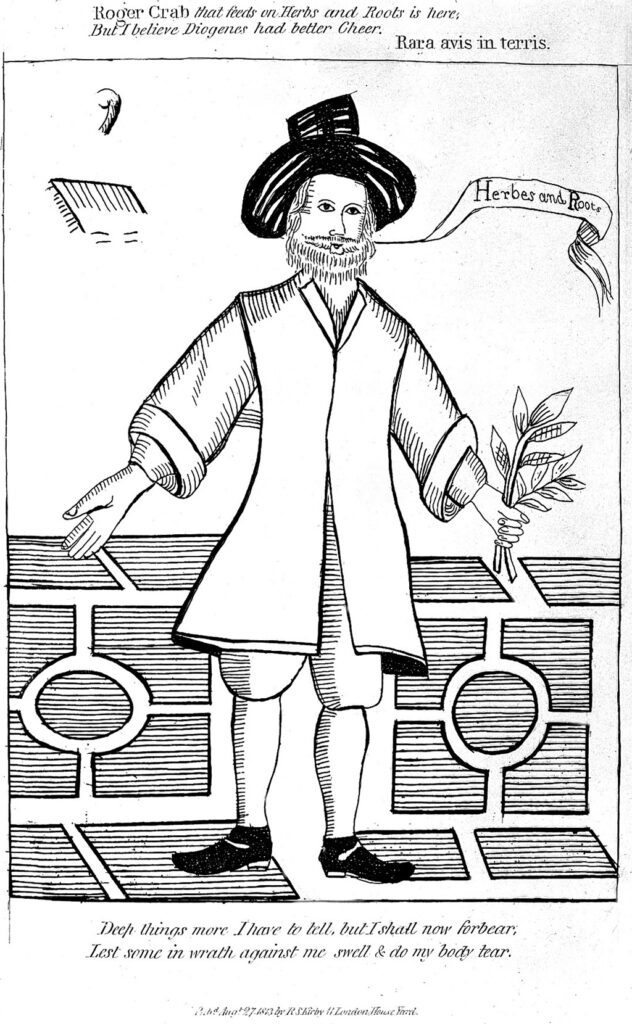
Crab is not entirely forgotten to history even though his tombstone is lost. The person I spoke to in the church says they do get people coming to enquire about him.
Like virtually all his radical plebeian contemporaries, Crab used the Bible and a homespun radical theology to make his political arguments. With the defeat of the radical plebeians, he moved from the militant radical left of the revolutionary movement to a pacifist, quiescent, hermitic Christianity
Crab was known to his contemporaries as The Mad Hatter. It is true that he is recorded as having been a “haberdasher of hats” and Hill speculates that he got the mad sobriquet because of extreme ideas on the redistribution of wealth and his refusal to eat meat. It is just as likely that a combination of natural eccentricity, a battle injury which left him “cloven through the skull to the brain” and the mercury used in hat making all played a part as well.
To be fair to Crab’s contemporaries, in a society where meat was a luxury and soldiers were marching twenty miles a day with full kit, his diet of potatoes, carrots, bran broth and turnip leaves must have seemed even more eccentric than it does today. He argued that “eating of flesh is an absolute enemy to pure nature” and causes aggression and moral corruption.
It seems that he eventually decided carrots and potatoes were luxuries and ended up eating dock leaves and grass. In his later years Hill says, “he allowed himself the delicacy of parsnips”. Crab reckoned he spent about three farthings a week on food, which was not very much even in the 1650s. He was celibate for his entire life and claimed it was his own choice. If you say so, Roger.
When the revolutionary war between the Monarchists and Parliamentarians started, Crab signed up and served in the revolutionary army for seven years.
We do not have the details, but Cromwell sentenced Crab to death, a sentence which was commuted to two years in prison. The assumption must be that he was involved in the anti-Cromwell Leveller agitation and had a role in mutinies by troops who refused to fight in an exceptionally vicious colonial war in Ireland.
He moved to Bethnal Green in 1657 where he lived as a hermit and practised as a herbal doctor. At least he wasn’t a homeopath. His advice, like that of modern doctors was to cut down on the drinking and eat less meat: “I sayd, eating flesh, or drinking strong beere would inflame their blood, venom their wounds, and encrease their disease.”
Anti-capitalist clothing

He was an early forerunner of some of the area’s trendier current residents, opting to make his own clothes out of sackcloth. He presented it as way of rejecting the ensnarement of the market and you could argue it was a form of proto anti-capitalism, albeit a deeply uncomfortable one.
Bethnal Green at the time was home to the Philadelphians, a radical religious sect with revolutionary tendencies and that is what attracted Crab to the area. They seemed to have been in favour of seizing the property of the rich, an idea they expressed as the Saints taking over the estates of the wicked, a conclusion they reached less by an analysis of property relations and political power than by commands from angels.
The radical section of the English revolutionary movement was defeated, and Crab’s later ideas expressed this defeat. The Fifth Monarchists concluded that since every other social group which had tried to exercise power had failed, this could only mean that the return of Jesus Christ was the sole way to effect social change in the interests of the poor. Crab’s equally unrealistic proposal was for God to enter the hearts of the rich so that they would share their wealth.
Crab would probably be pleased to know that his republican ideals and versions of his radical democratic politics still flourish, and his Leveller comrades would be astonished to learn that his notions on veganism, while not universally shared, are now uncontroversial.





Leave a comment