
“Master Sun said: “fighting with many is the same as fighting with few; it is a matter of marshalling men with Lambeg drums and hideous sounding flute bands, identifying them with flags and tacky nylon uniforms”. Sun Tzu, The Art of War (my loose translation.)
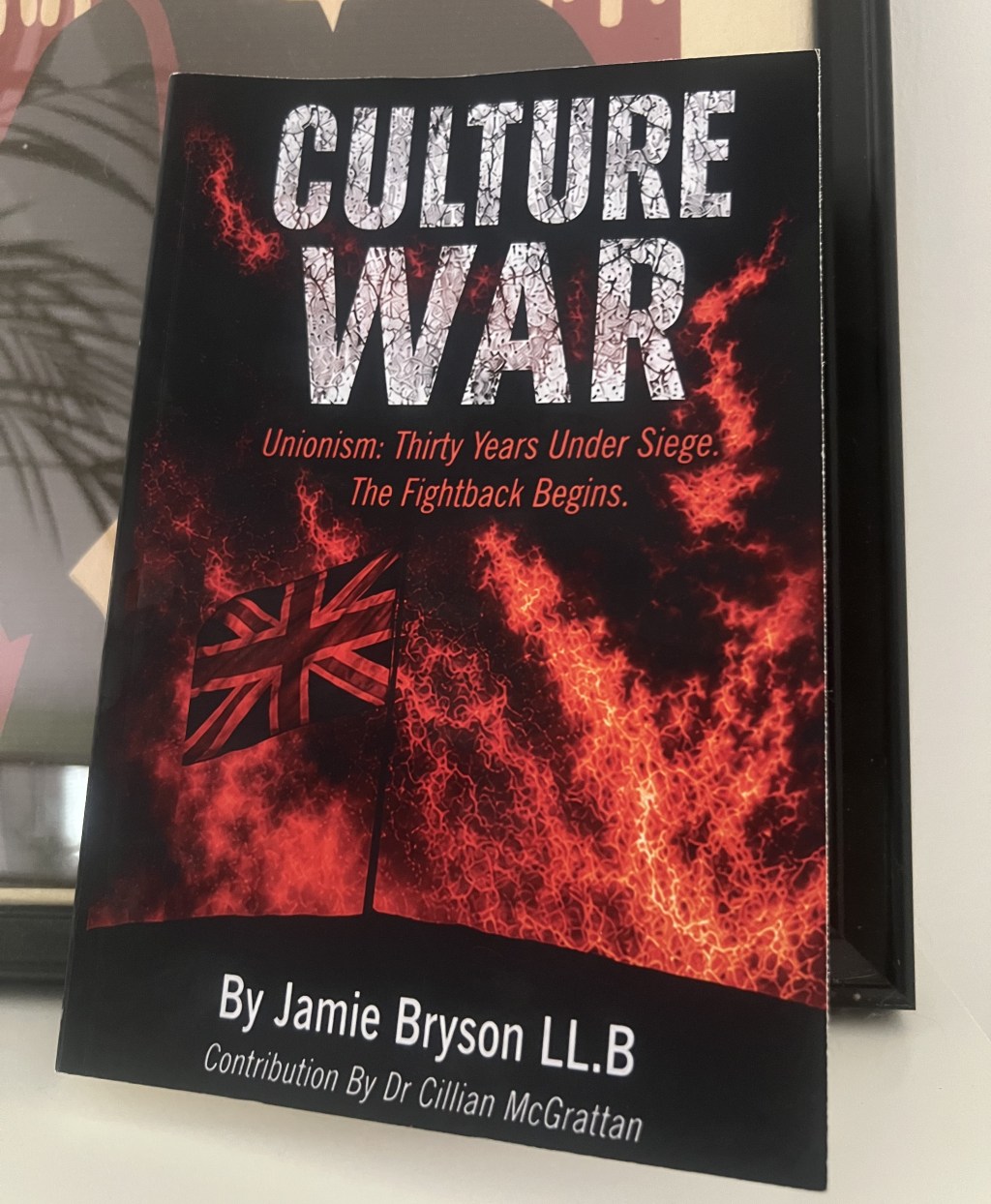
One of the advantages of not following politics in the north of Ireland is that you are unlikely to have heard of Jamie Bryson, author of a new book called Culture War (Unionism: Thirty Years Under Siege. The Fightback Begins). His oeuvre also includes Northern Ireland Constitutional Law: The Acts of Union and NI Protocol which has a forward by Jeffrey Donaldson who is currently in prison for child rape and other sexual offences against young girls. This latter work has a health warning on Amazon advising potential buyers “**Please Note: This book is the subject of a targeted campaign of negative and false reviews**.It is true that much of the commentary around Bryson’s books and politics is unserious and ad hominen, however he does little to lower the temperature of debate and owes much of his prominence to that personal characteristic.
Jamie Bryson is a “loyalist representative” who has never been elected to anything, a political propagandist and a far-right activist who says he is familiar with the thinking of the drug and extortion gangs which are a cancer in working class loyalist areas while at the same time denying their controlling influence. He described the burning of a mosque effigy on a bonfire as “an act of artistic political protest”. Referring to the loyalist campaign of indiscriminate sectarian murder in the 1970s and 80s he said “I understand why some people in the loyalist community felt as if they had to defend themselves against what was being done on them by the IRA”, though qualifies it with a platitude about killing civilians. This was the principal activity of those groups.
I began reading its 384 pages of large font, widely spaced text in expectation of a programmatic statement for his version of a loyalism for a statelet which is now more than a century old and yet commands absolutely no affection from at least half of the people who live in it. He does not waste any time disabusing the reader of that idea. He revels in the fact that it can only ever be a place of permanent sectarian conflict and, since his career depends on that fact, he is determined to keep it going.
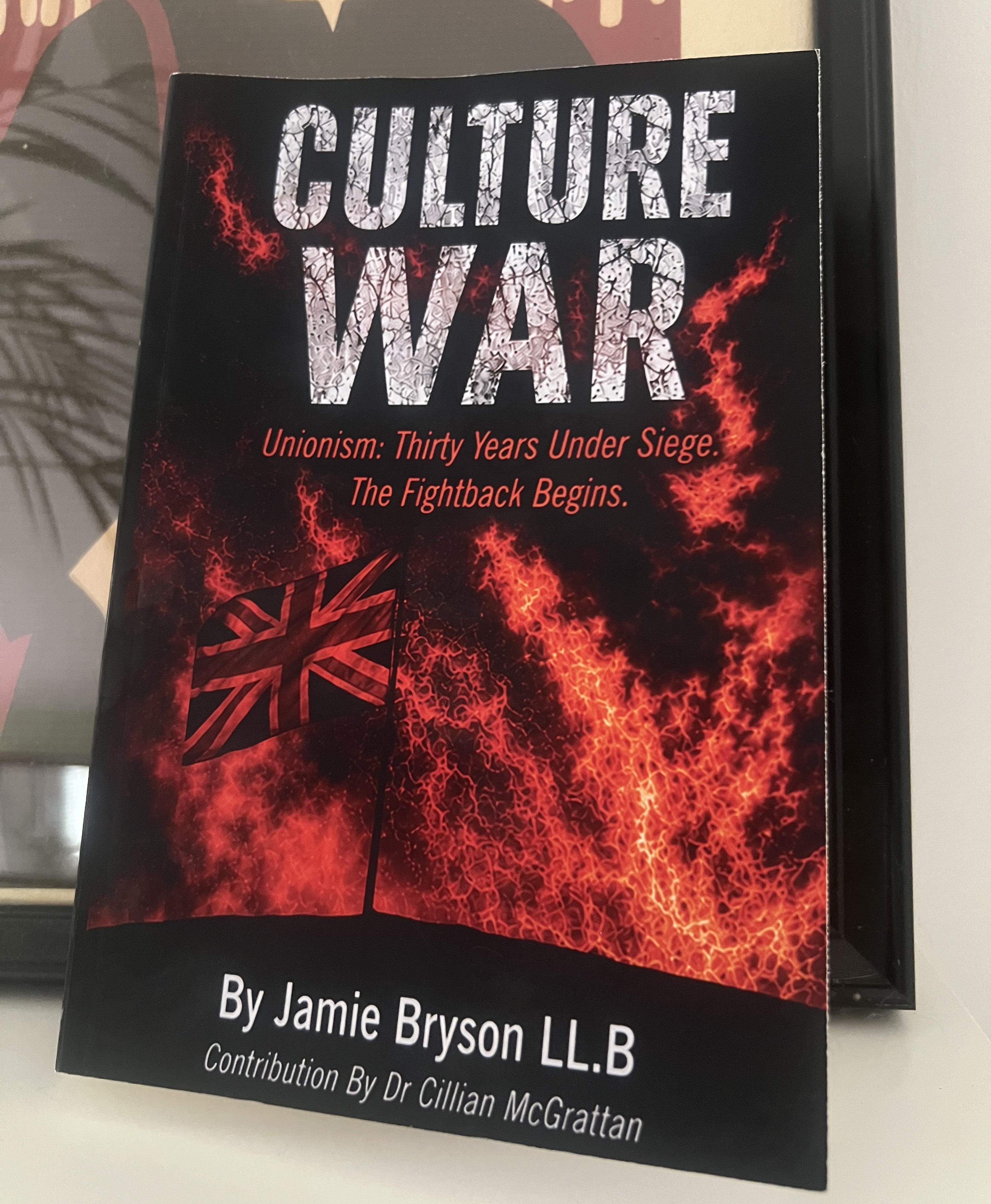
Number one best seller, sort of
To show his intellectual heft he is named on the cover as Jamie Bryson LL.B. Its Amazon listing describes it as “the number one best seller”. Then you look a bit more closely and see it’s in the category Law for the Layperson, a status roughly equivalent to being number one in the Belgian contemporary Christian rock chart. His writing style tends towards the declamatory and whiny with large chunks of legislation and court rulings cut and pasted to bulk it out. He is less adept at using spelling and grammar checks.
Bryson is a very frequent guest on the statelet’s most popular BBC radio programme, one that is considered so flagrantly biased that the two largest nationalist parties boycott it. This does not stop him complaining at some length about a perceived nationalist bias in the local media. He makes a valid point about how much of the local media traffic is driven by clickbait stories which make people cross and immediately undermines it by asserting the loyalist gangs like the UDA are not involved in sponsoring bonfires, organising pogroms against migrants and singing about being up to their necks in Fenian blood.
His fixation on law does create some unusual analytical and historical blind spots. He devotes a chapter to a place called Drumcree where the Orange Order used to march to demonstrate to local Catholics who controlled the streets. He copies and pastes all sorts of legal texts involving China, Serbia and Macedonia. The one thing he leaves out of his assertion of the right of loyalists to walk where they are not wanted is that some members of his target audience burned three children to death to show how upset they were. It is a surprising oversight to anyone familiar with the issue, though in keeping with his selective blindness.
Deranged and pathetic women
The book is not without humour, albeit unintentional. In a welcome break from the legalese, he pauses to comment on “a remarkably dedicated group of republican women, who appear to have nothing else to do in middle age but tweet or sub-tweet abuse about me”. Showing the grace which has made him such a well-loved local figure he describes them as utterly deranged and pathetic but concludes “I truly hope they get the help they need”.
His analysis of what is usually referred to as the “peace process” recycles an ancient argument that loyal Ulster is always being sold out and betrayed but doesn’t stand up to scrutiny. The IRA was militarily defeated by the British and had been heavily infiltrated by informers at every level. Republicans and their supporters belatedly and correctly saw the armed struggle as a futile waste of life and accepted a settlement that stopped the killing before entering government in the statelet they had spent decades trying to destroy. Despite all their bluster about it facilitating a united Ireland, this is not a foreseeable prospect in the next twenty or thirty years. No section of the Irish ruling class is interested in it and the polling evidence is against it. The result is a local administration which mainly exists to dole out jobs, cash and patronage on a sectarian basis while presiding over ecological collapse and the worst health service in Europe.
He complains a lot, mostly about Fenians. His preface has a moan about Fenians developing a “counter state”. These are not areas of dual power operating outside the authority of the British government. He is cross because they are getting jobs as solicitors, journalists, academics and in the judiciary and concludes that they are up to no good. Quite why more than half the statelet’s population should be excluded from these professions is not explained, though we can make a guess.
It is not a new complaint. In 1968 Ian Paisley’s Protestant Telegraph was saying “Nearly all the methods of propaganda are now firmly controlled by the Roman Catholic Church…Their representatives were carefully selected while posts were being prepared in political parties, trade unions, universities… Northern Ireland, being the last bastion of Protestantism in Europe, if not the world, was singled out for special attention.”
The Séimhiú and Urú are weapons too, apparently
Plus ça change, plus c’est la même chose. (I got an A in my French O-level as part of the Vatican / Communist conspiracy to undo Ulster.)
Bryson doesn’t offer his views on French, and we can probably guess what he thinks about Latin. The language that really exercises him is Irish. Cornish, Welsh and Scots Gaelic signage is uncontentious and most non speakers of the languages are interested to see placenames and public buildings using them. Bryson devotes an entire chapter to how the public display of Irish in the north of Ireland is an existential threat to his unionist identity. In fact, it’s not just a threat, it is “a weapon in the culture war and one being used against unionism”. Not only middle-aged republican women are deranged. Some thirty seven year old law graduates are too. Believe me as someone who is trying, there are many quicker and less intellectually challenging ways of threatening unionism than trying to master the Séimhiú and Urú.
Not the least of the book’s problems is that it really isn’t clear who it is written for. Bryson says he wants “this book to become viewed as unionist (sic – see what I mean about checking the text?) manual for waging culture war and fighting back”. Given the famously unscholarly milieu of the loyalist gangs he is associated with, it is hard to imagine too many of them organising study circles to pore over the incredibly prolix stetches of text about the impact of EU customs regulations on the six-county economy and the statelet’s relationship with to Britain. It is more likely to send most readers into a gentle snooze than to the barricades.
Fewer still will make it to the final chapter “Human Rights Law – Unionists Have Rights as Well”. To my knowledge, no credible person has said they don’t, but it fits in with the ambient whining tone. This is not a punchy closing case for what his unionist vision of a six-county state should look like in a future when it is going to be more racially mixed, and loyalists will be in a minority. That book has still to be written. It reads more like a random collection of yet more legal documents with an enervating commentary. It is a fitting end to a work which covers up its lack of innovative thinking with a blustering display of quasi-erudition to mask the fact that it is an overlong variation of the story that loyal Ulster is being betrayed by everyone and the Taigs are up to no good. Paisley was doing the same thing sixty years ago with better prose and it says something about Bryson’s version of loyalism that his ideas have not shifted an inch.


Leave a comment