
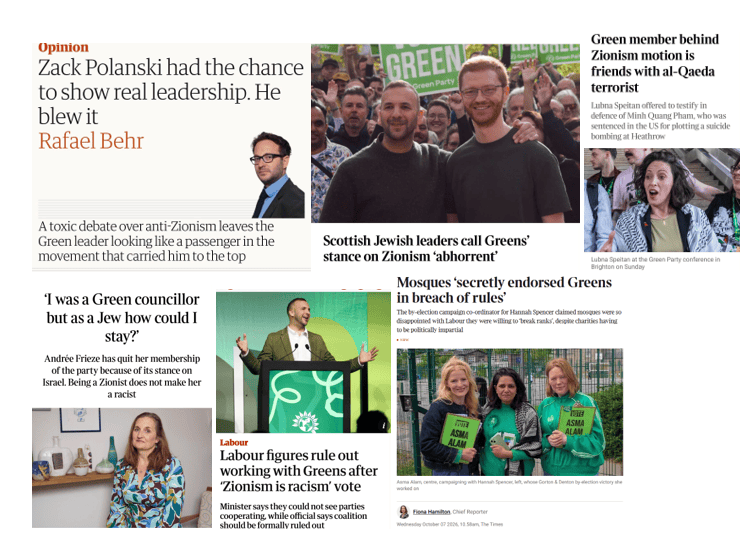
Green Party members are now learning the truth of the Piranhas’ observation in their 1980 track that getting beaten up is part of growing up. The party is currently on the receiving end of an ideological kicking as you can see from a selection of one day’s stories from two newspapers. Labour’s genocide agnostic right wing is also joining the fight by refusing to collaborate with Greens and are flinging round accusations of racism.
On Monday morning Zack Polanski woke up to learn that he is one of the few Jews in the world who is not automatically entitled to move to Israel, force a Palestinian family from its home and live on a settlement in the West Bank. Netanyahu’s genocidal, far-right government has banned him from entering the country because Green Party conference voted by a narrow majority to pass a motion asserting that Zionism is a form of racism. This is not a new idea, and it certainly was not invented by the Green Party.
Here is part of an AI summary of the position of the Israeli revolutionary socialist organisation Matzpen which was active from the 1960s to the 1980s:
“Zionism was seen not as a progressive national-liberation movement or socialist experiment, but as a bourgeois-nationalist, colonizing ideology that displaced the indigenous Palestinian population to create and expand a Jewish-majority state. The State of Israel in its Zionist form was both the outcome of this project and an instrument for its continuation and expansion. Matzpen called for the “de-Zionization” of Israel—abolishing institutions, laws (such as the Law of Return), regulations, and practices that conferred special privileges on Jews at the expense of Palestinians and Arabs—and for the overthrow of the Zionist regime as part of a broader socialist revolution.”
Molly Crabapple in the closing chapter of her recent book Here Where We Live Is Our Country on the Bund writes, in a distillation of the views of that Jewish socialist tradition:
“Zionism is ethnonationalism. Like all ethnonationalisms, it required mass murder to clear the land to build its dream…the inheritors of Zion would liquidate their very own ghetto in Gaza beside the sea”.
Growing pains
Much of the criticism of the party and the thrust of this motion is not being made in good faith. It is coming from journalists and politicians who barely offered more than mild perturbation at mass slaughter, but that is only part of the story. It is beyond doubt that many Green Party members have been upset by the Zionism is racism motion and the fact that an amendment adding protections for Jewish members was defeated. Some longstanding and very principled members are actively considering resigning and a few already have. This is hugely regrettable and anyone thinking of quitting should be dissuaded from doing so by other members.
It is a paradox that a party that can trace its origins to 1972 is only now experiencing growing pains. It has a membership of an estimated 216 000, up from 50 000 in 2019. However, in many ways it is a completely different party. Until about eighteen months ago its local structures hovered between being very loose and non-existent in a meaningful sense. Now it has local meetings, locally functioning leaderships and five MPs and over 1300 councillors. At the same time, it is not uncommon for around 40-50% of people at a meeting to say it is their first one. Reflecting the new young working class, only small numbers of them work in unionised or larger workplaces, and for the big majority the party is their first experience of political organisation. If there are elite teams of hard left infiltrators corrupting the innocent, I have yet to see them.
This is the most significant crisis the Green Party has ever faced, and it is dealing both with some of the most unpleasant and reactionary people in British and international politics as well as members and supporters who are genuinely angry and upset.
I would offer some preliminary conclusions.
The first is that Jewish members of the party, including those who have some affinity with aspects of Zionism, are given space to say what they think. The overlap between a sense of identity, family history, community and politics can be hard to navigate. Anyone expressing antisemitic ideas should be shown the door without delay.
The second is that a move to a delegate conference structure needs to happen quickly. Potentially contentious resolutions can be discussed beforehand, and delegates have a sense of the party’s mood in addition to their own ideas.
The third is that, irrespective of the phrasing of one motion or the tactics at conference, the things that prompted tens of thousands of, mostly young people new to politics, to get involved haven’t changed despite Labour’s tactical return to something that appeals to left voters. It is inevitable that any major party willing to take a clear stand on Palestine would be in the crosshairs. This is a crisis and an educative experience.




Leave a comment