
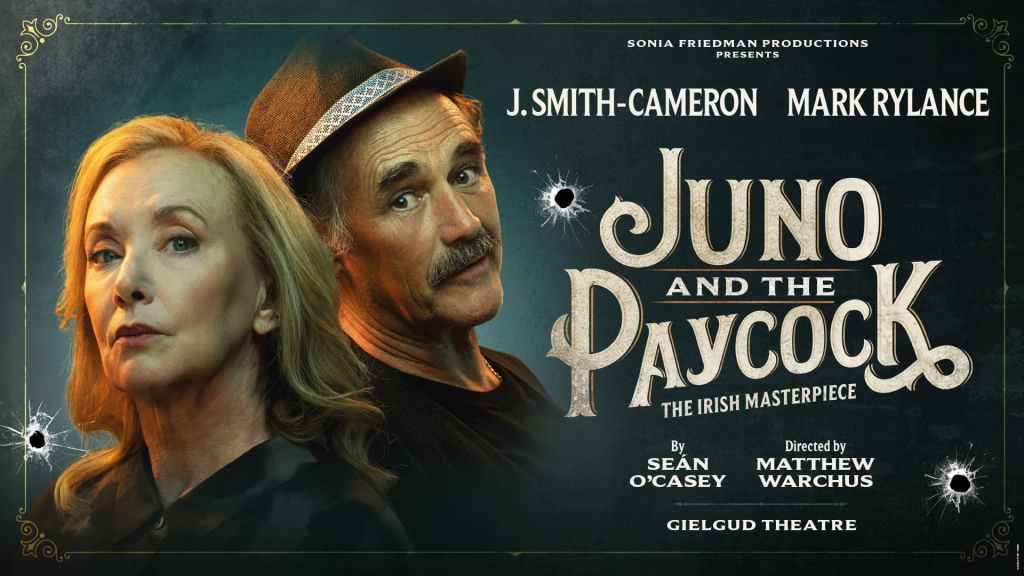
Top of the mornin’ to you, Séamus. It’s a grand soft day. May you be in heaven before the Devil knows you’re dead
Ah, begorrah it this that to be sure, Ciarán. And may the road rise to meet you yourself.
Oi went to see that feckin’ play by your man O’Casey last night.
Would that be Seán O’Casey, the Connolly man?
It would so. Juno and the feckin’ Paycock.
At this point my grasp of the Dublin dialect fizzles out on account of me being a native speaker of Ulster Scots, so let’s continue in an approximation of standard English. Still, you now have some idea of the accents.
Mark Rylance is probably the finest living male British actor, as anyone who saw him in Jerusalem can confirm. That play foregrounded the lives of people beyond the margins of English society. He gives a technically superb performance in this as the “paycock” (Dublin pronunciation of “peacock”; also “tay” for “tea”) of the title, Jack Boyle a drunken blowhard and looks exactly like Charlie Chaplin in The Great Dictator, but at times the clownishness and bravura overwhelmed the story and made it a bit too much of a star vehicle.
Juno and the Paycock which was first performed in 1924 is the story of a dirt poor Dublin slum family during the Irish Civil War, a conflict that consolidated the reactionary clerical character of the southern Irish state for the rest of the century. The defeat and demoralisation of the working class movement and the anti-Treaty forces, referred to as “the die hards” in the play is the bedrock of the plot. There is a lot of fuss about an inheritance that will lift the family out of poverty but all that does is emphasise that there was no way out for families in a state that would mainly export cattle and people for decades.
It was an ideologically brave work for the time. The Free State was established with British weapons, executions and the murder of Republican prisoners and within a year or so of its birth O’Casey was questioning its political and moral basis.
The two worst shames
He had been briefly under the influence of the revolutionary syndicalist Jim Larkin and joined the Irish Citizen army, an armed workers’ militia which took part in the Easter Rising under the leadership of James Connolly. O’Casey didn’t take part in the rebellion for reasons of which Lenin, who saw it as “a blow against the power of English imperialism”, would have disapproved.
Aisling Kearns and Eimhin Fitzgerald Doherty who play the adult children Mary and Johnny mirror the tensions in O’Casey’s politics. They inflict the two worst shames that an Irish family could endure. Johnny is an IRA volunteer with PTSD who was wounded fighting the British and lost an arm fighting the Free Staters. So far, so honourable but it turns out he was an informer and meets an informer’s fate. We are told that Mary is on strike but that is of no great relevance to the plot. Knowing what we now know about what happened to unmarried women and their babies in 20th century Ireland, anxiety about what she and the child might suffer create a real foreboding.
Juno, played by J Cameron-Smith, has spent decades fighting a losing battle to get her husband Jack to live up to his responsibilities. This was at a time when it was virtually inconceivable for a woman to walk away from an abusive or useless man. It is something of a tribute to O’Casey that he has Juno present this option to the pregnant Mary with the comment “the child will have something better than a father, it will have two mothers.” He offended the sensibilities of the Catholic Church so much that even thirty years later Archbishop McQuaid of Dublin (no relation) objected to his plays being performed.
Given English liberalism’s traditional trepidation and lack of knowledge about Irish radicalism it is a slightly disconcerting experience to be watching a radical socialist’s prescient critique of what the Free State was becoming in a London theatre. That is probably a reason to go along to see a play which shows its age in parts but broke new ground in its presentation of working class women characters and its defiance of Catholic morality.
A footnote about Rylance is that he was one of the few high profile public figures to defend Corbyn when the smear campaign was at its most mendacious and vociferous.

 Liam redux
Leave a comment