

It is probably a bit unfair to compare Robert Jenrick to Benito Mussolini. After all, Mussolini demonstrated some personal courage by leaving a cushy job editing a newspaper to serve in the Italian army in World War One. He fought on some of the quieter sections of the front but was severely wounded after a year and a half. Robert Jenrick’s only recorded display of personal valour was asking stupid questions to fare dodgers at a tube station. The closest he has come to the horror of spending the winter in a trench up a mountain was probably visiting the Wetherspoons in Clacton to meet Reform members.
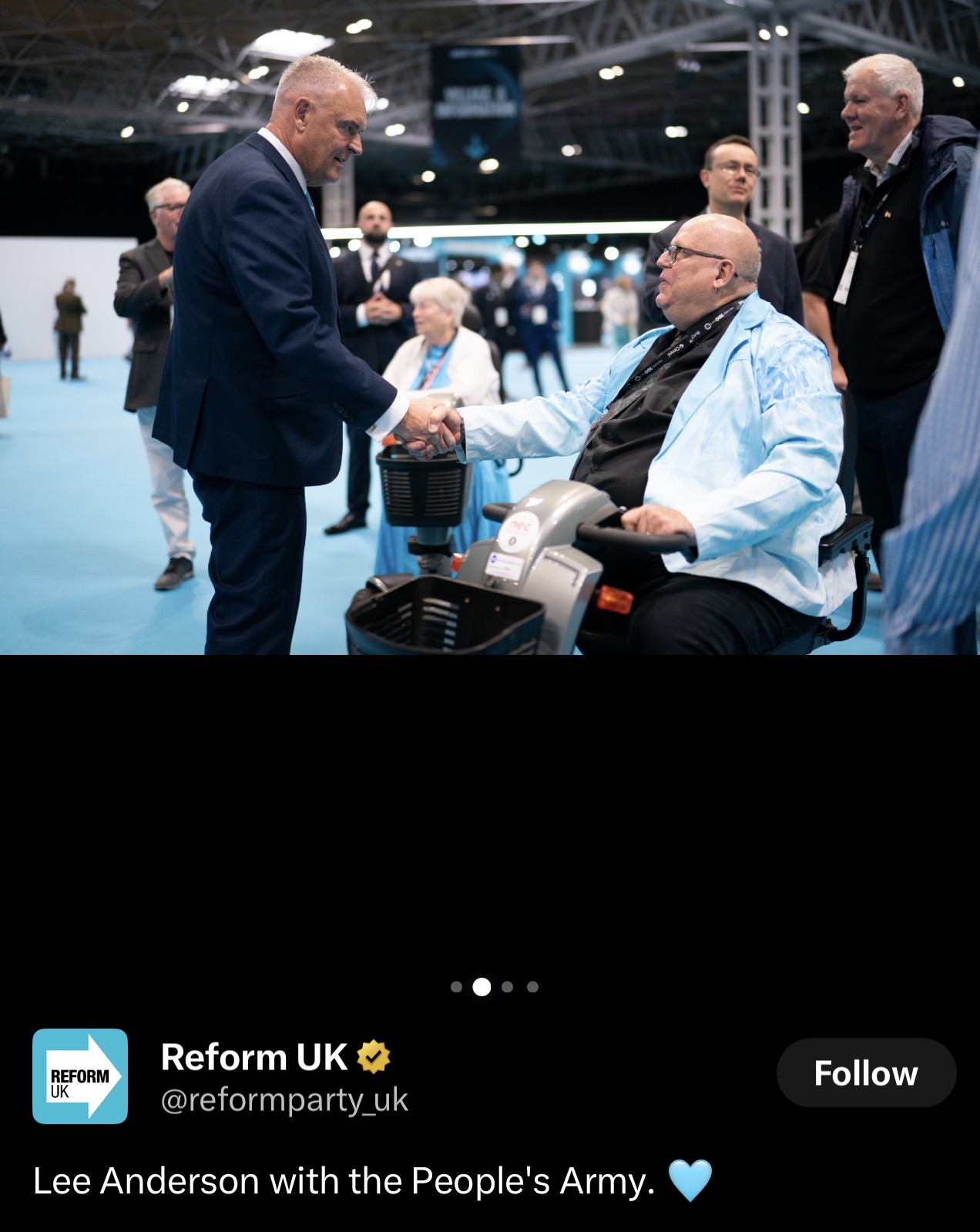
What they have in common is an enthusiasm for physical violence against their left-wing opponents. A minor difference is that Mussolini’s thugs were battled hardened ex-soldiers who were willing to beat up and murder the opposition while Reform is relying on a cadre of pensioners hitting people with walking sticks and potentially deploying panzer battalions of mobility scooters. Nevertheless, the impulse and the politics are identical.
Reform Gauleiter Lee Anderson and Jenrick explicitly supported political violence against a woman who heckled Nigel Farage at the party’s conference. An elderly thug swung at her with what seems to be a metal crutch. Anderson joked from the platform that they would take up a collection to buy him a new one. That was clearly telling the party membership that assaulting opponents is now permissible. The fact that serious physical exertion would probably be fatal to many of them is irrelevant. He was reminding them what sort of party they had joined and hinting at how they would behave in power.
Jenrick was offered several chances in the media to disassociate himself and the party from the violence. He chose not to, telling LBC:
“Let me think how sympathetic I am towards that person. Not at all.
“[This individual] infiltrates a party conference, stands on a chair, screams abuse at the leader of a party, tries to disrupt a party conference – and then she’s moaning that a pensioner knocked her on the head with a crutch.
“I mean, come on, get a life. Like, you take your chances, don’t you?
“I have zero sympathy.”
He said similar things to other broadcasters. “Oh boohoo” was his comment to Sky News. To my knowledge, setting aside the Irish unionists who sit in Westminster, this is the first time a member of the British parliament has repeatedly endorsed physical attacks against non-violent opponents. If Zarah Sultana or Jeremy Corbyn said something similar about an assault on a peacefully disruptive Reform member it would be a major scandal.
In fact, Jenrick and Anderson were taking a more aggressive line than the fascist militias which have been on the streets in Dover and Portsmouth. Their leader Daniel Thomas told them to avoid violence, though it is hard to believe the racists he has mobilised so effectively will stick to this policy for long.
Jenrick and Anderson have signalled a development in the thinking of the parliamentary British far right. Farage has always emphasised that while he might share most of the ideas of the fascist street fighters, he understands that their tactics mean electoral oblivion. His lieutenants are calculating that it is now time to start emulating them, if not with the elderly and chronically ill who seem to make up most of Reform’s membership, then with thugs who are up for street battles.
The recent, and very good, drama series on Mussolini depicted him as priapic, swashbuckling, Trumpian grotesque. Jenrick by contrast is the archetypal private school, Cambridge, corporate lawyer who, while not wanting to get his own hands dirty, is willing to encourage others to do the dirty work. The black clad militias now have their man in parliament.






Leave a Reply