
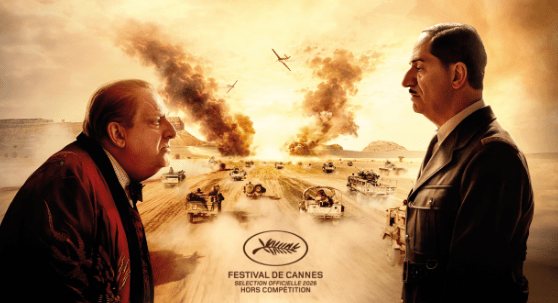
De Gaulle: Résistance is in cinemas at the moment, and a second part De Gaulle: Liberté will be screened in a few weeks. This is a fascinating film mainly because it is so unintentionally honest about what a reactionary imperialist Charles de Gaulle was. Its director Antonin Baudry is a former French diplomat and ministerial advisor, so this is very much the approved ruling class version of the story
As Ernest Mandel observed “there was an inter-imperialist war, a war between the Nazi, Italian, and Japanese imperialists on the one hand, and the Anglo-American-French imperialists on the other hand.” That was De Gaulle’s main focus. He was obsessed with the idea of France as a major imperialist power with extensive colonies, particularly in Africa, which he used as a springboard for rebuilding French military power. For him Chad, Cameroon and Algeria were France. At one point Anthony Eden also opines “Algeria is France”.
Simon Abkarian plays the general in the period after France’s surrender to the Nazis when he is in exile in London and declares himself, with no discernible mandate other than his own ego and a successful tank battle against the Germans, as the leader of the Free French. He believes himself to be France in some mystical way. It is a good performance as he bounces off Simon Russell Beale’s Churchill, the clash between England and France being reduced to fraught, shouty meetings between the two imperialist leaders.
At no point do we get an explanation from De Gaulle about why he hates fascism. His sole motivation was an idea of French national greatness, so when it is pointed out that the Vichy regime is moving against French Jews at the instruction of the Nazis, a path that will lead to French collaboration with the Holocaust, De Gaulle has nothing to say. His mind is on the imperial chess game and France’s place in the world after the war.
A sub-plot of the film is the domestic resistance to the Nazi occupation. This story is superbly told in The Resistance: The French Fight Against the Nazis by Matthew Cobb. Groups of mostly young activists organised impromptu demonstrations and protests. The film does not point out that the Communist Party had a leading role in this and presents them all as hero worshippers of the great man, though it is beyond doubt that for some people De Gaullism was a stepping stone to activity against the occupation. They, along with groups of workers who went on strike against the Nazi occupation were fighting a very different war from De Gaulle and that section of the French ruling class which opted to oppose German imperialism.
This is undoubtedly a film made to make propaganda for a variety of reactionary French nationalism and at times it falls flat because of that if you are not a reactionary French nationalist. I suspect there were a couple behind me in the cinema. However, if you take that into account it works as a piece of entertainment and really elucidates what motivate much of the European and American ruling classes.
Of course, we know now that De Gaulle’s project would be humiliated and defeated in Algeria and Vietnam within a few years, though he was right in his prediction that Britain would become an American vassal state.





Leave a Reply