
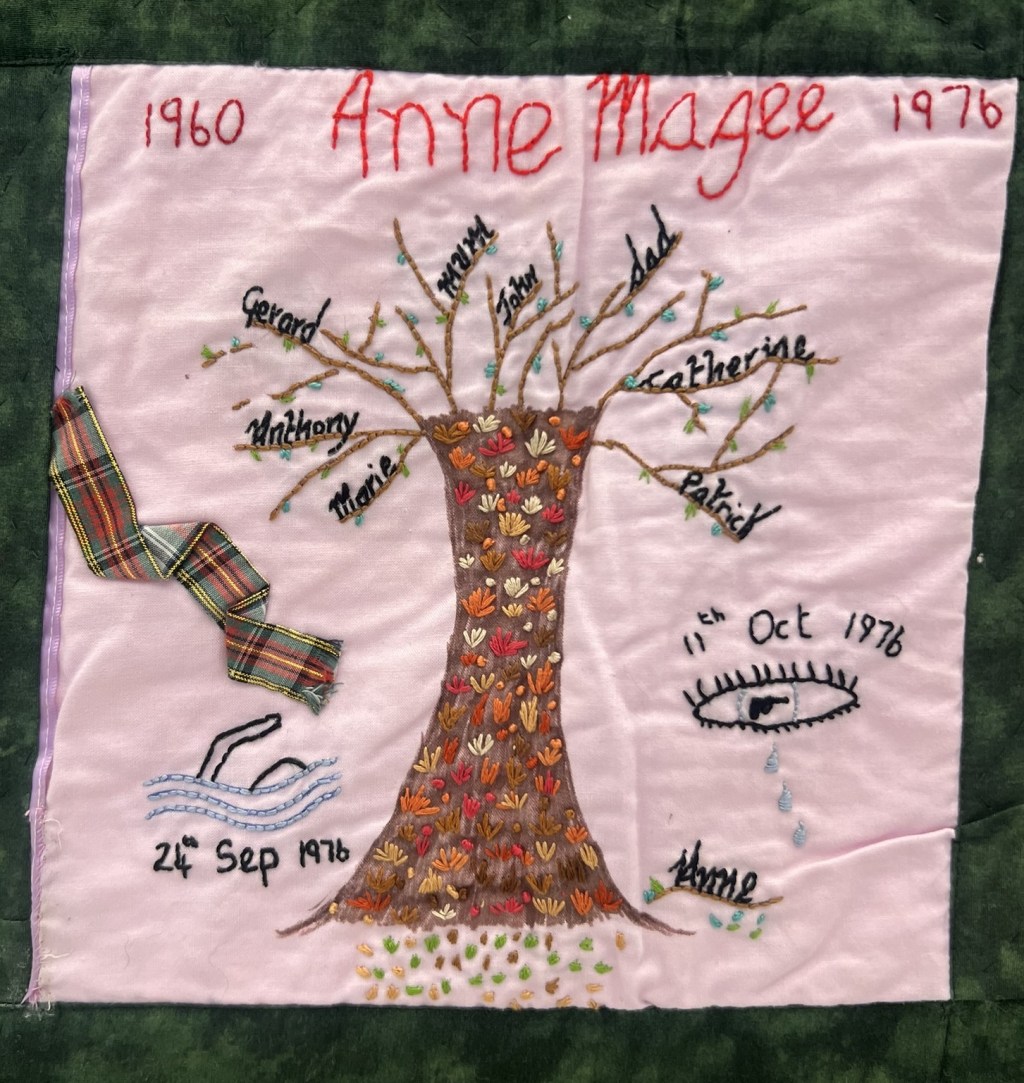
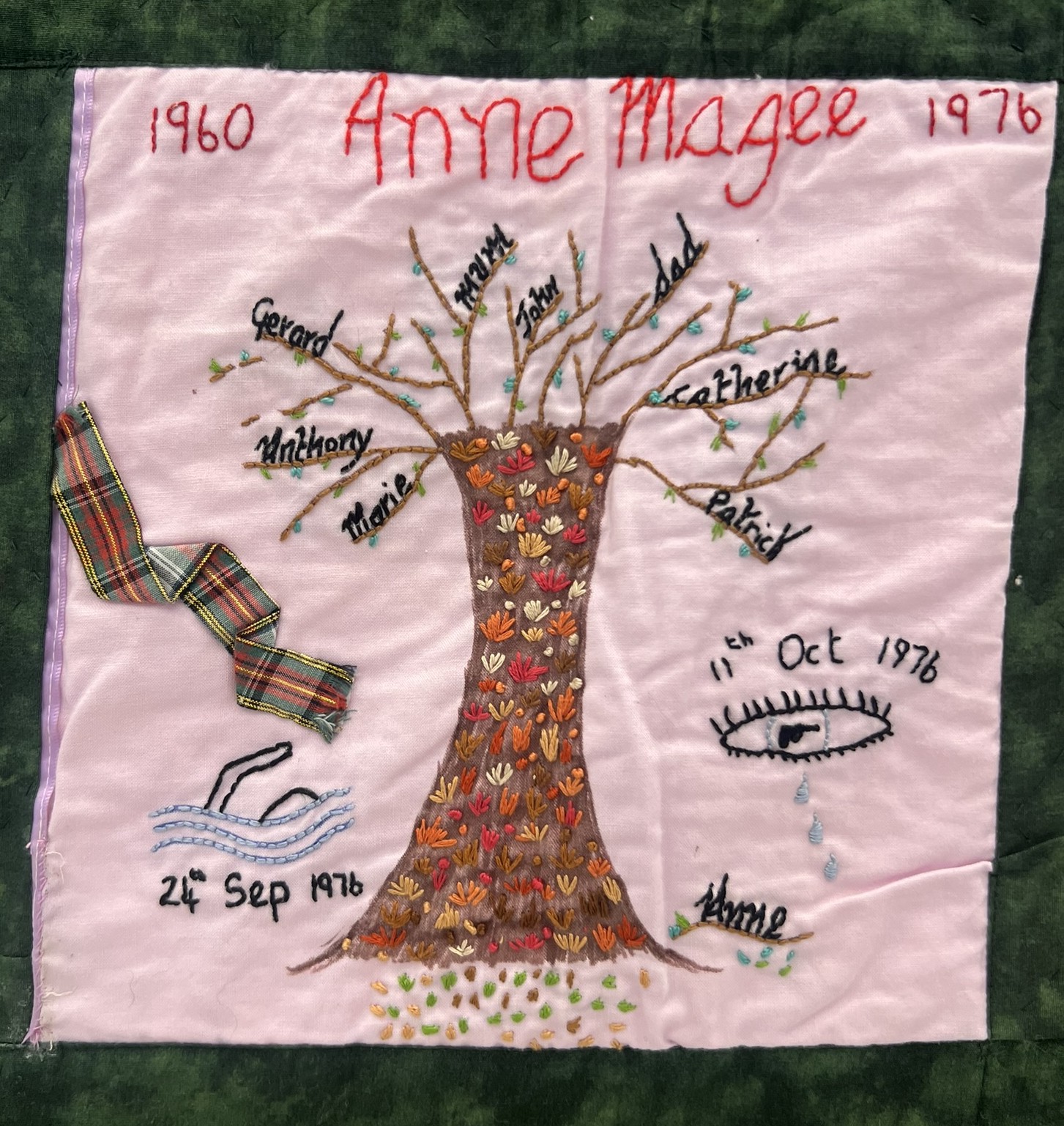
The embroidery is a memorial to Anne Magee, murdered in 1976 at the age of sixteen by loyalist gunmen who apparently were also teenagers and whose identities are not in the public domain. They also tried to kill my mother. I am not a fan of the Irish obsession with commemorations but the impending fiftieth anniversary of a formative event in my life has reminded me of how little I know about it, something I am relieved about.
From the point of view of the killers and the men who sent them, the job was only partially successful as there were three Catholic women in the shop and two of them survived. Anne was shot on September 24th and died on October 11th. Mrs McKenna, an activist in the Peace People, was shot in the head and lost an eye. My mother was there too. One version of the story is that she survived because the gun jammed, the other is that she hid behind the counter.
Hughes’ shop was directly across the street from us, and my mother would occasionally work behind the counter. On that night she had gone to chat to Mrs McKenna, and my sole memory of the evening is that it was dark and she ran into the house screaming.
After that there is an absolute gap in my memory of weeks or months. I remember nothing about the police response. I remember nothing about where we went afterwards. Apparently, my brothers and I were sent to stay with relatives in the comparative safety of Ballymurphy. This was a part of Belfast where, a few years previously the British army had murdered eleven civilians over two days as a warmup for Bloody Sunday. My sisters were sent to an aunt in the lower Falls Road. “Safe” was a flexible category in Belfast them.
I remember nothing about going to school and how or if St. Malachy’s reacted to me. The attitude then was that you picked yourself up and carried on. To be honest, it was not a bad technique. The next firm memory I have is moving into a newly built estate in west Belfast which had been built for displaced families. Everything else is blank for the intervening period even though I have the usual fragmentary childhood memories of earlier events.
Other than on a couple of fleeting occasions, I have had absolutely no desire to find out about the murderers. I do not care what their names are, whether they are dead or alive, whether they found Jesus, whether they are drug dealers or drug addicts. I do not wish to question them about their motives, whether they regret what they did and I have absolutely no desire to hear apologies from them or offer forgiveness.
People like them exist in every society. Ben Gvir is mobilising them in the West Bank, and the IDF gives them free rein to slaughter in Gaza. People like them bombed Black churches in the American South. The thugs outside Jewish shops in 1930s Germany would have recognised them as their own. They are simply the Belfast version of the reactionary, racist barbarism the world keeps producing. As individuals, they are irrelevant; the ideology that drove them endures. Their spiritual descendants set fire to migrants’ homes and take part in pogroms.
My story is nothing special in the context of the period. Tens of thousands of families had similar experiences to ours, and many will have known what Anne’s family went through. We dealt with it by not discussing it. To my knowledge, my mother never talked about it and only started reliving when she was in the traumatic stages of dementia. Clearly, that is not something I want to go through, but for me the essential point is that the huge gap in my memory has proven to be very helpful.



Leave a Reply