

Last night was my last time chairing a meeting of Tower Hamlets Green Party, having decided that it is best to pass the baton on to someone more indifferent to the risks of cycling home after a few beers.
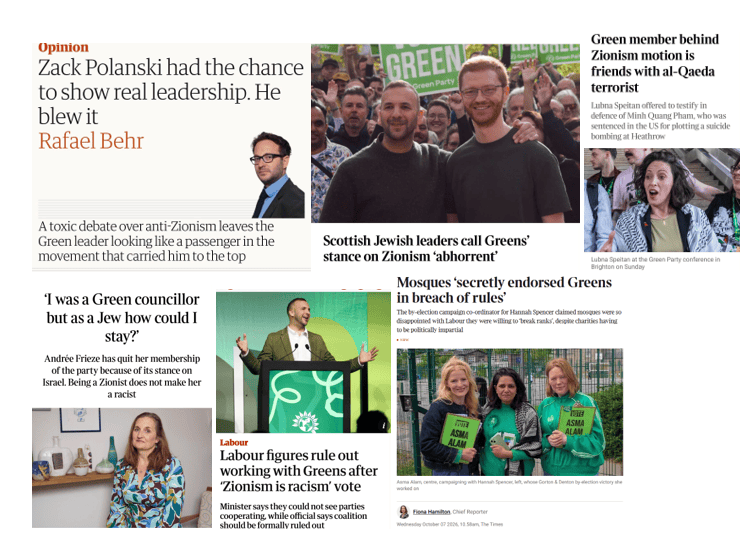
Inevitably the major discussion was on the Zionism is Racism motion. The preparation for the meeting had been dominated by plans for how to discuss a politically divisive topic in an organisation with no tradition of doing that, and a membership which largely has no experience of it.
Anyone who has been in a union, most political groups or even a tenants’ association will know that these things are inevitable. The important thing is how the disagreement is allowed to be expressed. Twenty years ago, I sat through the collapse of another promising local left party and still get flashbacks to it. I did not want the Green Party to repeat the Respect experience.
Two contrasting options were offered to the meeting on how to run the discussion. The first was a brief introduction followed by people breaking into small groups and writing their feelings on sticky notes. These would be collated and fed back at a future date. It is not an approach I have seen used in a political party, but it had its supporters.
The second was the traditional two minute contribution to allow as many people as possible to speak. The prospect of doing it this way had made some serious activists very nervous, presumably because they assumed the vileness which is often expressed on social media might spill over into real life.
Sticking to my mantra that the agenda is the property of the meeting, the vote went strongly in favour of the traditional method, and the meeting was all the better for it. I know for an absolute fact that several committed Green Party members with a record of supporting the Palestinian cause are upset by the passage of the Zionism is Racism motion. However, the entire history of the workers’ movement teaches us that political disagreements are only resolved, if at all, through open and comradely discussion.
That is what we did. The people present were able to hear the differences in the strategic approaches between supporters and critics of the motion. For a majority, this would have been the first time they would have heard the issue presented in terms of the distinction between a broad party and a more tightly ideological one. At the same time, members who expressed concerns about how the motion was perceived by some Jewish people were able to put them directly to the motion’s supporters.
A meeting and discussion that had generated quite a level of anxiety concluded with a round of applause. Every point of view was heard, all the participants were respectful to each other and around forty people had been able to engage in a political debate at quite a high level and many of them, irrespective of their position in the debate went to the pub together afterward. Far from shattering the local party, it was a major step forward in its development. It was a good night for the Mandelite method and the persuasive power of a stern Belfast accent when running a meeting.



Leave a Reply